misdirect - Master This Word
Master this word with our 5-step learning method – Learn English in English
Train English Through Brain Routes, Not Translation.
This page helps you stop memorizing isolated translations and start understanding a word through its shared mental image, native-style thinking, and practical training steps.
Master this word with our 5-step learning method – Learn English in English
Example sentences are the start of understanding. Don't rush to memorize. First feel how the word works in a sentence.
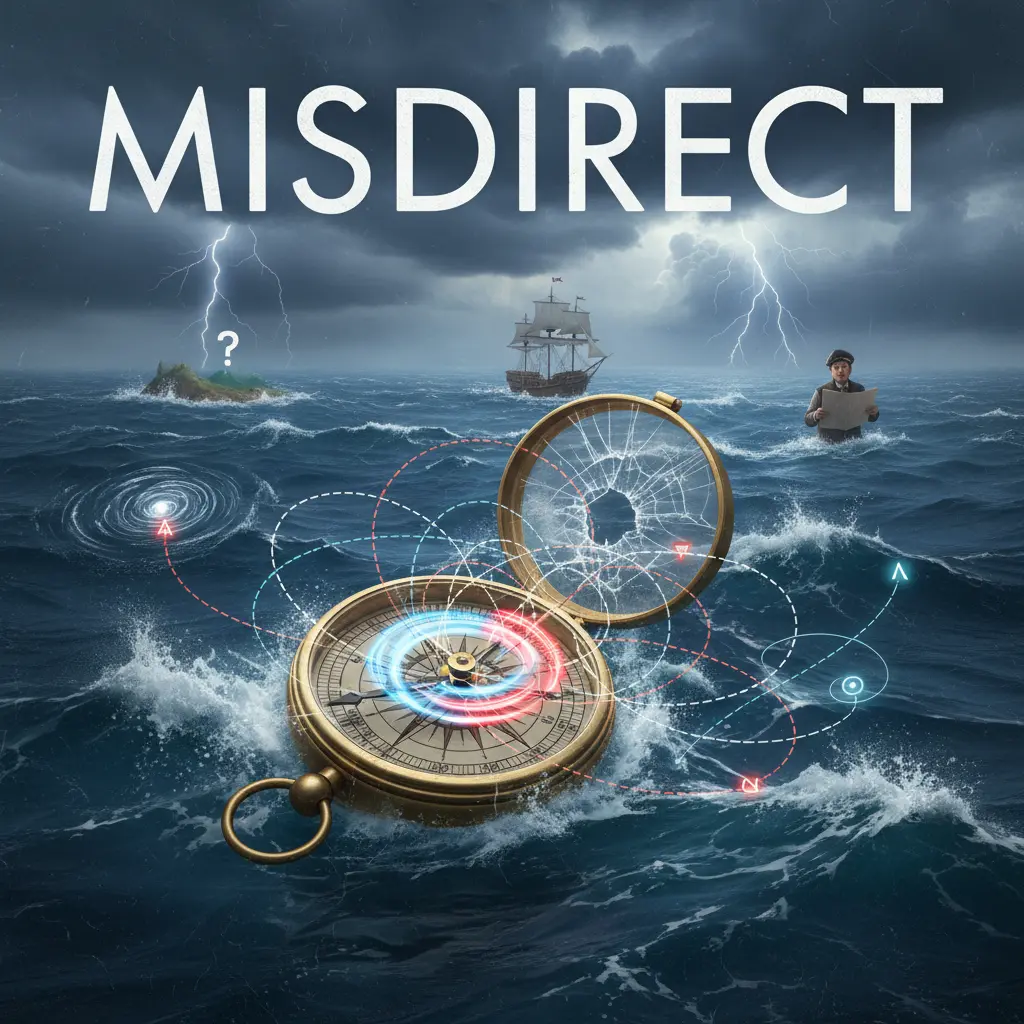
(a) mis- (wrongly) + direct (to guide); (b) Originated from Middle English, from Old French 'mesdirecter', from Latin 'mis-' + 'dirigere'; (c) Imagine trying to give someone directions but accidentally sending them to a completely wrong place, like a compass spinning wildly at sea.
Note 1: These definitions and etymologies are not standard dictionary definitions, but extended explanations provided to help with memorization and understanding of the actual application of words. Through this background information, we strive to make words more vivid and easier to understand, and help you remember their meanings in real life.
Note 2: LexiTalk designs the learning flow around the linguistics principle of “Comprehensible Input.” When learners encounter material that is slightly above their level but still understandable from context, the brain naturally absorbs the language. That’s why we keep every word inside authentic contexts, using examples and associations to help you understand it and use it flexibly.
Read the FAQ explanation of Comprehensible InputTo misdirect is to guide someone toward the wrong path or toward an incorrect goal, whether on purpose or by mistake. It can apply to giving wrong directions, pointing someone away from the right answer, or distracting attention with a misleading clue. The nuance often involves a lack of clarity or intention to confuse, rather than simply making a mistake. In everyday use you might misdirect a visitor by pointing to an empty doorway, or misdirect a search by focusing on a false lead. The word blends mis- (wrong) with direct (to guide) and traces back to Middle English via Old French mesdirecter and Latin roots. Learners should contrast misdirect with mislead, since mislead concerns belief, not direction.
Think of misdirect as a directional error: in English discussion, it often frames the act as leading someone somewhere incorrectly, whether physically or conceptually. Learners tend to default to mislead when they mean a wrong belief, so practice pairing misdirect with directions, maps, or clues.
What is the meaning of 'misdirect'?
Which sentence uses 'misdirect' correctly?
Which word is most similar to 'misdirect'?
What is the opposite of 'misdirect'?
Can you think of a real-life context where someone might misdirect efforts?
Download LexiTalk app for personalized learning experience
Download AppCookies
We use cookies for essential site functions, analytics, and ads. You can accept, reject, or manage preferences. Privacy Policy