modern - Master This Word
Master this word with our 5-step learning method – Learn English in English
Train English Through Brain Routes, Not Translation.
This page helps you stop memorizing isolated translations and start understanding a word through its shared mental image, native-style thinking, and practical training steps.
Master this word with our 5-step learning method – Learn English in English
Example sentences are the start of understanding. Don't rush to memorize. First feel how the word works in a sentence.
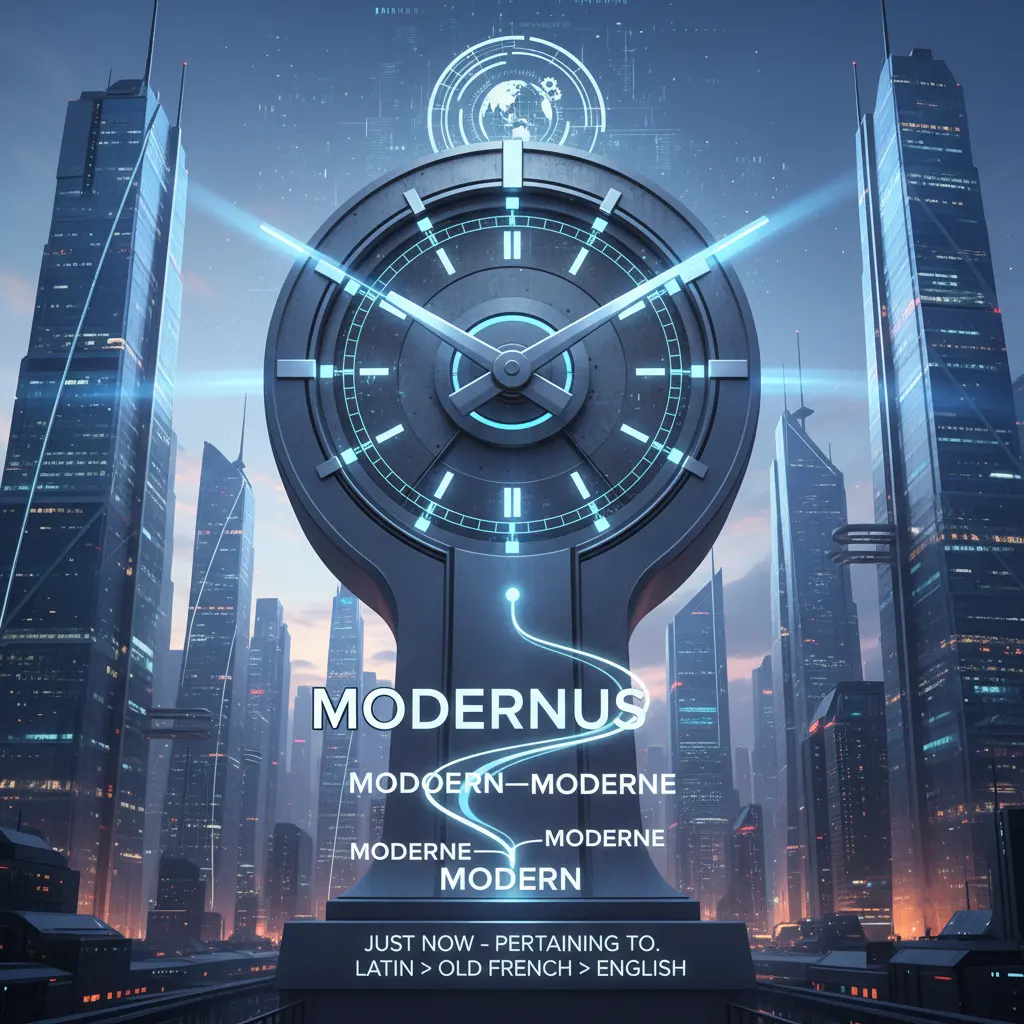
modernity comes from modernus, with "modo" meaning "just now" + "ern" denoting pertaining to. Originated from Latin (modernus) to Old French (moderne) and then to English. Imagine a big clock striking twelve, symbolizing the current moment as modernity.
Note 1: These definitions and etymologies are not standard dictionary definitions, but extended explanations provided to help with memorization and understanding of the actual application of words. Through this background information, we strive to make words more vivid and easier to understand, and help you remember their meanings in real life.
Note 2: LexiTalk designs the learning flow around the linguistics principle of “Comprehensible Input.” When learners encounter material that is slightly above their level but still understandable from context, the brain naturally absorbs the language. That’s why we keep every word inside authentic contexts, using examples and associations to help you understand it and use it flexibly.
Read the FAQ explanation of Comprehensible InputI lean forward, push the laptop lid open, and watch the glow move across the keyboard. I pull up the latest updates and adjust the settings, letting each click move me a notch closer to now. I keep a steady pace, with a small change here and a careful turn there, feeling the present settling in. In the end, modern feels less like a rule and more like the way I carry myself through the day.
Modern as a noun is less common than the noun 'modernity,' but it appears when speakers talk about the quality of being modern or the characteristics of the present era. It denotes a state of being current or up-to-date, or the cultural climate of today. In some contexts, 'the modern' refers to the present generation or the people who embody contemporary values, especially in sociological or literary discussions. Because it is less frequent in everyday speech, learners often confuse it with the adjective sense, or try to use 'the modern' where 'modern era' or 'modernity' would be more natural. Two quick tips: reserve it for abstract discussion and prefer alternatives in informal English.
Explain to an English speaker: English tends to favor modernity or the modern era for abstract concepts; the noun 'the modern' is rare and often sounds literary or sociological.
What is the best definition of the word 'modern'?
Which sentence uses the word 'modern' correctly?
Which word is most similar in meaning to 'modern'?
Which word is an opposite of 'modern'?
Can you think of a real-life context where using the word would be appropriate? Choose the best context.
Download LexiTalk app for personalized learning experience
Download AppCookies
We use cookies for essential site functions, analytics, and ads. You can accept, reject, or manage preferences. Privacy Policy