
mordant - Master This Word
Master this word with our 5-step learning method – Learn English in English
Train English Through Brain Routes, Not Translation.
This page helps you stop memorizing isolated translations and start understanding a word through its shared mental image, native-style thinking, and practical training steps.
Master this word with our 5-step learning method – Learn English in English
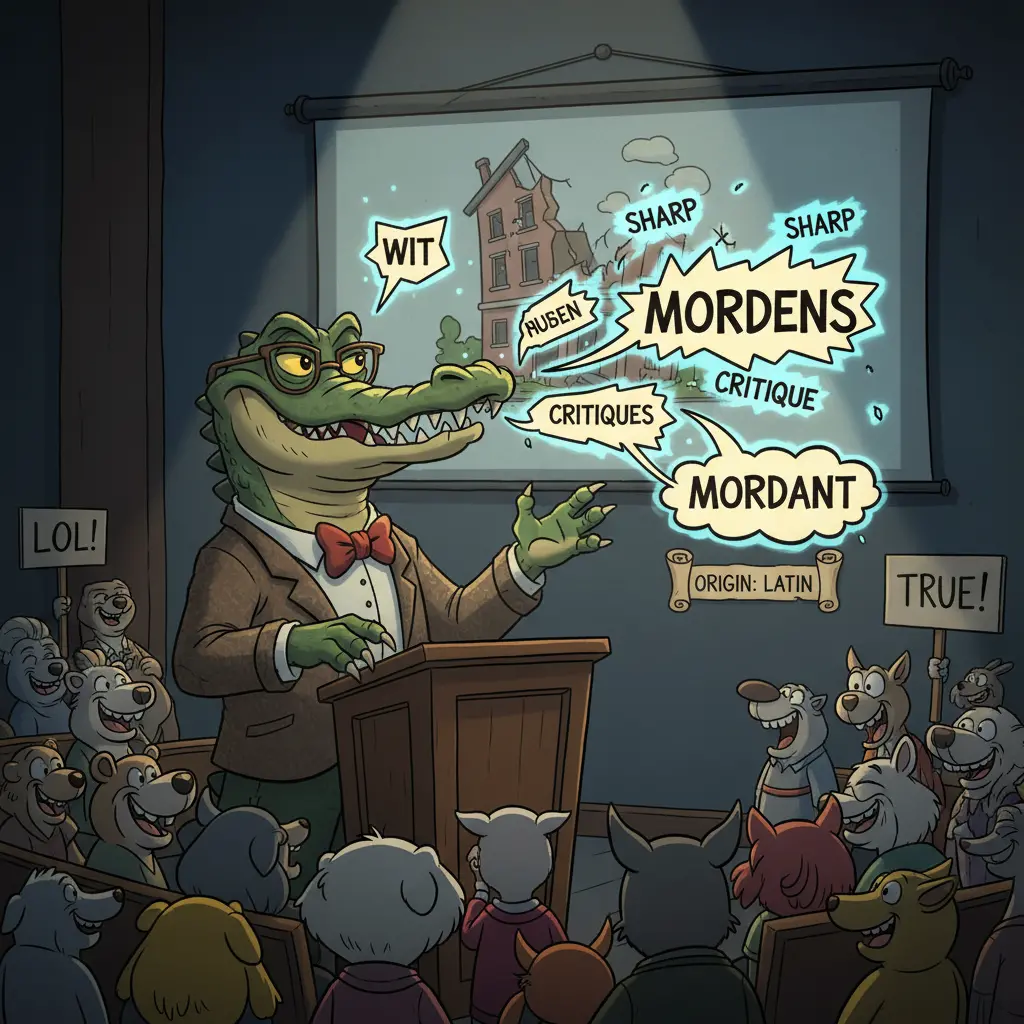
Example sentences are the start of understanding. Don't rush to memorize. First feel how the word works in a sentence.
Root: 'mord-' (to bite) + '-ant' (causing). Origin: Latin 'mordens' → Old French 'mordant' → English. Memory Image: Imagine a sharp-toothed creature, like a cartoon alligator, giving a biting critique, showcasing wit and sharpness.
Note 1: These definitions and etymologies are not standard dictionary definitions, but extended explanations provided to help with memorization and understanding of the actual application of words. Through this background information, we strive to make words more vivid and easier to understand, and help you remember their meanings in real life.
Note 2: LexiTalk designs the learning flow around the linguistics principle of “Comprehensible Input.” When learners encounter material that is slightly above their level but still understandable from context, the brain naturally absorbs the language. That’s why we keep every word inside authentic contexts, using examples and associations to help you understand it and use it flexibly.
Read the FAQ explanation of Comprehensible InputMordant describes something with a sharp bite in wit or style, and can refer to caustic humor, sharp criticism, or a dye fixing chemical. As an adjective, it often names wit that stings and provokes thought, or remarks that scorch pretensions with irony. As a noun, mordant is a chemical used to fix dyes, literally something that bites into fibers so color endures. The etymology links mord- to bite with -ant meaning causing, tracing through Latin mordens and Old French mordant into English. Memory image: a cartoon alligator with a gleaming tooth delivering a precise, witty zinger. In literature, journalism, and art criticism you’ll hear mordant remarks, but use the tone appropriately and tailor to audience.
English tends to label wit as sharp or biting; learners often equate mordant with cruelty or exaggeration. Practice with nouns like mordant wit or mordant remark to show precise critique and avoid implying general nastiness.
What is the meaning of the word 'mordant'?
In which of the following sentences is 'mordant' used correctly?
Which word is a synonym of 'mordant'?
Which word is an antonym of 'mordant'?
How would you describe a mordant piece of writing in a real-life context?
Download LexiTalk app for personalized learning experience
Download AppCookies
We use cookies for essential site functions, analytics, and ads. You can accept, reject, or manage preferences. Privacy Policy