narrative - Master This Word
Master this word with our 5-step learning method – Learn English in English
Train English Through Brain Routes, Not Translation.
This page helps you stop memorizing isolated translations and start understanding a word through its shared mental image, native-style thinking, and practical training steps.
Master this word with our 5-step learning method – Learn English in English
Example sentences are the start of understanding. Don't rush to memorize. First feel how the word works in a sentence.
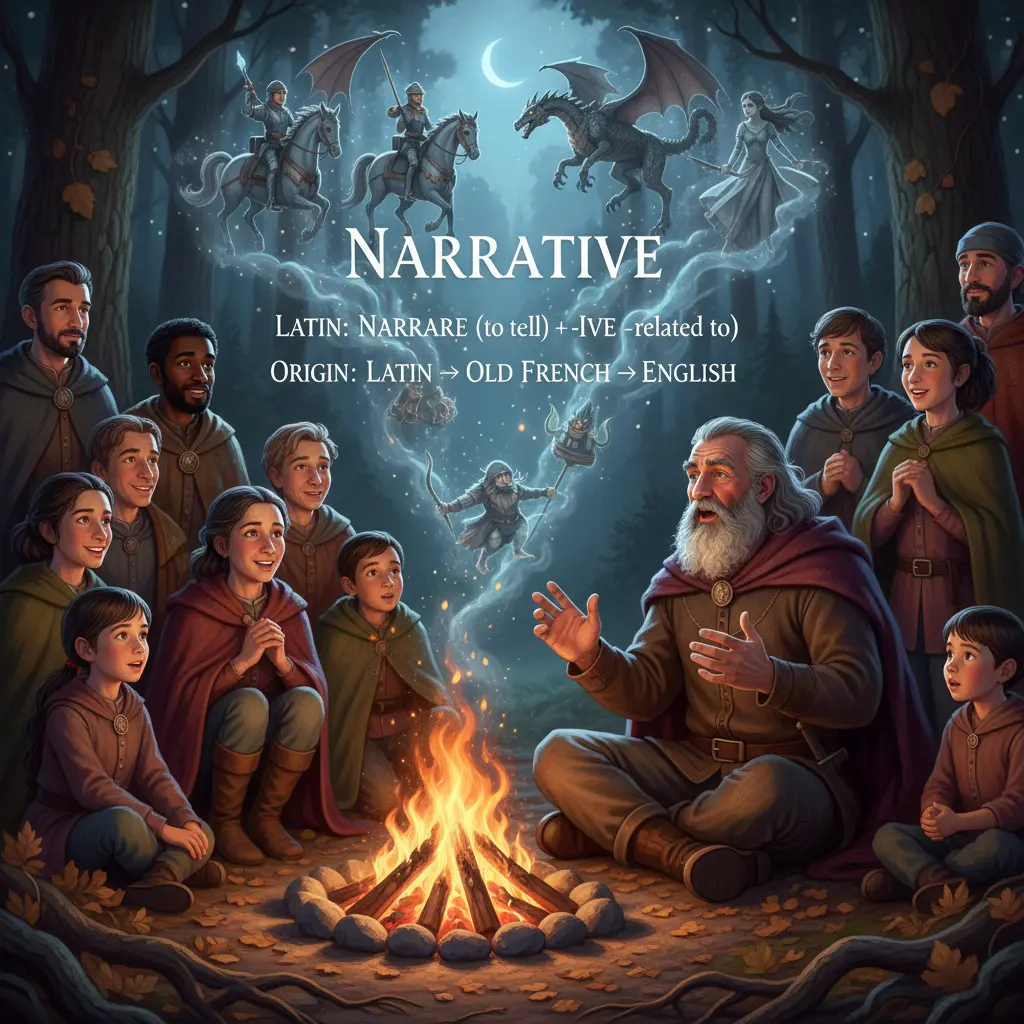
From Latin narrare (to tell) + -ive (related to). Origin: Latin → Old French → English. Imagine a storyteller around a campfire sharing tales, bringing characters to life with every word.
Note 1: These definitions and etymologies are not standard dictionary definitions, but extended explanations provided to help with memorization and understanding of the actual application of words. Through this background information, we strive to make words more vivid and easier to understand, and help you remember their meanings in real life.
Note 2: LexiTalk designs the learning flow around the linguistics principle of “Comprehensible Input.” When learners encounter material that is slightly above their level but still understandable from context, the brain naturally absorbs the language. That’s why we keep every word inside authentic contexts, using examples and associations to help you understand it and use it flexibly.
Read the FAQ explanation of Comprehensible InputI press a finger to the page and let my eyes move along the edge. I push the moment forward, choosing one scene and letting another drift away. It feels like effort and adjustment, a steady shift of attention and a turn of emphasis. The sequence holds, and the narrative emerges through what I place and what I leave out.
Narrative (noun) refers to a story or account of events, or the spoken or written representation of connected events. It can describe the overall arc of what happened, not just a list of facts. A narrative often follows a sequence of events with characters, settings, and a point of view, and it can be formal or informal, factual or fictional. In academic writing, a narrative might organize evidence around a chronological or thematic thread; in journalism, a narrative approach might weave real-life experiences into a compelling report. In storytelling contexts, people talk about a narrative voice or narrative technique to describe how the story is told. The etymology traces to Latin narrare 'to tell,' via Old French, and into English, with the sense of telling vividly brought to life.
Explain to an English speaker (meta, keep short)
What is the meaning of the word 'narrative'?
In what context is the word 'narrative' commonly used?
Which of the following words is similar to 'narrative'?
What is the opposite of 'narrative'?
How can 'narrative' be used in a real-life context?
Download LexiTalk app for personalized learning experience
Download AppCookies
We use cookies for essential site functions, analytics, and ads. You can accept, reject, or manage preferences. Privacy Policy