nor - Master This Word
Master this word with our 5-step learning method – Learn English in English
Train English Through Brain Routes, Not Translation.
This page helps you stop memorizing isolated translations and start understanding a word through its shared mental image, native-style thinking, and practical training steps.
Master this word with our 5-step learning method – Learn English in English
Example sentences are the start of understanding. Don't rush to memorize. First feel how the word works in a sentence.
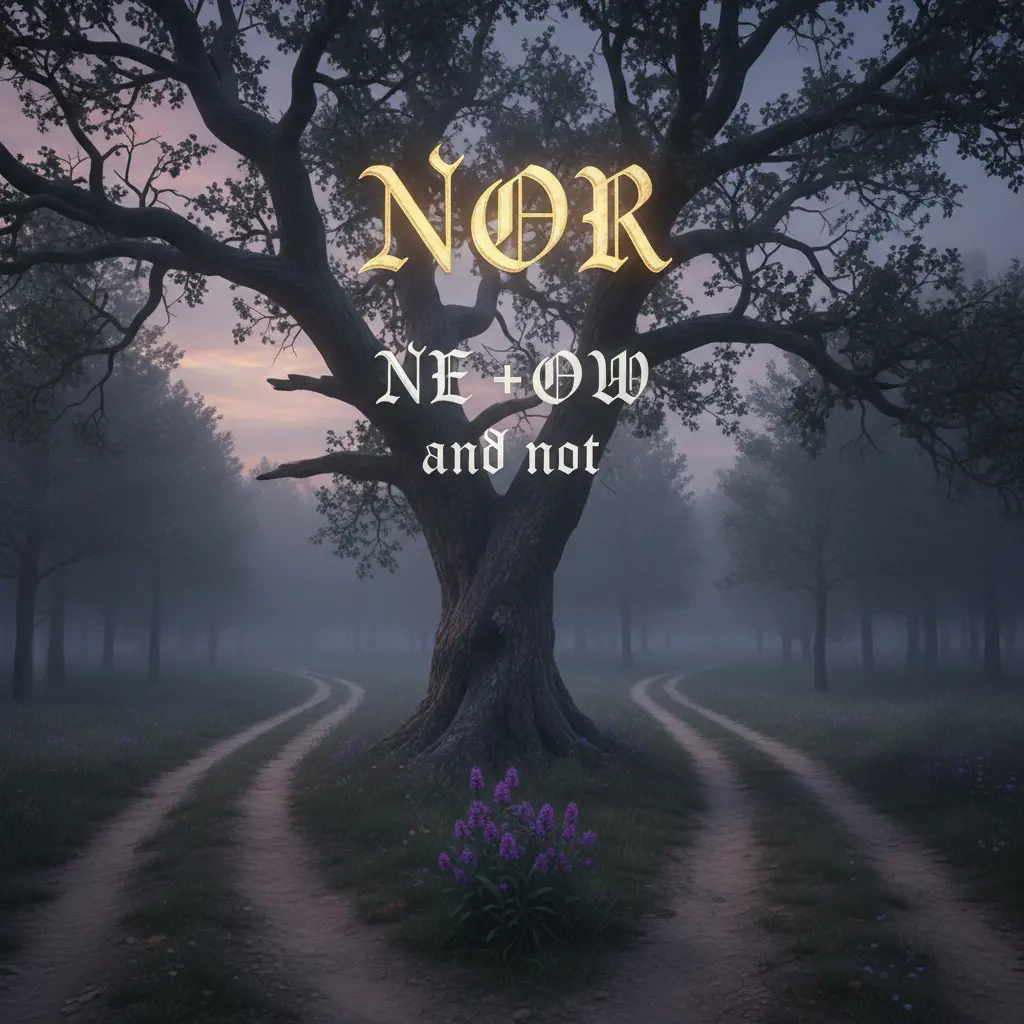
nor = not | Old English - 'nē' + 'ōw', meaning 'and not'. The word 'nor' was used in medieval texts for negation. Imagine a fork in the road where neither path is chosen, representing the absence of both options.
Note 1: These definitions and etymologies are not standard dictionary definitions, but extended explanations provided to help with memorization and understanding of the actual application of words. Through this background information, we strive to make words more vivid and easier to understand, and help you remember their meanings in real life.
Note 2: LexiTalk designs the learning flow around the linguistics principle of “Comprehensible Input.” When learners encounter material that is slightly above their level but still understandable from context, the brain naturally absorbs the language. That’s why we keep every word inside authentic contexts, using examples and associations to help you understand it and use it flexibly.
Read the FAQ explanation of Comprehensible InputI grip the door handle and turn it, watching the latch slide under my fingers. I push one option, then pull back and try another, my mind moving from doubt to decision. The effort comes in small adjustments, a careful turn, a steady hold on the edge of choice. Neither option feels right on its own, nor does rushing to one side save me, so I set the frame with both possibilities in view.
Nor is a coordinating conjunction used to add a second negative statement after neither. In everyday English, people commonly pair neither with nor to express that two possibilities are both negated, as in I neither drink coffee nor tea. In more formal contexts you can invert after nor, as in Nor did I expect to see such a scene. Note that you generally shouldn't mix nor with a positive verb in the same clause; instead you maintain parallel structure. Avoid overusing multiple negatives in the same sentence, which can confuse readers. Remember that 'nor' always carries a negative sense, linking two negative ideas.
Nor marks a second negative in English after neither; learners often forget to keep the two clauses parallel or confuse with 'or'.
What does the word 'nor' mean?
Which sentence uses the word 'nor' correctly?
Which word is most similar to 'nor'?
What is the opposite of 'nor'?
Can you think of a real-life context where 'nor' would be used correctly?
Technology & Social Media
Listen NowEnglish Learning Listening Content
Listen NowEnglish Learning Listening Content
Listen NowDownload LexiTalk app for personalized learning experience
Download AppCookies
We use cookies for essential site functions, analytics, and ads. You can accept, reject, or manage preferences. Privacy Policy