
nosy - Master This Word
Master this word with our 5-step learning method – Learn English in English
Train English Through Brain Routes, Not Translation.
This page helps you stop memorizing isolated translations and start understanding a word through its shared mental image, native-style thinking, and practical training steps.
Master this word with our 5-step learning method – Learn English in English
Example sentences are the start of understanding. Don't rush to memorize. First feel how the word works in a sentence.
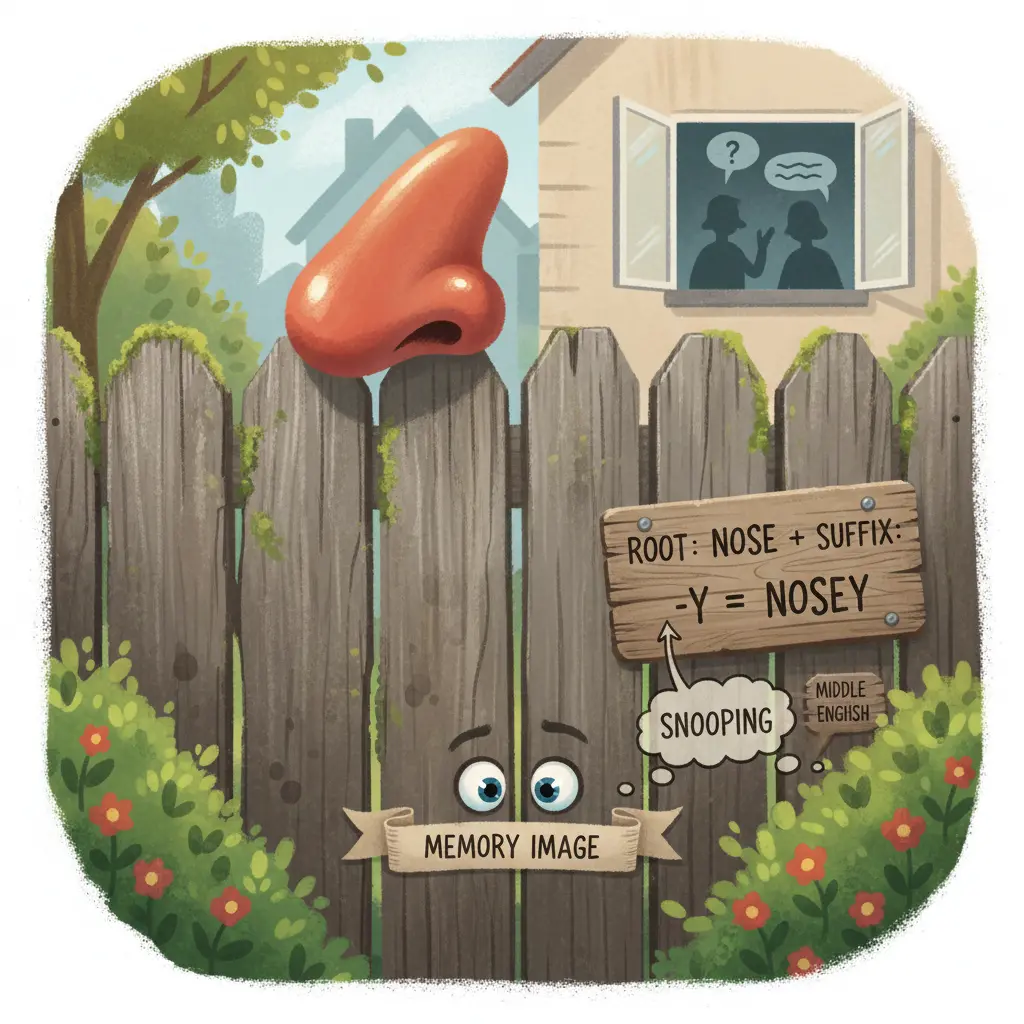
Root decomposition: 'nose' (root) + '-y' (suffix for adjective). Historical origin: From 'nose' linked to the idea of 'snooping' → Middle English. Memory image: Imagine a large nose peeking over a fence, trying to overhear secrets.
Note 1: These definitions and etymologies are not standard dictionary definitions, but extended explanations provided to help with memorization and understanding of the actual application of words. Through this background information, we strive to make words more vivid and easier to understand, and help you remember their meanings in real life.
Note 2: LexiTalk designs the learning flow around the linguistics principle of “Comprehensible Input.” When learners encounter material that is slightly above their level but still understandable from context, the brain naturally absorbs the language. That’s why we keep every word inside authentic contexts, using examples and associations to help you understand it and use it flexibly.
Read the FAQ explanation of Comprehensible InputNosy describes someone who wants to know other people’s private business and intrudes into matters that do not concern them. It carries a negative tone in most contexts, suggesting curiosity that crosses boundaries and can feel rude or controlling. A nosy person might ask about personal finances, relationships, or family issues, or linger after someone else has signaled they don’t want to share. The adjective can modify a person or a situation: 'That’s a nosy question' or 'Stop being so nosy.' The etymology connects to 'nose' and the idea of snooping, with roots in earlier forms of English. Remember that being curious about general topics is fine; nosy implies overstep and judgment.
English speakers typically hear nosy as negative, focusing on boundary-crossing behavior rather than simple curiosity; learners should note the distinction from 'curious' and from 'inquisitive' in polite contexts. Common mistakes: using nosy for neutral questions or applying it to friends; confusing 'nosey' spelling; overgeneralizing to positive traits like diligence.
What does the word 'nosy' mean?
Choose the sentence that uses 'nosy' correctly.
Which word is most similar to 'nosy'?
What is the opposite of 'nosy'?
Can you think of a real-life context where someone might be described as 'nosy'?
Download LexiTalk app for personalized learning experience
Download AppCookies
We use cookies for essential site functions, analytics, and ads. You can accept, reject, or manage preferences. Privacy Policy