outline - Master This Word
Master this word with our 5-step learning method – Learn English in English
Train English Through Brain Routes, Not Translation.
This page helps you stop memorizing isolated translations and start understanding a word through its shared mental image, native-style thinking, and practical training steps.
Master this word with our 5-step learning method – Learn English in English
Example sentences are the start of understanding. Don't rush to memorize. First feel how the word works in a sentence.
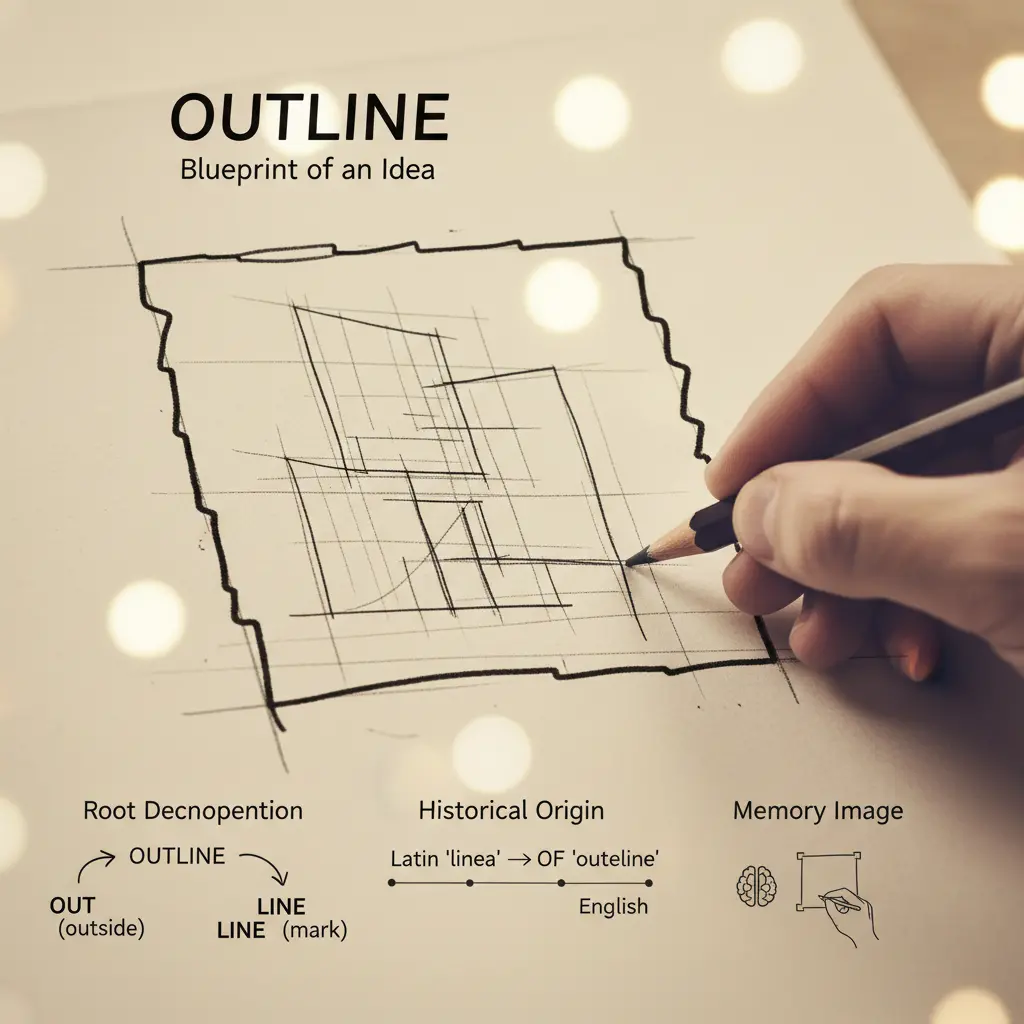
Root decomposition: out (outside) + line (mark); Historical origin: Latin 'linea' → Old French 'outeline' → English; Memory image: Visualize drawing the boundary lines of a shape, framing what is essential, similar to sketching a blueprint of an idea.
Note 1: These definitions and etymologies are not standard dictionary definitions, but extended explanations provided to help with memorization and understanding of the actual application of words. Through this background information, we strive to make words more vivid and easier to understand, and help you remember their meanings in real life.
Note 2: LexiTalk designs the learning flow around the linguistics principle of “Comprehensible Input.” When learners encounter material that is slightly above their level but still understandable from context, the brain naturally absorbs the language. That’s why we keep every word inside authentic contexts, using examples and associations to help you understand it and use it flexibly.
Read the FAQ explanation of Comprehensible InputFirst I hold the page steady and move my pencil along the edge, pushing and turning as I adjust what I am drawing. The line thickens into a rough map of ideas, and I sense the plan taking shape in front of me. Each small shift—a lighter stroke here, a firmer press there—makes the outline feel more alive, and I keep testing it against what I want to say. When the contour feels ready, I use it as a guide to place the main points and steps, letting the idea unfold into a usable structure.
An outline is a planning tool you use before writing or speaking to organize ideas and structure. It provides a general description or plan that highlights the main ideas, sections, and how they relate to each other. In writing, outlines help you sequence arguments, decide where to place evidence, and keep your argument coherent. A typical outline lists topics as headings, with subpoints beneath them, using a logical order such as introduction, body, and conclusion. A second meaning of outline is a drawing that shows the outer shape or boundary of a figure. As a verb, outline means to summarize or sketch the main points briefly, often as a preview or blueprint.
Outline is used by English speakers as both a planning device and a visible plan. Learners often mistake it for a full draft or assume outlines must be complete sentences, so they over‑detail or confuse structure with prose.
What is the definition of 'outline'?
Which sentence uses the word 'outline' correctly?
Which word is most similar to 'outline'?
What is the opposite of 'outline'?
Can you think of a real-life context where outlining is useful?
Download LexiTalk app for personalized learning experience
Download AppCookies
We use cookies for essential site functions, analytics, and ads. You can accept, reject, or manage preferences. Privacy Policy