
parliament - Master This Word
Master this word with our 5-step learning method – Learn English in English
Train English Through Brain Routes, Not Translation.
This page helps you stop memorizing isolated translations and start understanding a word through its shared mental image, native-style thinking, and practical training steps.
Master this word with our 5-step learning method – Learn English in English
Example sentences are the start of understanding. Don't rush to memorize. First feel how the word works in a sentence.
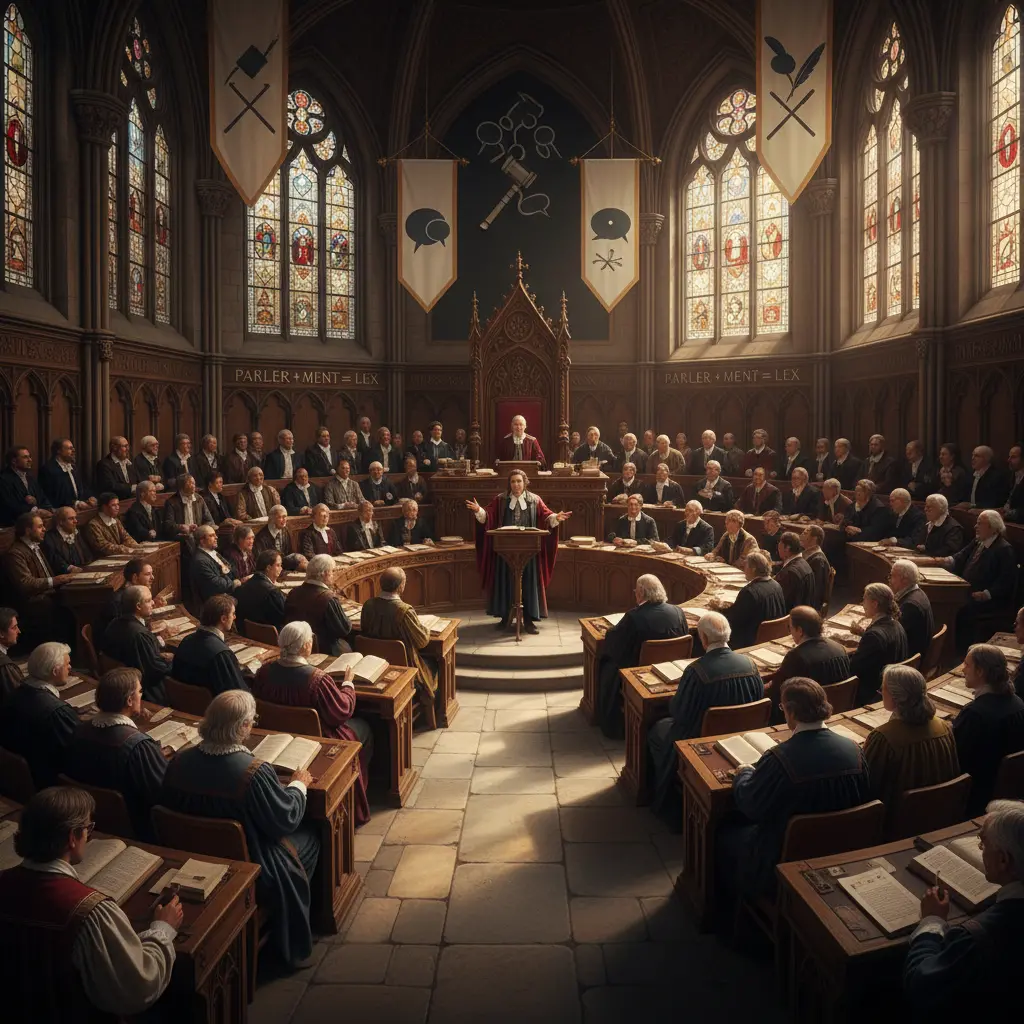
parliament = parler (to speak) + ment (action or result). Historical origin: Old French parelement → English. Memory image: Imagine a group of people gathered in a grand hall, each taking turns to speak and debate, forming laws that govern society.
Note 1: These definitions and etymologies are not standard dictionary definitions, but extended explanations provided to help with memorization and understanding of the actual application of words. Through this background information, we strive to make words more vivid and easier to understand, and help you remember their meanings in real life.
Note 2: LexiTalk designs the learning flow around the linguistics principle of “Comprehensible Input.” When learners encounter material that is slightly above their level but still understandable from context, the brain naturally absorbs the language. That’s why we keep every word inside authentic contexts, using examples and associations to help you understand it and use it flexibly.
Read the FAQ explanation of Comprehensible InputFirst I push open the heavy door and move toward the long row of desks. I adjust my posture, listening as voices rise and fall. I keep my breath steady as ideas shift, arguments turn, and a decision starts to settle in the air. The room begins to feel like parliament, a place where people speak to shape the rules that govern everyone.
Parliament is the supreme legislative body in many democracies, consisting of elected representatives who debate, amend, and vote on laws while holding the government to account. It may be bicameral, with two houses, or unicameral with a single chamber. Members work in committees, question ministers, and draft bills, balancing different interests to serve the public. The word comes from Old French parler (to speak) and ment (action or result), highlighting the assembly’s purpose to speak for the people. In practice, usage varies: in the United Kingdom, Parliament refers to the entire institution, while in the United States the equivalent body is Congress. Learners should note that parliament is a collective noun; it takes singular verb forms in English when referring to the institution.
In English, parliament is a singular collective noun that denotes the whole institutional body; learners often miscapitalize it or treat it as a plural when used generically. Also, learners may mix up Parliament (UK) with Congress (US), so awareness of national terminology helps.
What is the meaning of the word 'parliament'?
Which sentence uses 'parliament' correctly?
What is a synonym for 'parliament'?
What is an antonym for 'parliament'?
How does the concept of 'parliament' apply in real-world politics?
Download LexiTalk app for personalized learning experience
Download AppCookies
We use cookies for essential site functions, analytics, and ads. You can accept, reject, or manage preferences. Privacy Policy