partly - Master This Word
Master this word with our 5-step learning method – Learn English in English
Train English Through Brain Routes, Not Translation.
This page helps you stop memorizing isolated translations and start understanding a word through its shared mental image, native-style thinking, and practical training steps.
Master this word with our 5-step learning method – Learn English in English
Example sentences are the start of understanding. Don't rush to memorize. First feel how the word works in a sentence.
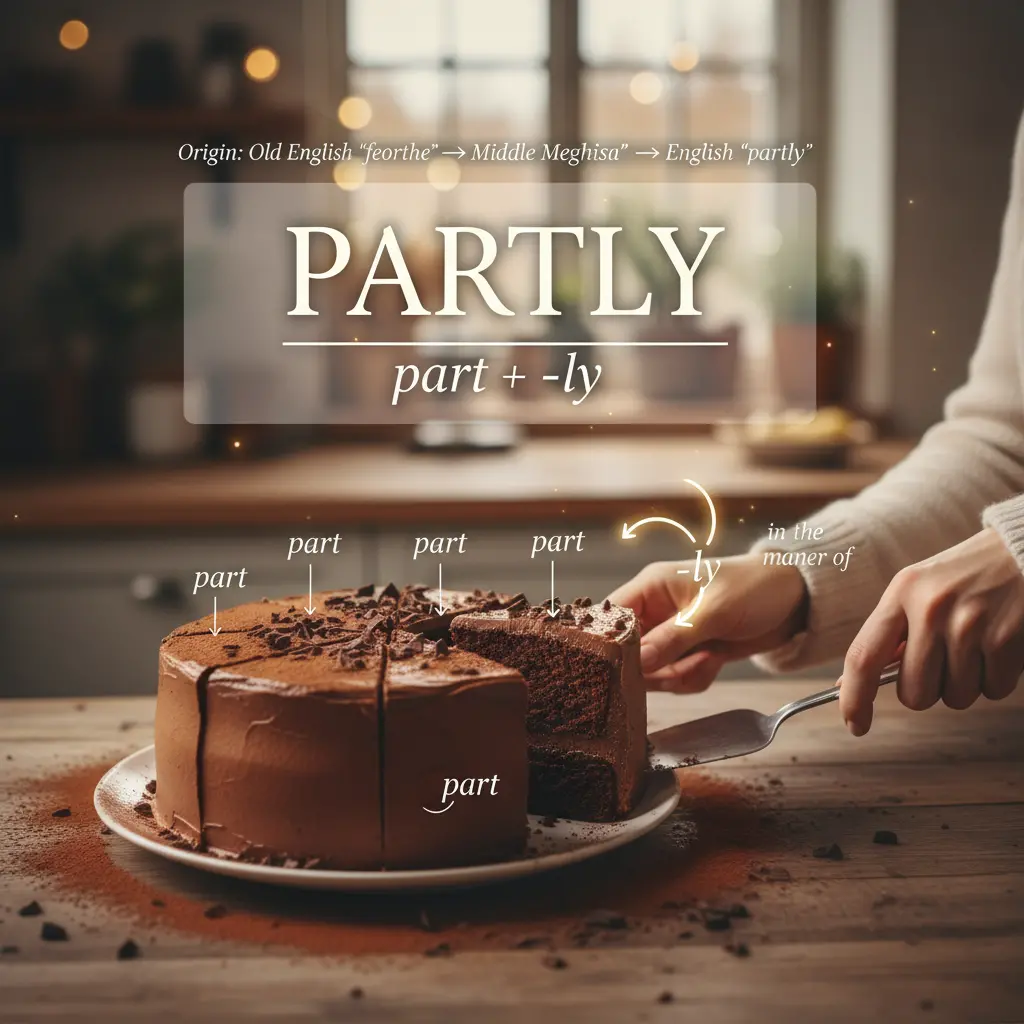
partly = part + -ly; Origin: Old English 'feorthe' → Middle English 'partli' → English 'partly'. Picture someone dividing a cake into slices – each slice represents a part, and 'ly' indicates how it’s done, as in 'in the manner of'.
Note 1: These definitions and etymologies are not standard dictionary definitions, but extended explanations provided to help with memorization and understanding of the actual application of words. Through this background information, we strive to make words more vivid and easier to understand, and help you remember their meanings in real life.
Note 2: LexiTalk designs the learning flow around the linguistics principle of “Comprehensible Input.” When learners encounter material that is slightly above their level but still understandable from context, the brain naturally absorbs the language. That’s why we keep every word inside authentic contexts, using examples and associations to help you understand it and use it flexibly.
Read the FAQ explanation of Comprehensible InputI reach for the window and move the shade a little, letting light spill in partly. I hold the cord, pull it slowly, and adjust the tilt until the room feels right. The change arrives in a quiet warmth, and I sense a small effort behind the ease. I know I’ll use this again, to keep a scene soft or bright, depending on the moment.
Partly is an adverb used to express that something is true to a certain degree but not entirely. It often modifies adjectives and clauses to soften or qualify a statement, contrasting with completely or entirely. For example, 'The report is partly complete' signals some parts are done, while others remain. It is frequently interchangeable with 'in part' or 'partially' but carries a more informal tone. Learners should watch for collocations like partly due to, partly because, and avoid overusing it in formal writing where 'partially' or 'to some extent' may be clearer. Note that pronunciation stresses the first syllable: PART-ly.
For learners of English, partly often feels more casual and immediate than partially; English speakers frequently use it in everyday talk to hedge statements about degree without sounding tentative. Other languages may prefer more explicit degrees or different adverbs for formal writing; learners should note when a broader choice like in part or to some extent is clearer.
What is the meaning of the word 'partly'?
Which of the following sentences uses 'partly' correctly?
What is the most similar word to 'partly'?
What is the opposite of 'partly'?
Can you give an example of a real-life scenario of 'partly'?
Download LexiTalk app for personalized learning experience
Download AppCookies
We use cookies for essential site functions, analytics, and ads. You can accept, reject, or manage preferences. Privacy Policy