parts - Master This Word
Master this word with our 5-step learning method – Learn English in English
Train English Through Brain Routes, Not Translation.
This page helps you stop memorizing isolated translations and start understanding a word through its shared mental image, native-style thinking, and practical training steps.
Master this word with our 5-step learning method – Learn English in English
Example sentences are the start of understanding. Don't rush to memorize. First feel how the word works in a sentence.
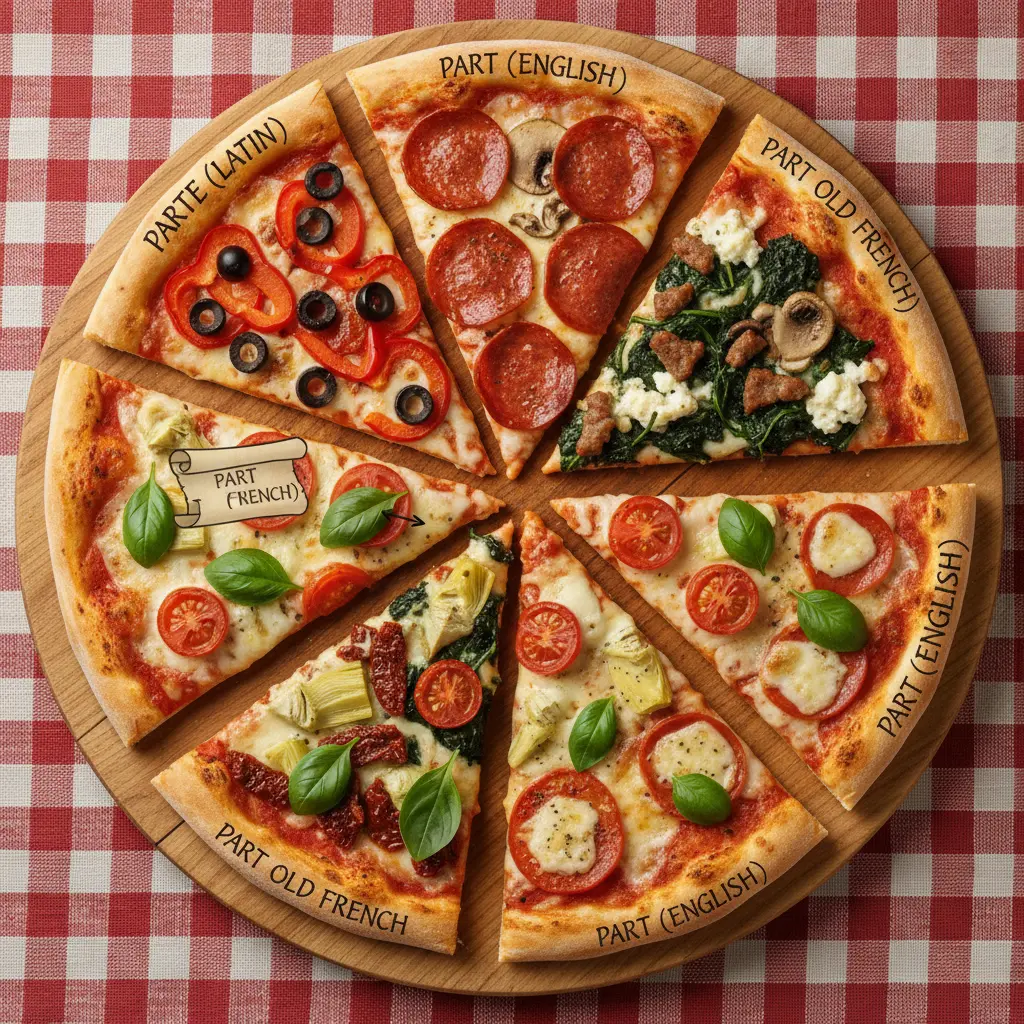
From 'parte' (Latin) = part, 'part' (Old French) → 'part' (English). Imagine a pizza, with each slice representing a part of the whole.
Note 1: These definitions and etymologies are not standard dictionary definitions, but extended explanations provided to help with memorization and understanding of the actual application of words. Through this background information, we strive to make words more vivid and easier to understand, and help you remember their meanings in real life.
Note 2: LexiTalk designs the learning flow around the linguistics principle of “Comprehensible Input.” When learners encounter material that is slightly above their level but still understandable from context, the brain naturally absorbs the language. That’s why we keep every word inside authentic contexts, using examples and associations to help you understand it and use it flexibly.
Read the FAQ explanation of Comprehensible InputFirst you move your hands, picking up a small piece and set it on the table. The object shifts in your grip as you adjust its position, and you notice how it becomes a part of the whole you’re building. The feeling is practical and focused, like you’re guiding a tiny piece of a bigger system, a role you’re about to fill. Later, you let the idea settle: where this part will fit in, what it will do, and how it keeps the flow going. This is how part grows from a simple piece to a place in a larger process, a function you give it as you work.
Part is a versatile word that can name a piece of something larger, a role or function in a process, or the act of separating or dividing. You’ll hear it in phrases like part of the whole, play a part in a project, and part ways when people go different directions. The etymology points to Latin parte and Old French, but today part spans tangible pieces, abstract roles, and actions. When you talk about a piece, you might say a part of the cake or a part of the plan; when you discuss duties, you refer to a part you play; and as a verb it can mean to split or to part hair, to partition, or to part from someone.
To English speakers, part often maps to a tangible piece or a social role; it blends concrete and abstract senses, so learners must watch collocations and prepositions.
What is the meaning of 'parts'?
Choose the correct usage of the word 'parts' in a sentence.
Which word is most similar to 'parts'?
What is the opposite of 'parts'?
Can you think of a real-life context where 'parts' would be used?
Download LexiTalk app for personalized learning experience
Download AppCookies
We use cookies for essential site functions, analytics, and ads. You can accept, reject, or manage preferences. Privacy Policy