
photon - Master This Word
Master this word with our 5-step learning method – Learn English in English
Train English Through Brain Routes, Not Translation.
This page helps you stop memorizing isolated translations and start understanding a word through its shared mental image, native-style thinking, and practical training steps.
Master this word with our 5-step learning method – Learn English in English
Example sentences are the start of understanding. Don't rush to memorize. First feel how the word works in a sentence.
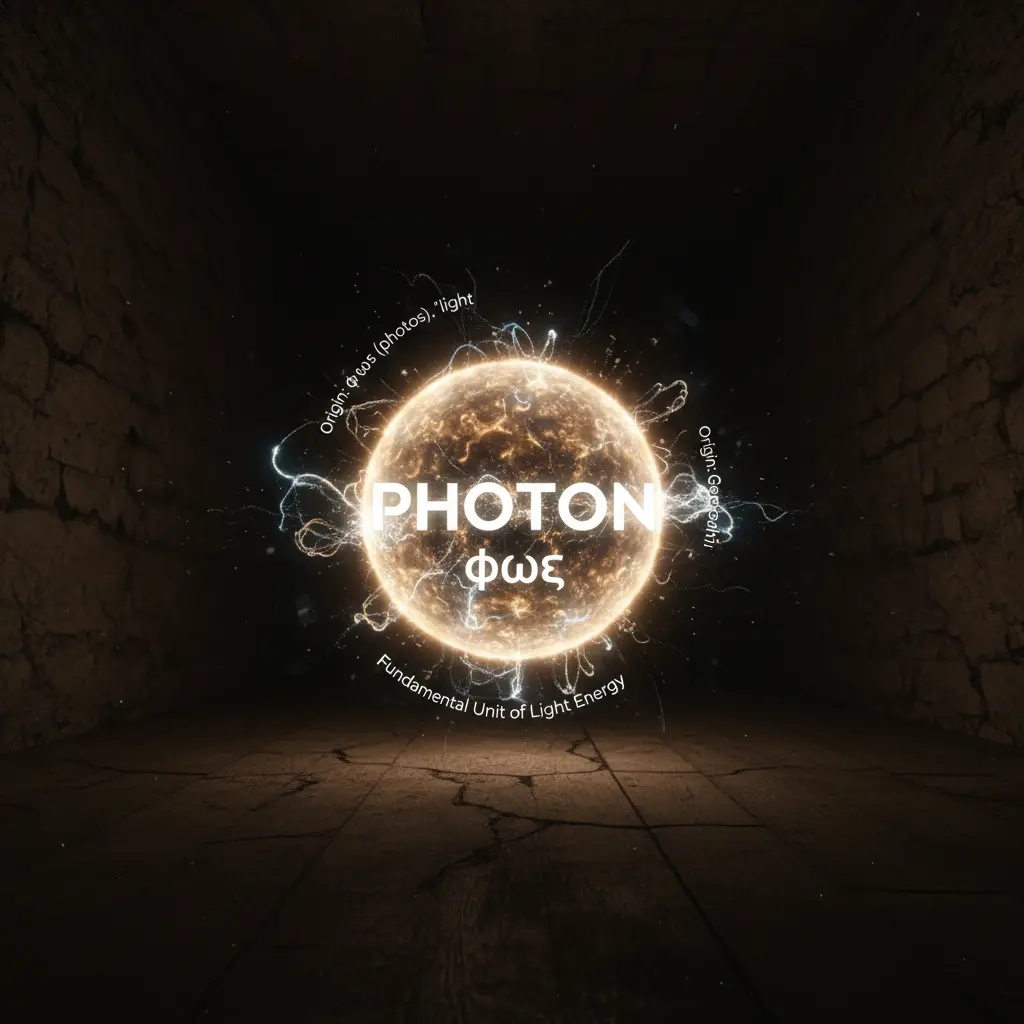
photo- = light, -on = particle. Originating from Greek φως (photos), meaning 'light', it came into English through the term 'quantum' in the early 20th century. Imagine a small, glowing orb of light that dances and flickers in a dark room, highlighting its importance as a fundamental unit of light energy.
Note 1: These definitions and etymologies are not standard dictionary definitions, but extended explanations provided to help with memorization and understanding of the actual application of words. Through this background information, we strive to make words more vivid and easier to understand, and help you remember their meanings in real life.
Note 2: LexiTalk designs the learning flow around the linguistics principle of “Comprehensible Input.” When learners encounter material that is slightly above their level but still understandable from context, the brain naturally absorbs the language. That’s why we keep every word inside authentic contexts, using examples and associations to help you understand it and use it flexibly.
Read the FAQ explanation of Comprehensible InputPhoton is the fundamental quantum of light. In physics, a photon carries energy proportional to its frequency and momentum, and it can interact with matter in discrete packets rather than a continuous wave. This dual particle–wave nature explains phenomena from the photoelectric effect to interference patterns. In everyday terms, photons are the tiny carriers that make light feel fast and energetic, and they enable technologies like lasers, LEDs, and solar cells. Counting light energy often means counting photons, especially in quantum optics experiments. Understanding photons helps bridge classical descriptions of light with quantum theory, clarifying how color, brightness, and information are encoded in electromagnetic radiation.
English tends to emphasize precise countable units and the wave–particle paradox; learners often mix up 'light' vs 'photon' and struggle with articles and plurals.
What is the meaning of the word 'photon'?
In which of the following sentences is 'photon' used correctly?
Which of the following is a synonym for 'photon'?
In what real-life context would you encounter the term 'photon'?
Can you explain the concept of 'photon' in your own words?
Download LexiTalk app for personalized learning experience
Download AppCookies
We use cookies for essential site functions, analytics, and ads. You can accept, reject, or manage preferences. Privacy Policy