poetry - Master This Word
Master this word with our 5-step learning method – Learn English in English
Train English Through Brain Routes, Not Translation.
This page helps you stop memorizing isolated translations and start understanding a word through its shared mental image, native-style thinking, and practical training steps.
Master this word with our 5-step learning method – Learn English in English
Example sentences are the start of understanding. Don't rush to memorize. First feel how the word works in a sentence.
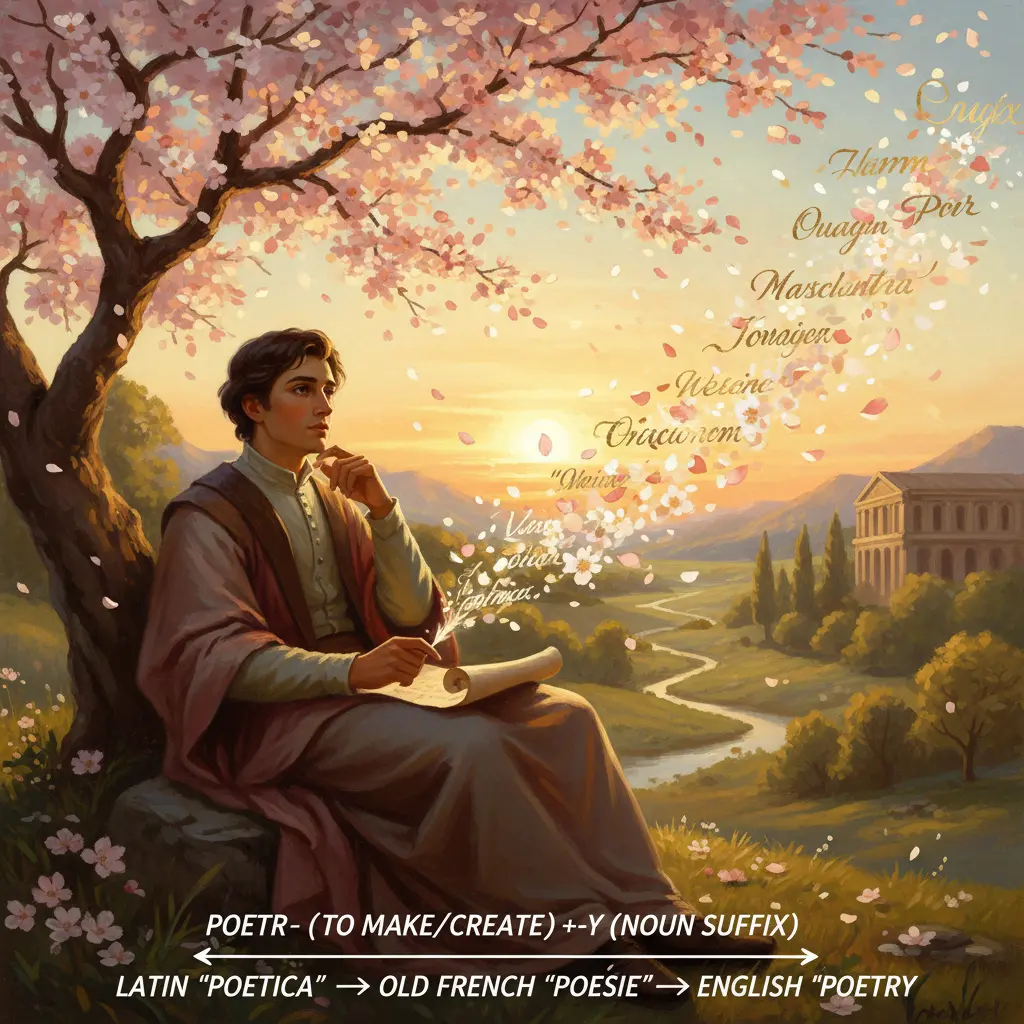
poetry = poetr- (to make/create) + -y (noun suffix); Latin 'poetica' → Old French 'poesie' → English 'poetry'. Memory image: Imagine a poet creating a beautiful verse while sitting under a blooming tree, with words flowing like petals in the wind, illustrating the beauty of expression.
Note 1: These definitions and etymologies are not standard dictionary definitions, but extended explanations provided to help with memorization and understanding of the actual application of words. Through this background information, we strive to make words more vivid and easier to understand, and help you remember their meanings in real life.
Note 2: LexiTalk designs the learning flow around the linguistics principle of “Comprehensible Input.” When learners encounter material that is slightly above their level but still understandable from context, the brain naturally absorbs the language. That’s why we keep every word inside authentic contexts, using examples and associations to help you understand it and use it flexibly.
Read the FAQ explanation of Comprehensible InputI set a finger on the page and let the lines catch my breath. I move my attention along the rhythm, feeling the push and pull between sound and feeling as I adjust my pace. The meaning rises like a small current, changing with the tone I choose and the pause I keep. When I close the book, the words stay with me, ready to be used in new moments, not as a rule but as a feeling I can carry.
Poetry is a literary form that expresses ideas, feelings, and stories through carefully chosen words arranged in lines and sometimes stanzas. It often uses rhythm, meter, rhyme, and vivid imagery to create mood and resonance beyond straightforward prose. A poem can reveal inner thoughts in compact speech, invite readers to find patterns and connections, and evoke sensory experiences through sound devices like alliteration and assonance. Poetry spans many traditions—from compact lyric poems to expansive epics—and it invites personal interpretation. When you study poetry, you notice how form shapes meaning, how imagery transports you, and how repetition can deepen emotion or highlight a theme.
In English, poetry is often valued for its formal craft and openness to interpretation; learners may over-fixate on vocabulary or assume all poetry rhymes, while risk is missing nuance in free verse.
What is the meaning of the word 'poetry'?
How is 'poetry' commonly used in sentences?
Which word is similar to 'poetry'?
What is the opposite of 'poetry'?
In what real-life context would you find 'poetry'?
Download LexiTalk app for personalized learning experience
Download AppCookies
We use cookies for essential site functions, analytics, and ads. You can accept, reject, or manage preferences. Privacy Policy