poll - Master This Word
Master this word with our 5-step learning method – Learn English in English
Train English Through Brain Routes, Not Translation.
This page helps you stop memorizing isolated translations and start understanding a word through its shared mental image, native-style thinking, and practical training steps.
Master this word with our 5-step learning method – Learn English in English
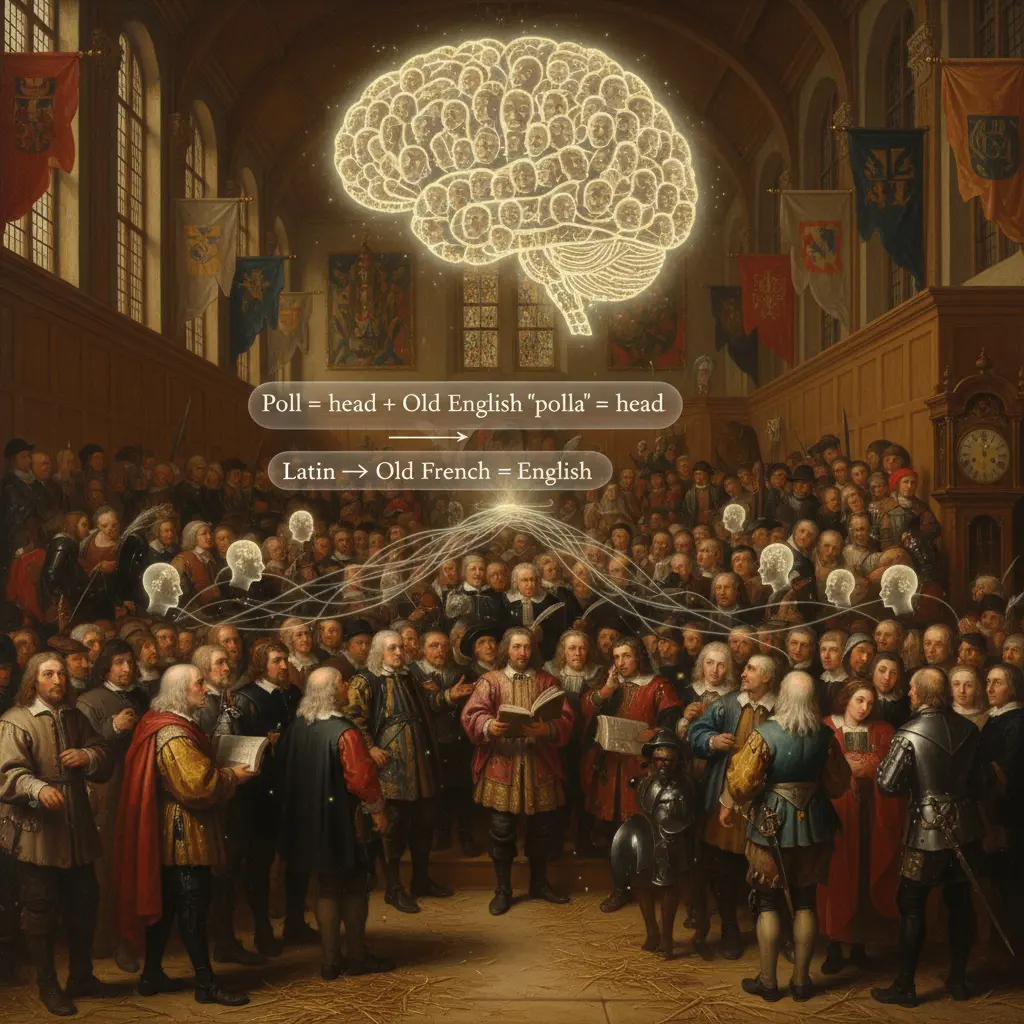
Example sentences are the start of understanding. Don't rush to memorize. First feel how the word works in a sentence.
Poll = head + Old English 'polla' = head. Historical origin: Latin → Old French → English. Imagine counting heads at a crowded event to hear everyone's opinion, forming a complete picture of the room.
Note 1: These definitions and etymologies are not standard dictionary definitions, but extended explanations provided to help with memorization and understanding of the actual application of words. Through this background information, we strive to make words more vivid and easier to understand, and help you remember their meanings in real life.
Note 2: LexiTalk designs the learning flow around the linguistics principle of “Comprehensible Input.” When learners encounter material that is slightly above their level but still understandable from context, the brain naturally absorbs the language. That’s why we keep every word inside authentic contexts, using examples and associations to help you understand it and use it flexibly.
Read the FAQ explanation of Comprehensible InputI lean forward, hand steady, and move a mark toward the line. I shift from doubt to decision as the page settles under my gaze. The tiny click or screen glow makes my opinion feel real, like I have set a compass and let it point. In surveys and votes, this small action repeats, and my voice keeps moving into the outcome.
Poll is a versatile word in English that can be a noun or a verb. As a noun, it most commonly means a survey of people’s opinions, such as a political poll or a market poll. It can also refer to the result of voting in an election, i. e., the poll numbers. As a verb, to poll means to collect opinions or votes from a group, or to tally attendance or support. The word originates from counting heads: poll originally meant head, and the practice was counting heads at gatherings. In everyday use, you can say, 'The poll shows a shift in public opinion' or 'We polled 500 voters.'
English tends to frame poll as a formal data source and a measure of opinion shifts; some learners overemphasize exact percentages and ignore sampling error.
What is the meaning of the word 'poll'?
Which sentence uses the word 'poll' correctly?
Which word is most similar to 'poll'?
What is the opposite of 'poll'?
Can you give an example of a real-life scenario of 'poll'?
Technology & Social Media
Listen NowDownload LexiTalk app for personalized learning experience
Download AppCookies
We use cookies for essential site functions, analytics, and ads. You can accept, reject, or manage preferences. Privacy Policy