pollution - Master This Word
Master this word with our 5-step learning method – Learn English in English
Train English Through Brain Routes, Not Translation.
This page helps you stop memorizing isolated translations and start understanding a word through its shared mental image, native-style thinking, and practical training steps.
Master this word with our 5-step learning method – Learn English in English
Example sentences are the start of understanding. Don't rush to memorize. First feel how the word works in a sentence.
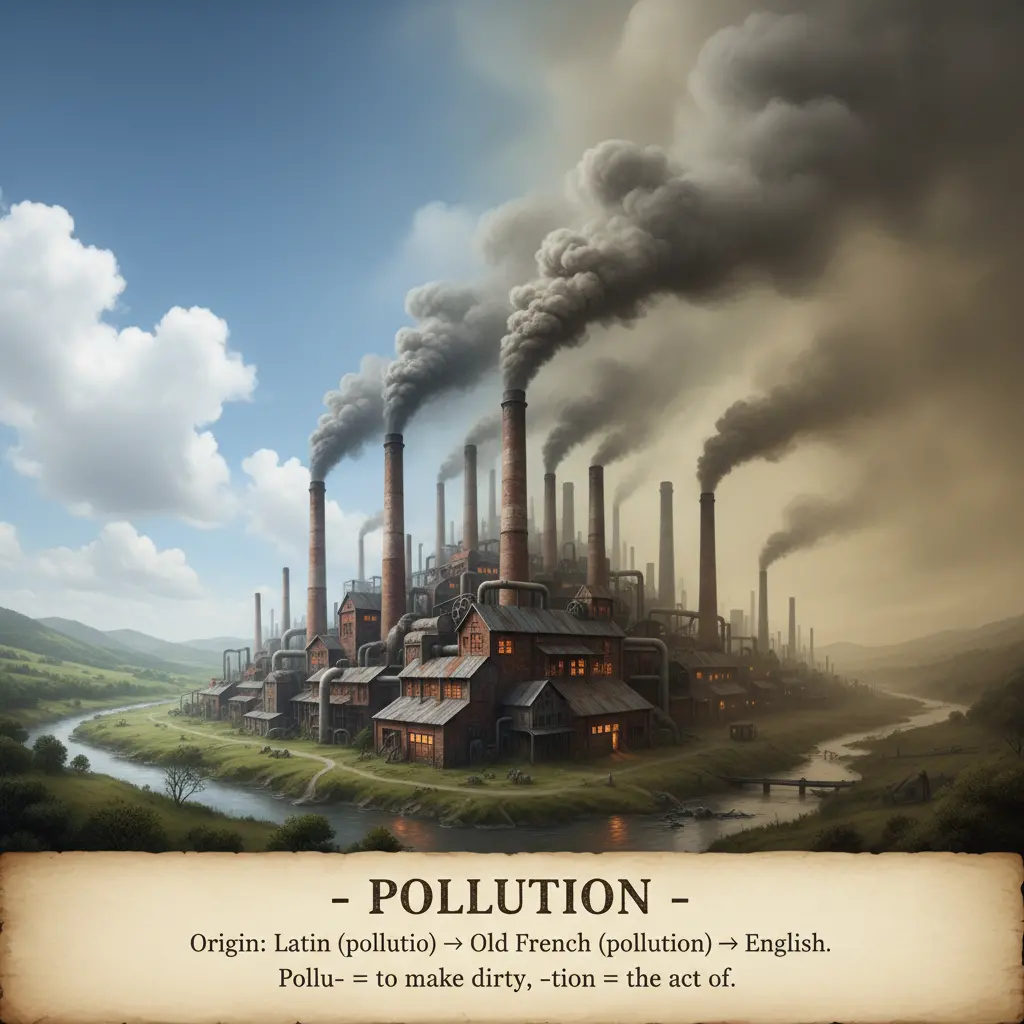
pollu- = to make dirty, -tion = the act of. Origin: Latin (pollutio) → Old French (pollution) → English. Imagine a factory belching smoke into clean air, transforming it into a murky haze.
Note 1: These definitions and etymologies are not standard dictionary definitions, but extended explanations provided to help with memorization and understanding of the actual application of words. Through this background information, we strive to make words more vivid and easier to understand, and help you remember their meanings in real life.
Note 2: LexiTalk designs the learning flow around the linguistics principle of “Comprehensible Input.” When learners encounter material that is slightly above their level but still understandable from context, the brain naturally absorbs the language. That’s why we keep every word inside authentic contexts, using examples and associations to help you understand it and use it flexibly.
Read the FAQ explanation of Comprehensible InputFirst I push the door open and step into a room that doesn’t breathe easy. Dust flickers in the light, and a sour smell shifts as the air moves. I adjust the fan, pull the blinds, and keep the window ajar a crack, watching the room change with every flow. The squeeze of the air, the way things don’t settle, makes me sense pollution—not as a label, but as that invisible push that lingers when many things stay out of balance.
Pollution is a broad term for the contamination of air, water, or land, making them dirty or unsafe to use. It includes emissions from cars and factories, spills of oil, litter, and chemical waste. You can talk about air pollution, water pollution, and soil pollution as specific kinds. The noun pollution is usually uncountable (for example, air pollution), though you may occasionally hear 'pollutions' in technical contexts referring to different pollution events. Understanding pollution helps explain debates about health, climate, and sustainable development.
English speakers commonly treat pollution as an abstract, broad noun focused on harm and policy; mistakes include overgeneralizing to any dirt, assuming 'pollution' is always visible, and misusing 'pollutions' in rare technical contexts.
What is the meaning of the word 'pollution'?
How is the word 'pollution' used in a sentence?
Which word is similar to 'pollution'?
Which word is the opposite of 'pollution'?
In what real-life context would you encounter 'pollution'?
Download LexiTalk app for personalized learning experience
Download AppCookies
We use cookies for essential site functions, analytics, and ads. You can accept, reject, or manage preferences. Privacy Policy