predictable - Master This Word
Master this word with our 5-step learning method – Learn English in English
Train English Through Brain Routes, Not Translation.
This page helps you stop memorizing isolated translations and start understanding a word through its shared mental image, native-style thinking, and practical training steps.
Master this word with our 5-step learning method – Learn English in English
Example sentences are the start of understanding. Don't rush to memorize. First feel how the word works in a sentence.
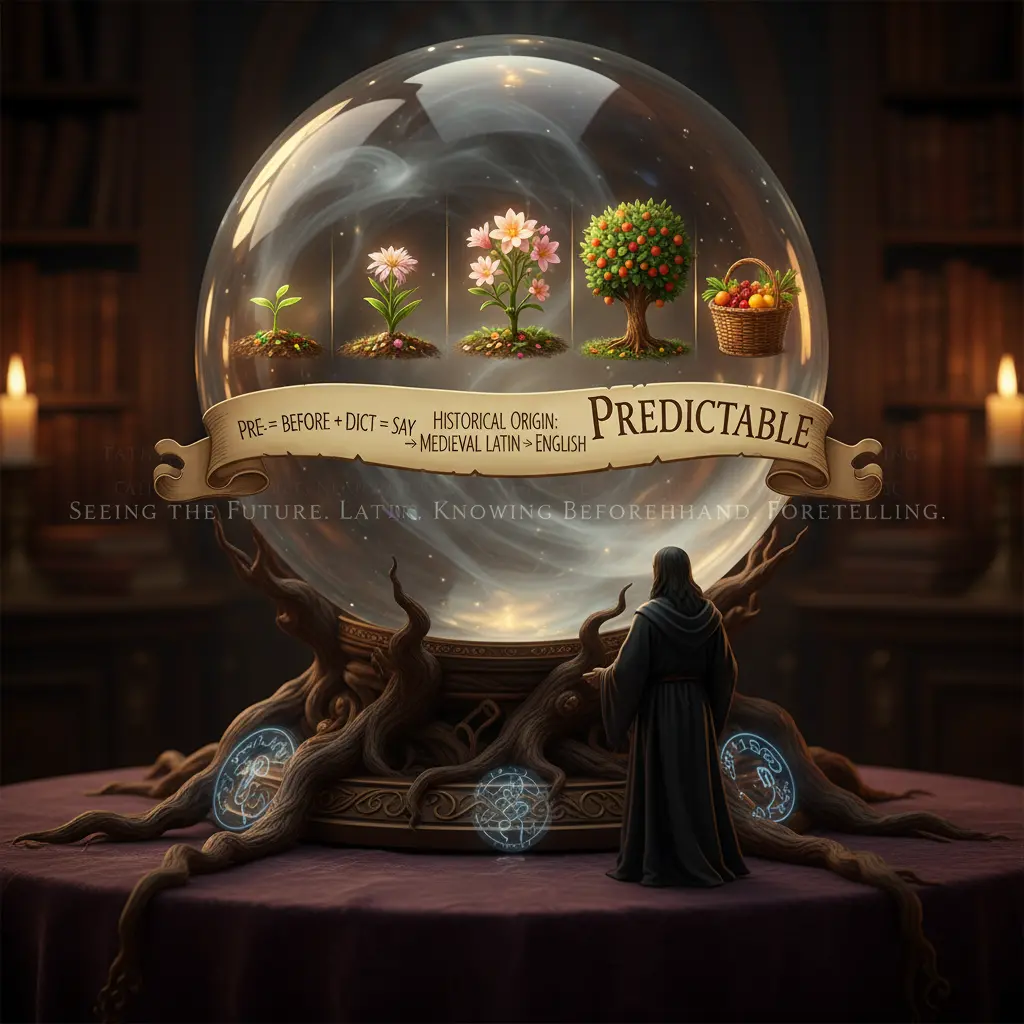
predictable: pre- = before + dict = say. Historical origin: Latin → Medieval Latin → English. Memory image: Imagine a crystal ball where you can see events coming before they happen, much like the word's implication of being able to foresee outcomes.
Note 1: These definitions and etymologies are not standard dictionary definitions, but extended explanations provided to help with memorization and understanding of the actual application of words. Through this background information, we strive to make words more vivid and easier to understand, and help you remember their meanings in real life.
Note 2: LexiTalk designs the learning flow around the linguistics principle of “Comprehensible Input.” When learners encounter material that is slightly above their level but still understandable from context, the brain naturally absorbs the language. That’s why we keep every word inside authentic contexts, using examples and associations to help you understand it and use it flexibly.
Read the FAQ explanation of Comprehensible InputOn a quiet morning I set the kettle and push the switch, watching the steam rise in a steady line. I adjust the timing, moving the spoon in small circles as the coffee wakes up. The rhythm feels steady, every move leading toward the same end, and I keep my breath even. That ease in the routine makes the day feel predictable, like I can trust what comes next.
Predictable means something that can be foreseen or anticipated, either because the pattern is obvious, common, or based on reliable regularities. It is often used for events, outcomes, or behavior that follow a known routine. In neutral contexts it simply says you can expect the result, but in everyday speech it can carry a subtle negative tone if the result seems dull or lacks novelty. The word helps contrast with unpredictable or surprising outcomes, and it also appears in phrases like a predictable pattern or a predictable outcome.
Predictable is viewed in English as a descriptor that can be neutral or carry a slight negative nuance, depending on context (plots, events, or people). Learners often equate it with absolute certainty or overgeneralize to people, missing that something can be foreseen yet still be acceptable or reliable.
What is the meaning of 'predictable'?
In which sentence is 'predictable' used correctly?
Which word is an antonym of 'predictable'?
In what real-life context can 'predictable' be applied?
Give an example sentence using 'predictable'.
Download LexiTalk app for personalized learning experience
Download AppCookies
We use cookies for essential site functions, analytics, and ads. You can accept, reject, or manage preferences. Privacy Policy