
proton - Master This Word
Master this word with our 5-step learning method – Learn English in English
Train English Through Brain Routes, Not Translation.
This page helps you stop memorizing isolated translations and start understanding a word through its shared mental image, native-style thinking, and practical training steps.
Master this word with our 5-step learning method – Learn English in English
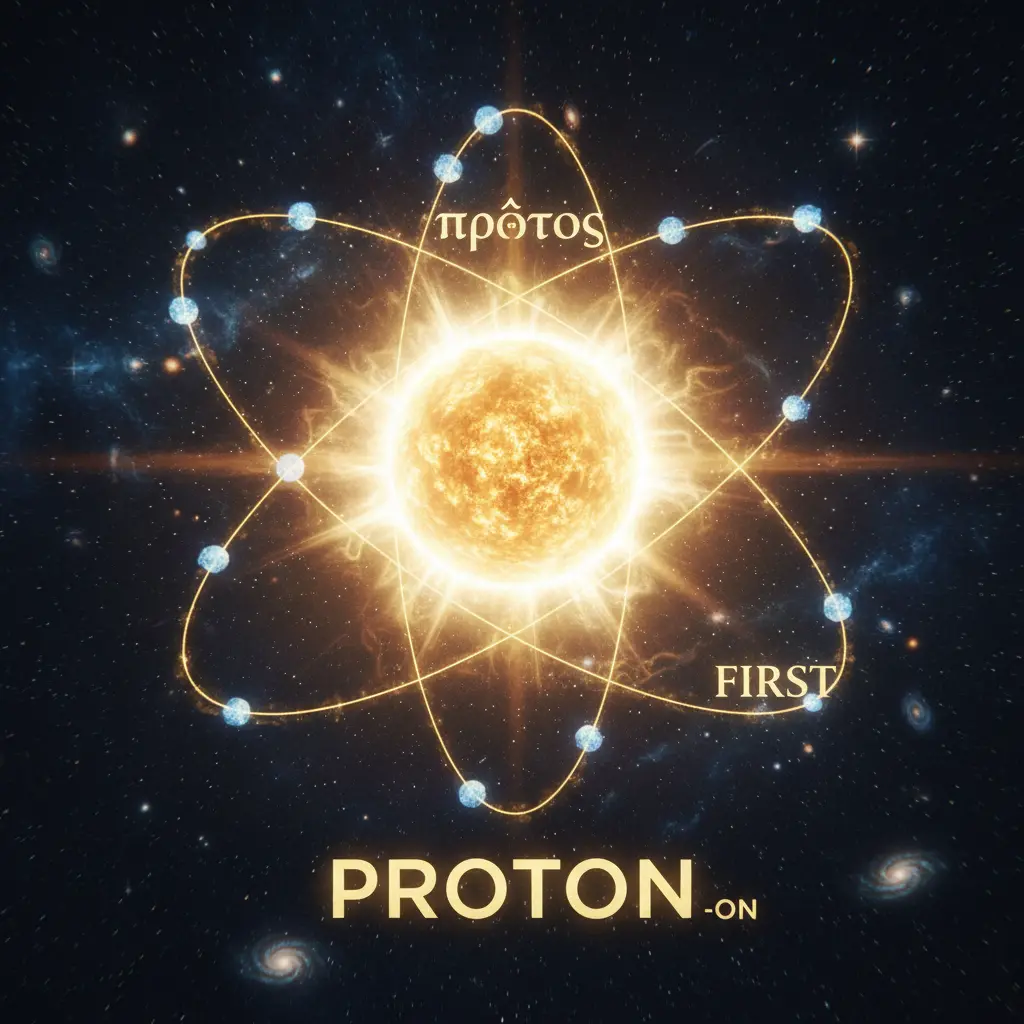
Example sentences are the start of understanding. Don't rush to memorize. First feel how the word works in a sentence.
(a) The root comes from the Greek 'protos', meaning 'first' + suffix '-on' denoting particles. (b) It evolved through Latin 'protonium', then into Middle French before reaching English. (c) Imagine a tiny sun at the center of an atom, the 'first' glowing particle that gives life to all matter.
Note 1: These definitions and etymologies are not standard dictionary definitions, but extended explanations provided to help with memorization and understanding of the actual application of words. Through this background information, we strive to make words more vivid and easier to understand, and help you remember their meanings in real life.
Note 2: LexiTalk designs the learning flow around the linguistics principle of “Comprehensible Input.” When learners encounter material that is slightly above their level but still understandable from context, the brain naturally absorbs the language. That’s why we keep every word inside authentic contexts, using examples and associations to help you understand it and use it flexibly.
Read the FAQ explanation of Comprehensible InputProton is a positively charged subatomic particle located in the nucleus of an atom. It is one of the three main constituents of an atom, along with neutrons and electrons. Its charge, mass, and presence in the nucleus help define the element’s identity: changing the number of protons changes the element (carbon vs nitrogen), while its interplay with neutrons and electrons shapes chemical behavior and stability. In physics, protons are studied in nuclear reactions, particle accelerators, and various fields from chemistry to biology. When teaching, teachers often connect the idea of a proton to a tiny positive sun at the atom’s heart, guiding learners to visualize scale and charge.
English learners often separate charge, location, and identity in clear terms; keep in mind proton counts define identity but mass comes from both protons and neutrons.
What is the meaning of 'proton'?
Choose the sentence that uses 'proton' correctly.
Which word is most similar to 'proton'?
What is the opposite of 'proton'?
Can you think of a real-life context related to 'proton'?
Download LexiTalk app for personalized learning experience
Download AppCookies
We use cookies for essential site functions, analytics, and ads. You can accept, reject, or manage preferences. Privacy Policy