pump - Master This Word
Master this word with our 5-step learning method – Learn English in English
Train English Through Brain Routes, Not Translation.
This page helps you stop memorizing isolated translations and start understanding a word through its shared mental image, native-style thinking, and practical training steps.
Master this word with our 5-step learning method – Learn English in English
Example sentences are the start of understanding. Don't rush to memorize. First feel how the word works in a sentence.
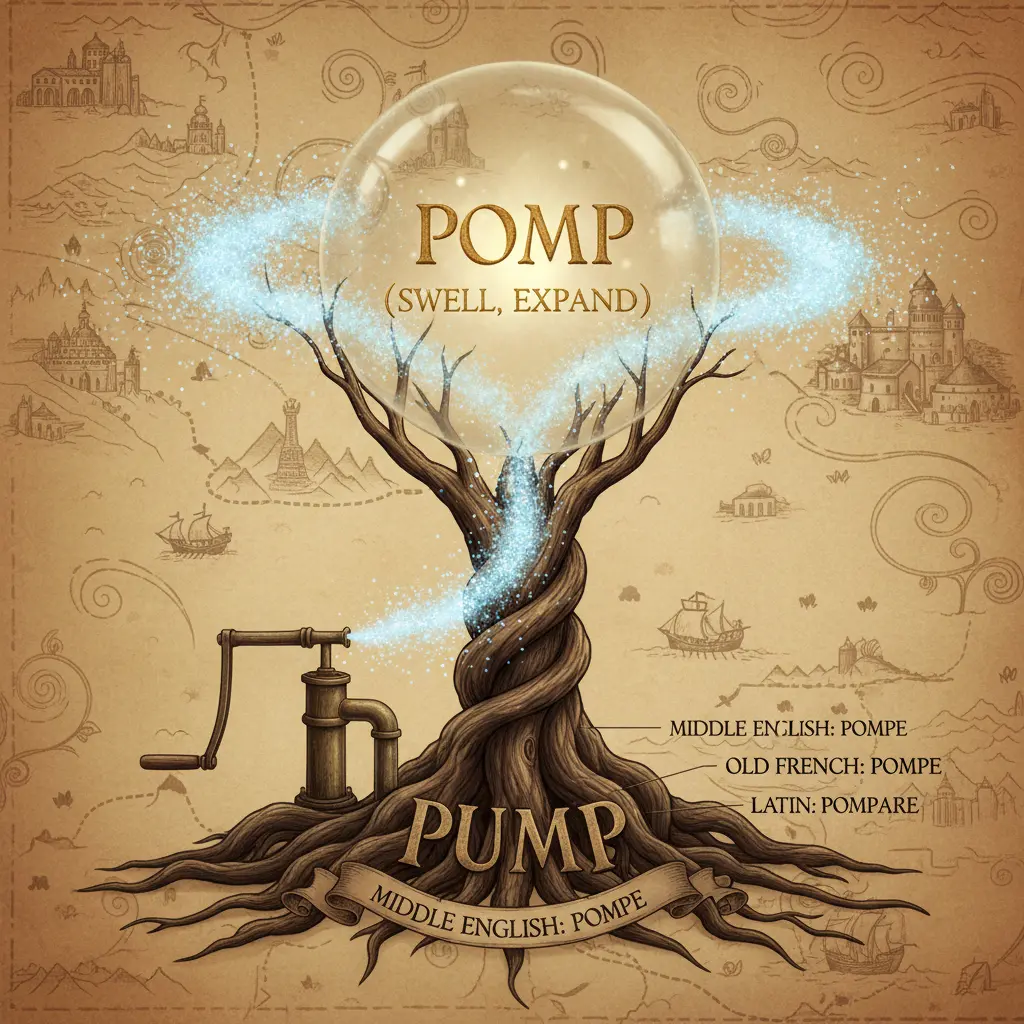
pump = a root that has uncertain origins, possibly linked to 'pomp' meaning to swell or expand. Historical origin: Middle English (from Old French 'pompe'), with further connections to Latin 'pompāre'. Memory image: Picture a balloon expanding as you pump air into it, visualizing the action of pushing air forward.
Note 1: These definitions and etymologies are not standard dictionary definitions, but extended explanations provided to help with memorization and understanding of the actual application of words. Through this background information, we strive to make words more vivid and easier to understand, and help you remember their meanings in real life.
Note 2: LexiTalk designs the learning flow around the linguistics principle of “Comprehensible Input.” When learners encounter material that is slightly above their level but still understandable from context, the brain naturally absorbs the language. That’s why we keep every word inside authentic contexts, using examples and associations to help you understand it and use it flexibly.
Read the FAQ explanation of Comprehensible InputI grip the pump handle and start to move it up and down, letting the action unfold. I pump the device a few times, watching air or liquid travel through the tube. The rhythm requires focus and a little effort, with a steady push and pull that I can feel in my arms. In real life this motion shows up when I inflate a tire, fill a balloon, or transfer liquid into a container.
Pump is a versatile word in English, functioning as both a verb and a noun. As a verb, it can mean to draw liquid through a tube or container by applying pressure, to inflate or fill with air, or to move fluids with a device. As a noun, it describes a device that moves liquids or gases, such as a water pump, a bicycle pump, or a fuel pump. You will see it in many fixed phrases, like pump up the volume, pump up the tires, or pump out the water. Some phrasal uses are idiomatic and distinctive, so learners should pay attention to context and collocations to avoid literal translations.
In English, pump is a compact, everyday word that spans technical devices and everyday actions. Learners often treat it as only an air-inflation term or only as a device name, missing its broad use in phrases like pump up the volume or pump out water. English relies on phrasal verbs and idioms to convey nuance, so context is essential.
What is the meaning of the word 'pump'?
Which sentence uses the word 'pump' correctly?
Which word is most similar to 'pump'?
What is the opposite of the word 'pump'?
Can you give an example of a real-life scenario of 'pump'?
Download LexiTalk app for personalized learning experience
Download AppCookies
We use cookies for essential site functions, analytics, and ads. You can accept, reject, or manage preferences. Privacy Policy