radios - Master This Word
Master this word with our 5-step learning method – Learn English in English
Train English Through Brain Routes, Not Translation.
This page helps you stop memorizing isolated translations and start understanding a word through its shared mental image, native-style thinking, and practical training steps.
Master this word with our 5-step learning method – Learn English in English
Example sentences are the start of understanding. Don't rush to memorize. First feel how the word works in a sentence.
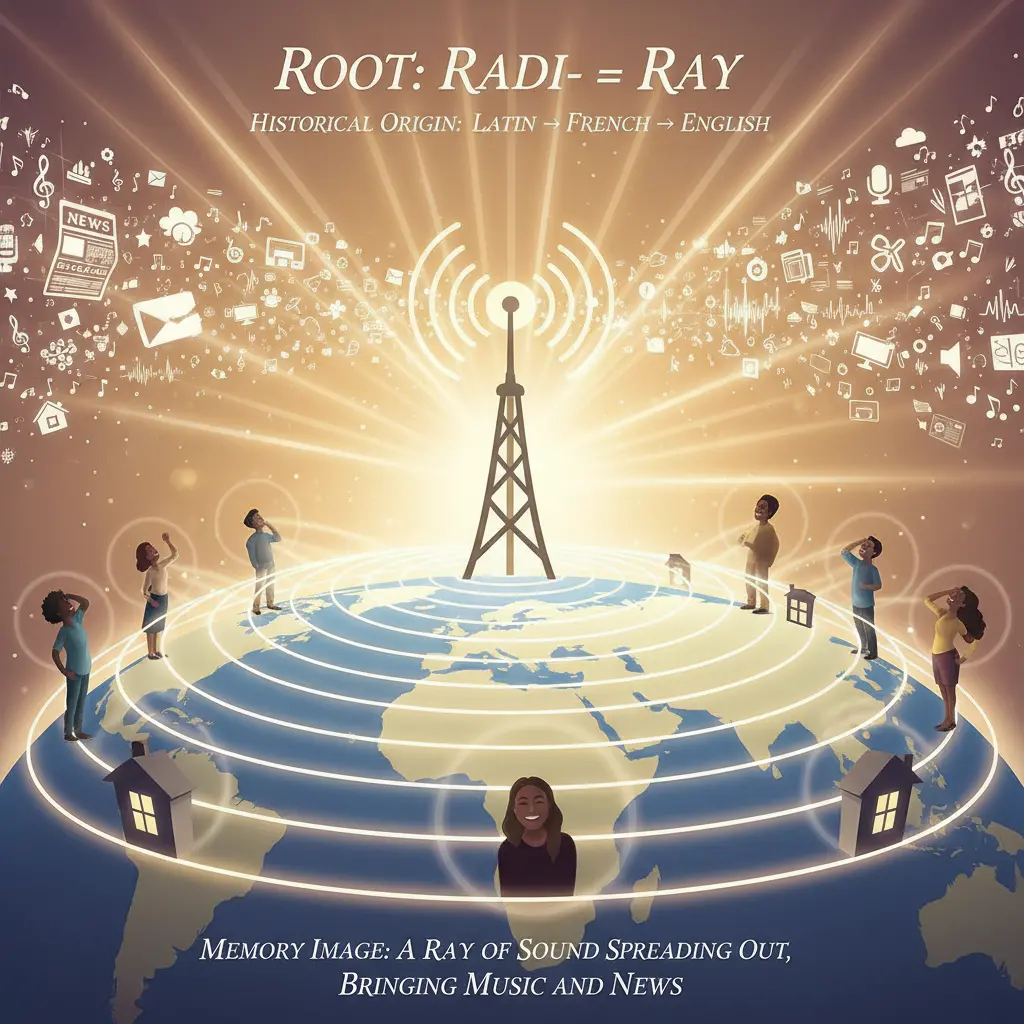
Root: radi- = ray; Historical origin: Latin → French → English; Memory image: Imagine a ray of sound spreading out through the air, bringing music and news to everyone.
Note 1: These definitions and etymologies are not standard dictionary definitions, but extended explanations provided to help with memorization and understanding of the actual application of words. Through this background information, we strive to make words more vivid and easier to understand, and help you remember their meanings in real life.
Note 2: LexiTalk designs the learning flow around the linguistics principle of “Comprehensible Input.” When learners encounter material that is slightly above their level but still understandable from context, the brain naturally absorbs the language. That’s why we keep every word inside authentic contexts, using examples and associations to help you understand it and use it flexibly.
Read the FAQ explanation of Comprehensible InputI reach for the radio, my fingers move to the dial and I turn it. A faint crackle answers, the room shifts as a station wakes up. I adjust the volume, hold my breath a moment, and decide what to keep listening to. Soon the hum becomes music or talk, and the radio feels like a small bridge to the world.
Radio is one of the oldest ubiquitous technologies in everyday life. In English, the word can mean the physical device you tune to a station, the medium that broadcasts music, news, and talk, or the act of sending information by radio waves. In practice, speakers distinguish between the radio as hardware (a receiver or radio set) and radio as a medium (radio programs). In many contexts, you can also talk about radio as a field of communication or a government or commercial service. Learners often confuse radio with television, or mix up phrases like 'listen to the radio' vs 'watch TV' when people mean media in general.
Radio in English often treats the radio as both a physical object and a broad medium, with clear distinction in phrasing; other languages may separate device and medium more explicitly, so learners sometimes confuse hardware with the medium or mix up how to refer to a station or program.
Download LexiTalk app for personalized learning experience
Download AppCookies
We use cookies for essential site functions, analytics, and ads. You can accept, reject, or manage preferences. Privacy Policy