rather - Master This Word
Master this word with our 5-step learning method – Learn English in English
Train English Through Brain Routes, Not Translation.
This page helps you stop memorizing isolated translations and start understanding a word through its shared mental image, native-style thinking, and practical training steps.
Master this word with our 5-step learning method – Learn English in English
Example sentences are the start of understanding. Don't rush to memorize. First feel how the word works in a sentence.
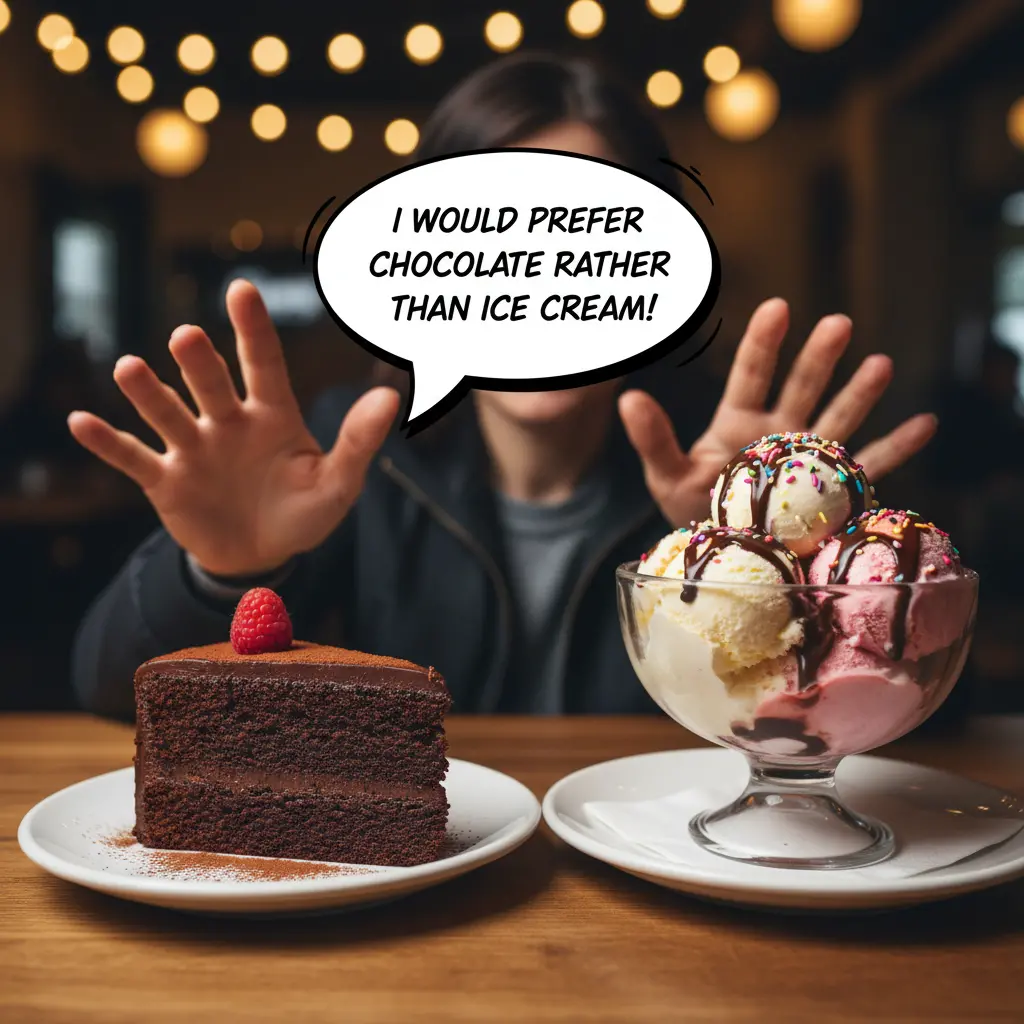
The word 'rather' consists of 'ra-', an Old English prefix meaning 'more', and 'ther', related to 'there'. Historically, it originates from Old English 'riðer', which conveys a sense of preference. Imagine someone choosing a dessert, saying 'I would prefer chocolate cake rather than ice cream', illustrating a clear choice.
Note 1: These definitions and etymologies are not standard dictionary definitions, but extended explanations provided to help with memorization and understanding of the actual application of words. Through this background information, we strive to make words more vivid and easier to understand, and help you remember their meanings in real life.
Note 2: LexiTalk designs the learning flow around the linguistics principle of “Comprehensible Input.” When learners encounter material that is slightly above their level but still understandable from context, the brain naturally absorbs the language. That’s why we keep every word inside authentic contexts, using examples and associations to help you understand it and use it flexibly.
Read the FAQ explanation of Comprehensible InputI lift the mug, move it in my hands, and feel the weight settle as I shift my grip. As the steam curls, I weigh two tiny routes in my mind and set one aside. I would rather sip slowly than gulp, so I keep the pace steady and let the moment decide. That small choice teaches me to adjust my steps, move a bit slower, and see how the day changes.
Rather is an adverb used to express a preference or to indicate that something is true to a certain degree, often softer than a direct statement of choice. It can show what you would choose in a comparison, as in I would rather stay home than go out, or I would rather have tea, please. It also signals that one option is more desirable: He would rather arrive early, if possible. In conversation, rather can modify adjectives and adverbs (much better, rather quickly) or come before a clause with would rather: I would rather you called first. Etymology: from Old English roots implying preference, historically linked to choosing one option over another. In short, use rather for measured preference, not necessity.
In English, rather is a flexible softener for preference and degree. Learners often overuse it or place it awkwardly in longer phrases; native speakers expect it to attach to the exact option or quality you prefer.
What is the meaning of the word 'rather'?
How is 'rather' used in a sentence?
Which word is the opposite of 'rather'?
In what real-life context would you most likely hear the word 'rather'?
Can you use the word 'rather' in a sentence?
Download LexiTalk app for personalized learning experience
Download AppCookies
We use cookies for essential site functions, analytics, and ads. You can accept, reject, or manage preferences. Privacy Policy