remote - Master This Word
Master this word with our 5-step learning method – Learn English in English
Train English Through Brain Routes, Not Translation.
This page helps you stop memorizing isolated translations and start understanding a word through its shared mental image, native-style thinking, and practical training steps.
Master this word with our 5-step learning method – Learn English in English
Example sentences are the start of understanding. Don't rush to memorize. First feel how the word works in a sentence.
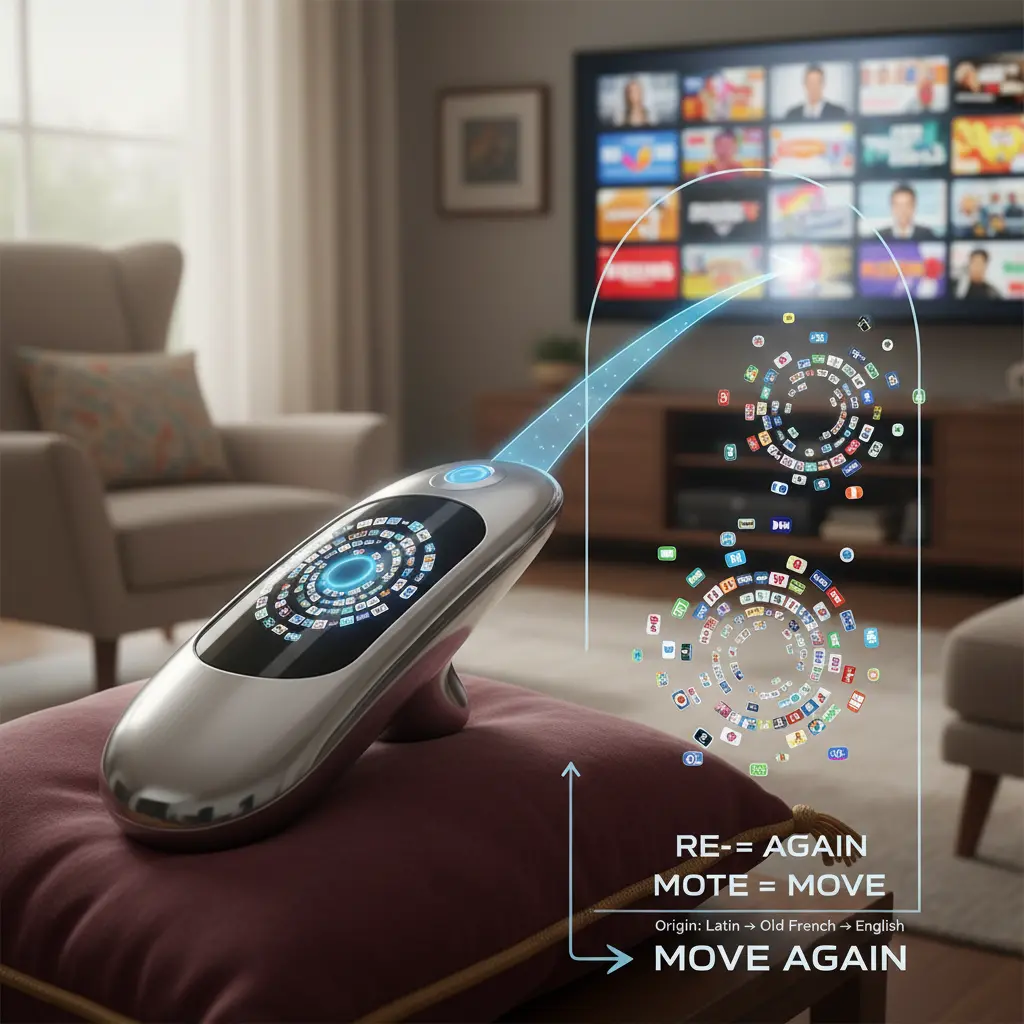
re- = again + mote = move (from Latin 'movere'). Origin: Latin → Old French → English. Visualize a remote control, allowing you to 'move again' through channels without getting up.
Note 1: These definitions and etymologies are not standard dictionary definitions, but extended explanations provided to help with memorization and understanding of the actual application of words. Through this background information, we strive to make words more vivid and easier to understand, and help you remember their meanings in real life.
Note 2: LexiTalk designs the learning flow around the linguistics principle of “Comprehensible Input.” When learners encounter material that is slightly above their level but still understandable from context, the brain naturally absorbs the language. That’s why we keep every word inside authentic contexts, using examples and associations to help you understand it and use it flexibly.
Read the FAQ explanation of Comprehensible InputFirst I reach for the remote, my fingers finding its cool shape. I push a button and shift my wrist to aim the glow toward the TV. I adjust my chair a touch so the screen stays in view as the scene changes. The sense of control grows as I keep the moment close, as if distance itself could be managed with a gentle turn of the hand.
Remote describes something far away in space or time, or something operated from a distance. It often refers to places that are physically distant, such as a remote island, or to processes that occur without close proximity, like remote work or remote sensing. As a noun, remote commonly appears in compounds like remote control or remote access, a device or capability that lets you act from afar. Students should note that remote is an adjective and usually precedes the noun (a remote location) or follows a linking verb (The location is remote). The adverb form is remotely. Learners often confuse remote with far or distant, and may overuse the word in everyday contexts.
In English, remote commonly marks spatial distance or distance in time, and also tech contexts like remote control. Learners often treat it as a generic synonym for far, which hides its nuance in tech phrases and fixed collocations like remote work or remote sensing.
What is the meaning of the word 'remote'?
In which of the following sentences is 'remote' used correctly?
Which word is similar to 'remote'?
What is the opposite of 'remote'?
In what context would you use the word 'remote'?
Technology & Social Media
Listen NowDownload LexiTalk app for personalized learning experience
Download AppCookies
We use cookies for essential site functions, analytics, and ads. You can accept, reject, or manage preferences. Privacy Policy