
reproduction - Master This Word
Master this word with our 5-step learning method – Learn English in English
Train English Through Brain Routes, Not Translation.
This page helps you stop memorizing isolated translations and start understanding a word through its shared mental image, native-style thinking, and practical training steps.
Master this word with our 5-step learning method – Learn English in English
Example sentences are the start of understanding. Don't rush to memorize. First feel how the word works in a sentence.
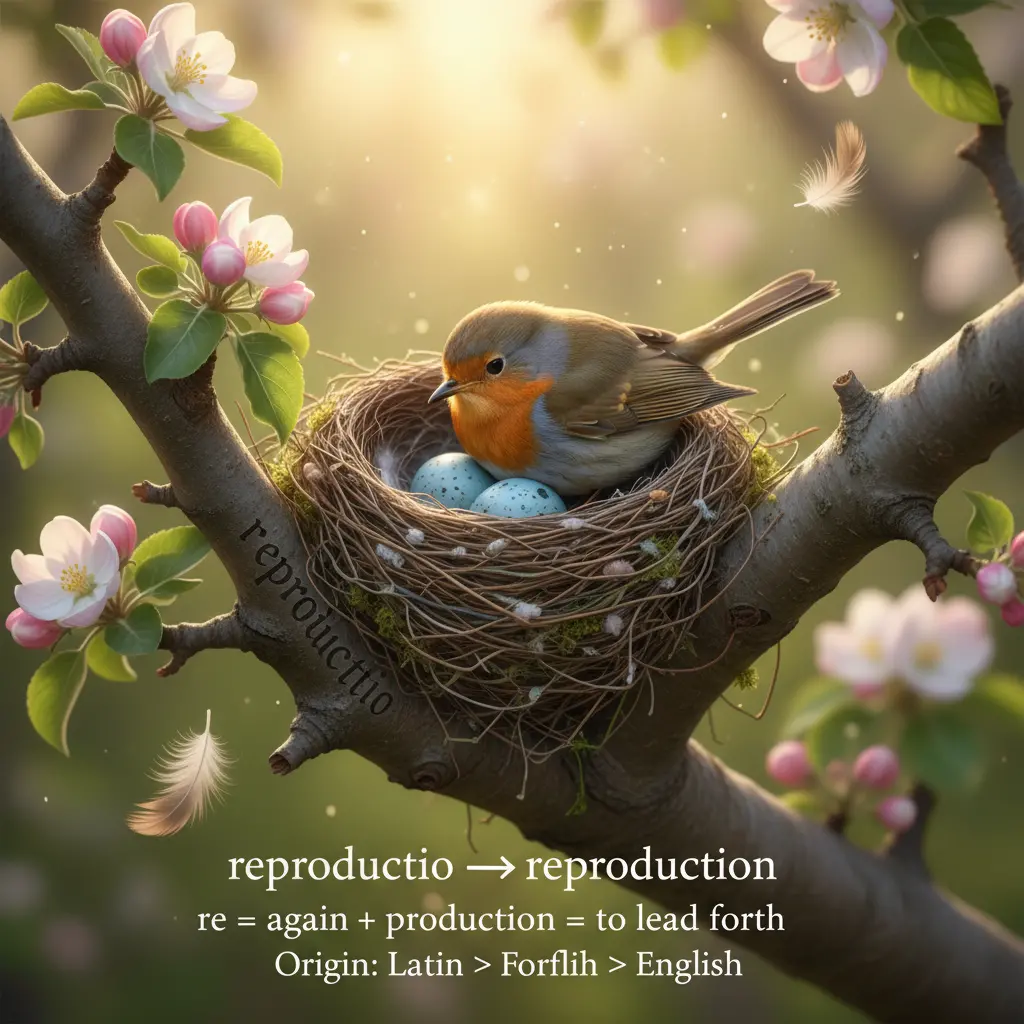
re- = again + production = to lead forth. Originated from Latin 'reproductio' through Old French to English. Imagine a mother bird returning to her nest to hatch her eggs again, symbolizing the cycle of life and creation.
Note 1: These definitions and etymologies are not standard dictionary definitions, but extended explanations provided to help with memorization and understanding of the actual application of words. Through this background information, we strive to make words more vivid and easier to understand, and help you remember their meanings in real life.
Note 2: LexiTalk designs the learning flow around the linguistics principle of “Comprehensible Input.” When learners encounter material that is slightly above their level but still understandable from context, the brain naturally absorbs the language. That’s why we keep every word inside authentic contexts, using examples and associations to help you understand it and use it flexibly.
Read the FAQ explanation of Comprehensible InputI adjust the copier, push the start, and watch the page glide through, a new sheet slipping out like a twin. The hum fills the room as I hold the edge, noticing how a small change at the start makes the copy look different. I keep the rhythm steady, shift my grip, and set the two pages side by side to see how one mirrors the other. Later, in a garden, a seed shifts, a bud changes, and life seems to repeat itself in quiet, patient steps.
Reproduction has several common meanings in English. It can mean the act of making copies of something, as when printers produce prints or a museum creates a replica of an artifact. It also describes the biological process by which living beings generate offspring and pass on genes to the next generation. In cultural contexts, reproduction can refer to the reproduction of a work of art or music, or to the reproduction of texts and ideas across time. Learners should note the distinction between replica and reproduction, and be mindful of contexts like biology, literature, and media where the word is used differently.
English commonly separates reproduction into biological and copying senses, and learners must note subtle distinctions across fields; mistakes often arise from thinking of reproduction only as art or only as biology.
What is the meaning of the word 'reproduction'?
In which of the following sentences is the word 'reproduction' used correctly?
Which word is an antonym of 'reproduction'?
In which real-life context is 'reproduction' most commonly used?
Reflect on why understanding 'reproduction' is important and how it impacts various fields.
Download LexiTalk app for personalized learning experience
Download AppCookies
We use cookies for essential site functions, analytics, and ads. You can accept, reject, or manage preferences. Privacy Policy