scheduled - Master This Word
Master this word with our 5-step learning method – Learn English in English
Train English Through Brain Routes, Not Translation.
This page helps you stop memorizing isolated translations and start understanding a word through its shared mental image, native-style thinking, and practical training steps.
Master this word with our 5-step learning method – Learn English in English
Example sentences are the start of understanding. Don't rush to memorize. First feel how the word works in a sentence.
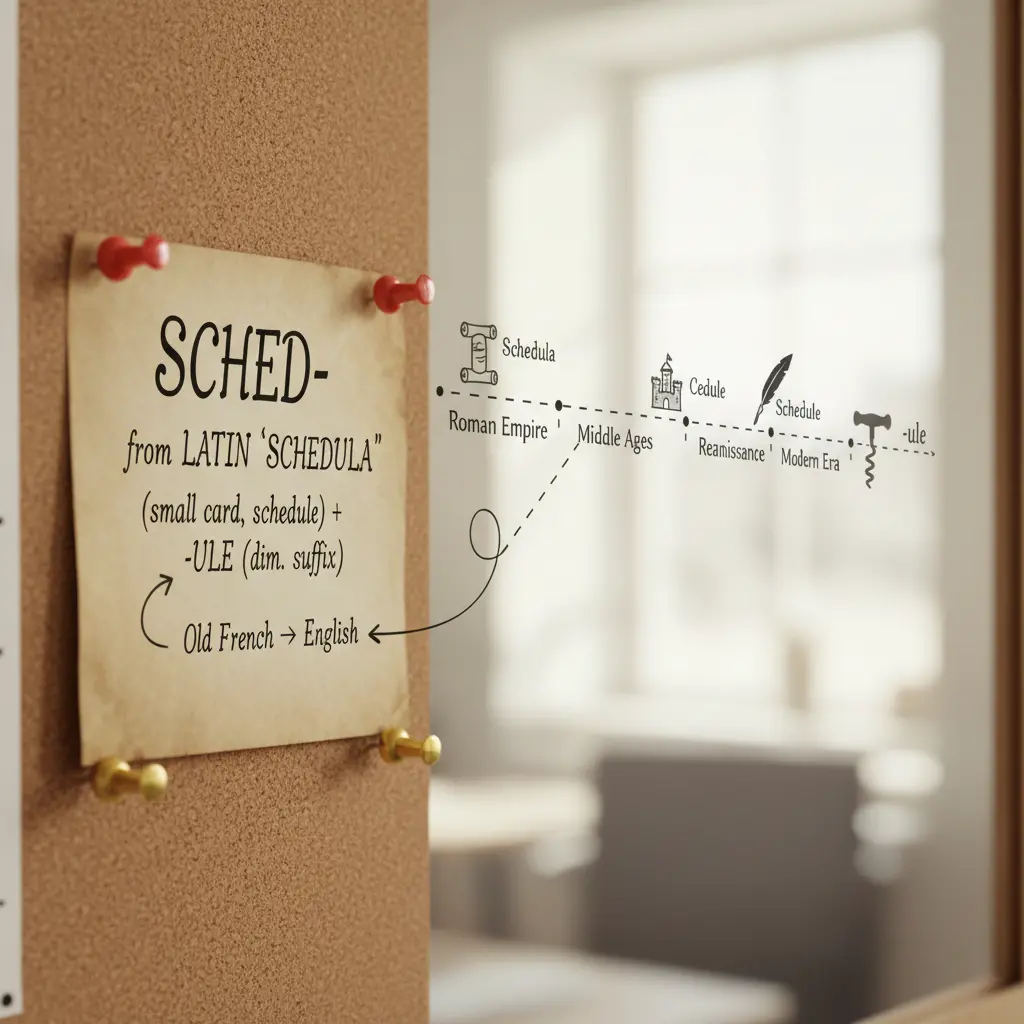
Sched- from Latin 'schedula' (small card, schedule) + -ule (diminutive suffix), originating from Latin through Old French into English. Imagine a small card pinned on a board with a timeline and events mapped out, like a project board.
Note 1: These definitions and etymologies are not standard dictionary definitions, but extended explanations provided to help with memorization and understanding of the actual application of words. Through this background information, we strive to make words more vivid and easier to understand, and help you remember their meanings in real life.
Note 2: LexiTalk designs the learning flow around the linguistics principle of “Comprehensible Input.” When learners encounter material that is slightly above their level but still understandable from context, the brain naturally absorbs the language. That’s why we keep every word inside authentic contexts, using examples and associations to help you understand it and use it flexibly.
Read the FAQ explanation of Comprehensible InputI reach for my notebook and pull out a clean page. I move the clock in my mind, nudging the times I must keep. I shift things around, deciding what must happen first and what can wait, and it feels like tuning a small instrument. As I place tasks next to days, I sense control growing; this is how a plan starts to feel real, a schedule that guides what I do next.
Schedule refers to a plan for carrying out a process or sequence of events, a timetable listing times and activities, or the act of arranging a time for something. It is both a noun and a verb. As a noun, it means a calendar-like list of tasks and deadlines; as a verb, it means to set a time for an event or to arrange activities. Learners often confuse the pronunciation and spelling in different dialects, and they may choose synonyms like plan or program in contexts where schedule implies a formal timeline. In daily life, you might check a work schedule, class schedule, or travel schedule to stay organized.
Think of schedule as a dual tool that covers both planning and booking; learners often default to plan or timetable and mix contexts between formal and informal use.
What is the meaning of the word 'scheduled'?
In which of the following sentences is 'scheduled' used correctly?
Which word is a synonym of 'scheduled'?
What is the opposite meaning of 'scheduled'?
How do airlines use the word 'scheduled' in their operations?
Download LexiTalk app for personalized learning experience
Download AppCookies
We use cookies for essential site functions, analytics, and ads. You can accept, reject, or manage preferences. Privacy Policy