
simulate - Master This Word
Master this word with our 5-step learning method – Learn English in English
Train English Through Brain Routes, Not Translation.
This page helps you stop memorizing isolated translations and start understanding a word through its shared mental image, native-style thinking, and practical training steps.
Master this word with our 5-step learning method – Learn English in English
Example sentences are the start of understanding. Don't rush to memorize. First feel how the word works in a sentence.
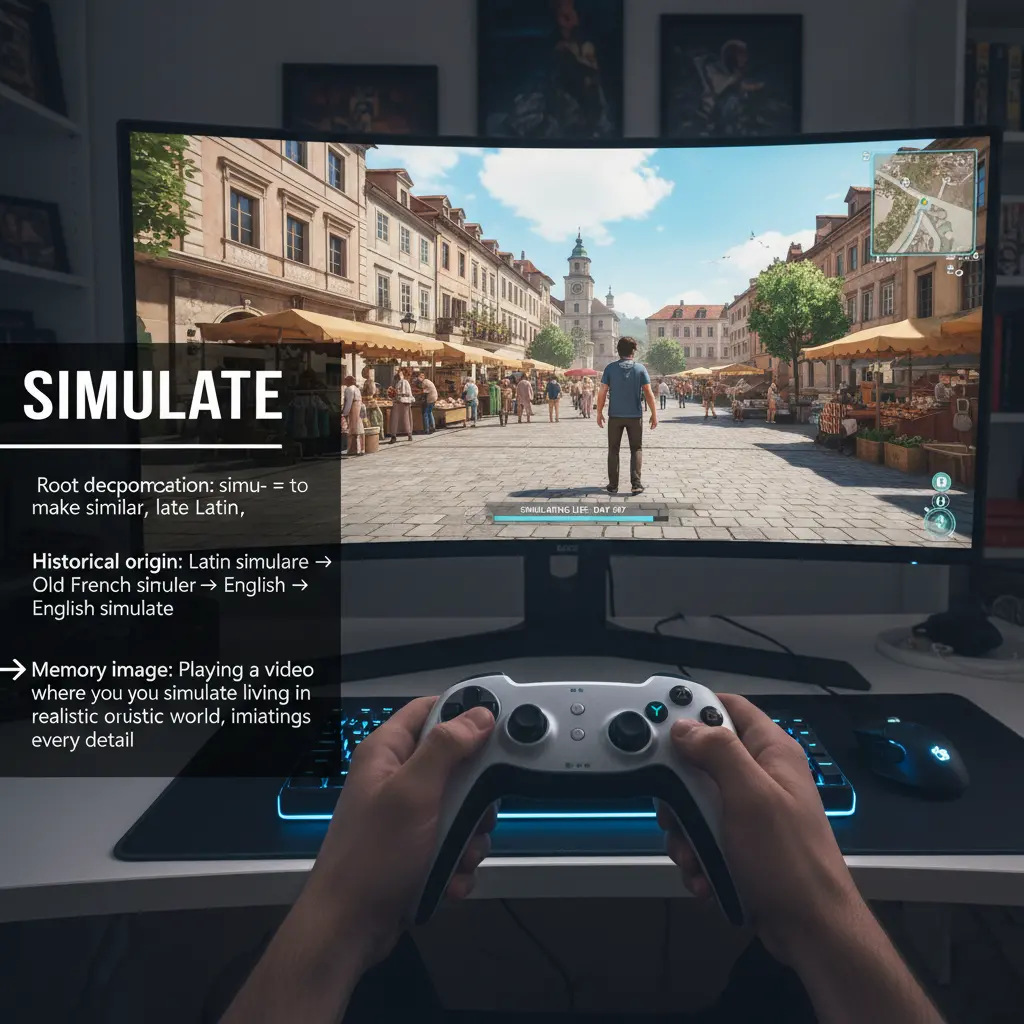
Root decomposition: simu- = to make similar, late Latin. Historical origin: Latin simulare → Old French simuler → English simulate. Memory image: Picture yourself playing a video game where you simulate living in a realistic world, imitating every detail.
Note 1: These definitions and etymologies are not standard dictionary definitions, but extended explanations provided to help with memorization and understanding of the actual application of words. Through this background information, we strive to make words more vivid and easier to understand, and help you remember their meanings in real life.
Note 2: LexiTalk designs the learning flow around the linguistics principle of “Comprehensible Input.” When learners encounter material that is slightly above their level but still understandable from context, the brain naturally absorbs the language. That’s why we keep every word inside authentic contexts, using examples and associations to help you understand it and use it flexibly.
Read the FAQ explanation of Comprehensible InputI rest my hand on the desk and set a small dial to start. I move the knobs, push and pull, and try to simulate a simple scene. The display changes and my grip tightens a little as I adjust, keeping the flow going. With each tweak, meaning grows not from rules but from how close the picture feels to real life.
Simulate means to create a model or imitation of a process or situation so you can study, test, or train with it. It also can refer to performing a model of something, such as a computer simulation or a physical replica, to predict how it will behave under different conditions. In everyday use, simulate often applies to scenarios, data, or environments rather than people. It carries a sense of repetition and control, rather than mere pretense. Learners should note that you simulate something to analyze or explore it, not to pretend in a casual way. Common collocations include simulate a scenario, simulate the system, or simulate results.
Explain to an English speaker (meta, short): Simulate in English often centers on building a model for analysis and prediction; learners should watch out for collocations like simulate a scenario and simulate data, and distinguish it from imitate, which is about copying appearance or behavior.
What is the meaning of 'simulate'?
Which sentence uses 'simulate' correctly?
What is a synonym for 'simulate'?
What is an antonym for 'simulate'?
In what real-life scenario would someone simulate something?
Download LexiTalk app for personalized learning experience
Download AppCookies
We use cookies for essential site functions, analytics, and ads. You can accept, reject, or manage preferences. Privacy Policy