stare - Master This Word
Master this word with our 5-step learning method – Learn English in English
Train English Through Brain Routes, Not Translation.
This page helps you stop memorizing isolated translations and start understanding a word through its shared mental image, native-style thinking, and practical training steps.
Master this word with our 5-step learning method – Learn English in English
Example sentences are the start of understanding. Don't rush to memorize. First feel how the word works in a sentence.
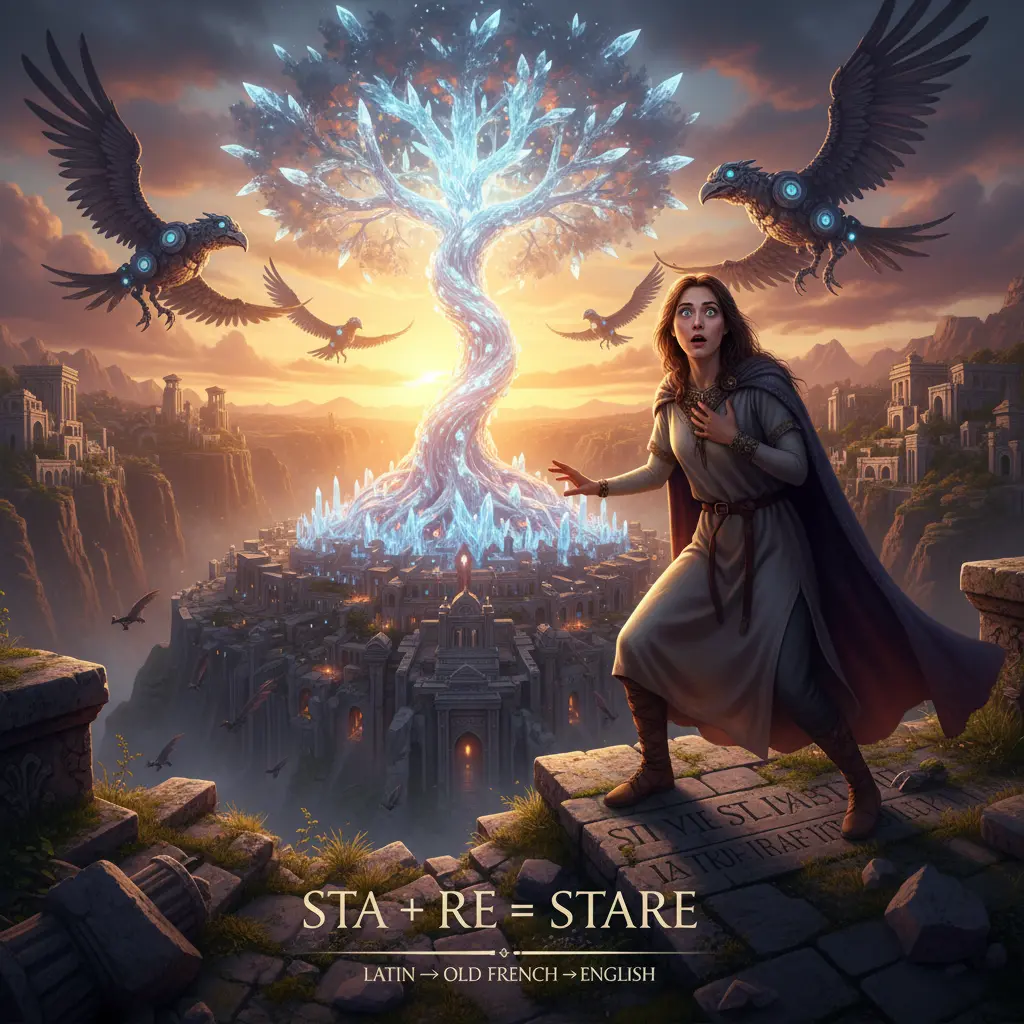
Root decomposition: 'sta' (to stand) + 're'; Historical origin: Latin → Old French → English; Memory image: Picture a person standing with their eyes wide open, fixed on something astonishing ahead.
Note 1: These definitions and etymologies are not standard dictionary definitions, but extended explanations provided to help with memorization and understanding of the actual application of words. Through this background information, we strive to make words more vivid and easier to understand, and help you remember their meanings in real life.
Note 2: LexiTalk designs the learning flow around the linguistics principle of “Comprehensible Input.” When learners encounter material that is slightly above their level but still understandable from context, the brain naturally absorbs the language. That’s why we keep every word inside authentic contexts, using examples and associations to help you understand it and use it flexibly.
Read the FAQ explanation of Comprehensible InputI settle into my chair, lift my chin, and move my eyes to the person across the street. I hold the stare a beat longer, letting my gaze stay fixed as thoughts race and settle. The room seems to tighten; I feel the control of my own attention and decide when to turn away. In real life, that lived moment of looking becomes a way to show emphasis or challenge without saying a word.
Stare is a strong verb that means to look fixedly at something or someone for an extended moment, often with intensity or curiosity. It covers plain focused looking (to stare at the painting), a surprised or shocked look (she stared in astonishment), and even a confrontational sense when someone regards another with a bold, unwavering gaze (the detective stared him down). Learn its separable form 'stare down' (to intimidate by sustained eye contact) and related phrases like 'stare into space' (looking with little perception). The word implies duration and attention rather than a quick glance, and it can be impolite in the wrong context.
For English learners, stare often conveys a longer, more intense look than a simple glance. Native speakers native-level use can imply emotion (surprise, anger, determination) or social tension (staring someone down). Learners often over-generalize to any look; remember 'stare at' is typically with a direct object and can be awkward with polite listeners. In some contexts, 'stare' can sound aggressive, so choose softer verbs like 'gaze' or 'look' when the social mood is neutral or friendly.
What is the meaning of the word 'stare'?
Choose the sentence where 'stare' is used correctly:
Which word is most similar to 'stare'?
What is the opposite of 'stare'?
Can you think of a real-life scenario of 'stare'?
Download LexiTalk app for personalized learning experience
Download AppCookies
We use cookies for essential site functions, analytics, and ads. You can accept, reject, or manage preferences. Privacy Policy