startled - Master This Word
Master this word with our 5-step learning method – Learn English in English
Train English Through Brain Routes, Not Translation.
This page helps you stop memorizing isolated translations and start understanding a word through its shared mental image, native-style thinking, and practical training steps.
Master this word with our 5-step learning method – Learn English in English
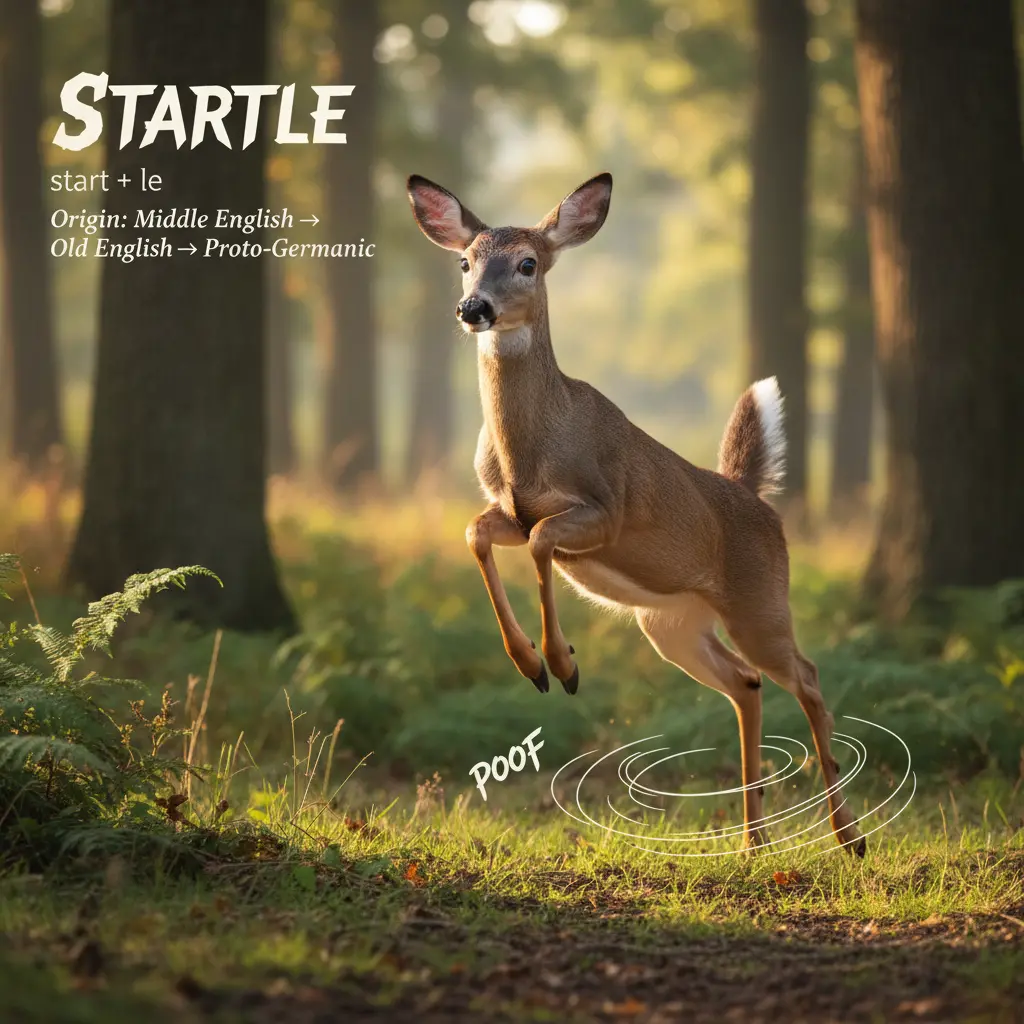
Example sentences are the start of understanding. Don't rush to memorize. First feel how the word works in a sentence.
startle = start + le; 'start' relates to suddenly moving, 'le' is a diminutive; Origin: Middle English → Old English → Proto-Germanic; Imagine a deer suddenly ‘starting’ and jumping, surprised by a noise.
Note 1: These definitions and etymologies are not standard dictionary definitions, but extended explanations provided to help with memorization and understanding of the actual application of words. Through this background information, we strive to make words more vivid and easier to understand, and help you remember their meanings in real life.
Note 2: LexiTalk designs the learning flow around the linguistics principle of “Comprehensible Input.” When learners encounter material that is slightly above their level but still understandable from context, the brain naturally absorbs the language. That’s why we keep every word inside authentic contexts, using examples and associations to help you understand it and use it flexibly.
Read the FAQ explanation of Comprehensible InputStartle is a quick, involuntary reaction to something surprising or frightening. In everyday English it covers three related ideas: a sudden surprise that catches someone off guard, a brief scare that momentarily startles a person, and an automatic jump or flinch when a loud noise or abrupt motion occurs nearby. You can say The sudden shout started her, The loud bang startled him, or The dog was startled by the doorbell. Startle emphasizes immediacy and intensity of the reaction, not a lasting fear. It is transitive: you startle someone; you do not use startle to describe your own calm state. The etymology links startle to start + le, with 'start' referring to sudden movement and 'le' a diminutive; origins go back to Middle English, Old English, and Proto-Germanic.
English relies on a sharp, physical sense of a jump or flinch; learners should separate startle (a quick action) from surprise (an internal feeling) and from scare (a stronger emotion). In many languages the equivalent is a general word for surprise, so learners must add be startled by or startle someone to show the transitive nuance.
What is the meaning of 'startled'?
Which of the following sentences uses 'startled' correctly?
What is a synonym for 'startled'?
What is an antonym for 'startled'?
Can you think of a real-life situation where someone might feel startled?
Download LexiTalk app for personalized learning experience
Download AppCookies
We use cookies for essential site functions, analytics, and ads. You can accept, reject, or manage preferences. Privacy Policy