
subsequently - Master This Word
Master this word with our 5-step learning method – Learn English in English
Train English Through Brain Routes, Not Translation.
This page helps you stop memorizing isolated translations and start understanding a word through its shared mental image, native-style thinking, and practical training steps.
Master this word with our 5-step learning method – Learn English in English
Example sentences are the start of understanding. Don't rush to memorize. First feel how the word works in a sentence.
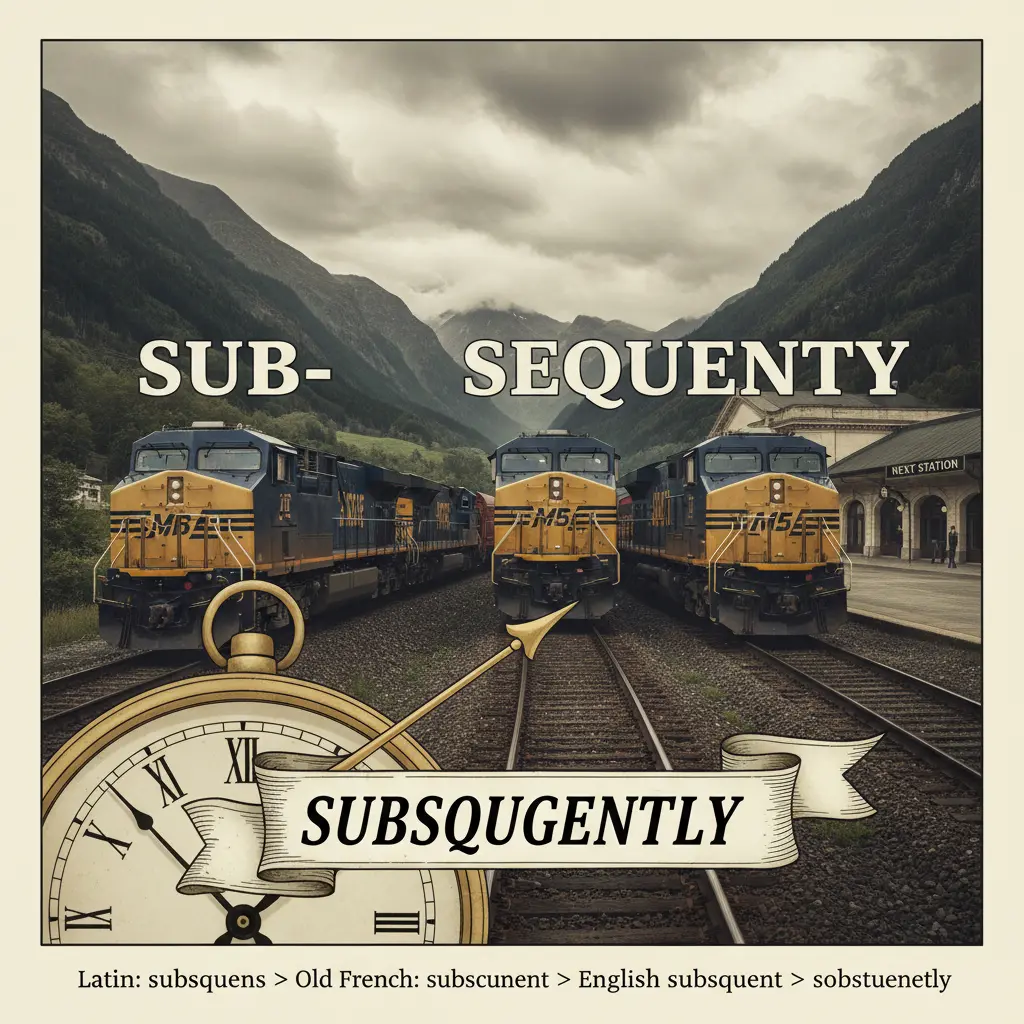
(a) Root decomposition: sub- prefix + sequ- root from Latin sequi 'to follow', with -ent forming the adjective and -ly forming the adverb. (b) Historical origin: Latin subsequens 'following', via Old French subsequent, into English as subsequent and then subsequently. (c) Memory image: imagine a train closely following another, then arriving at the next station.
Note 1: These definitions and etymologies are not standard dictionary definitions, but extended explanations provided to help with memorization and understanding of the actual application of words. Through this background information, we strive to make words more vivid and easier to understand, and help you remember their meanings in real life.
Note 2: LexiTalk designs the learning flow around the linguistics principle of “Comprehensible Input.” When learners encounter material that is slightly above their level but still understandable from context, the brain naturally absorbs the language. That’s why we keep every word inside authentic contexts, using examples and associations to help you understand it and use it flexibly.
Read the FAQ explanation of Comprehensible InputI push the door open, then move into the hallway as the light shifts with the morning. I adjust my pace, place a hand on the wall to steady myself, and keep walking toward the kitchen. When the timer rings, I change direction a bit and turn toward the schedule, letting the moment set what comes next. Subsequently, I carry on with the task, feeling how the steps after this one grow from what I just did.
Subsequently is a formal adverb used to describe events that occur after something else in time. In narrative or analytical writing it helps sequence steps or consequences without repeating already stated information. It often follows a clause about an earlier event, and it signals a logical flow from one stage to the next. Because it is relatively formal, you will see it in reports, academic articles, legal texts, or business plans. It can appear at the beginning of a sentence or after a semicolon. Remember that subsequent events are not simultaneous; they occur after the referenced moment, and the adverb emphasizes chronology and causality rather than immediacy.
Subsequently is a marker of formal, written flow in English. Learners may overuse it in casual speech or replace it with 'then' or 'later', which can weaken the tone. It often pairs with past events and a clear chronology, so misuse happens when timing is fuzzy or when the writer wants immediacy rather than sequence.
What is the meaning of the word 'subsequently'?
Which of the following sentences uses 'subsequently' correctly?
What is a synonym for 'subsequently'?
What is an opposite word for 'subsequently'?
How would you use 'subsequently' in a real-life context?
Download LexiTalk app for personalized learning experience
Download AppCookies
We use cookies for essential site functions, analytics, and ads. You can accept, reject, or manage preferences. Privacy Policy