
suffrage - Master This Word
Master this word with our 5-step learning method – Learn English in English
Train English Through Brain Routes, Not Translation.
This page helps you stop memorizing isolated translations and start understanding a word through its shared mental image, native-style thinking, and practical training steps.
Master this word with our 5-step learning method – Learn English in English
Example sentences are the start of understanding. Don't rush to memorize. First feel how the word works in a sentence.
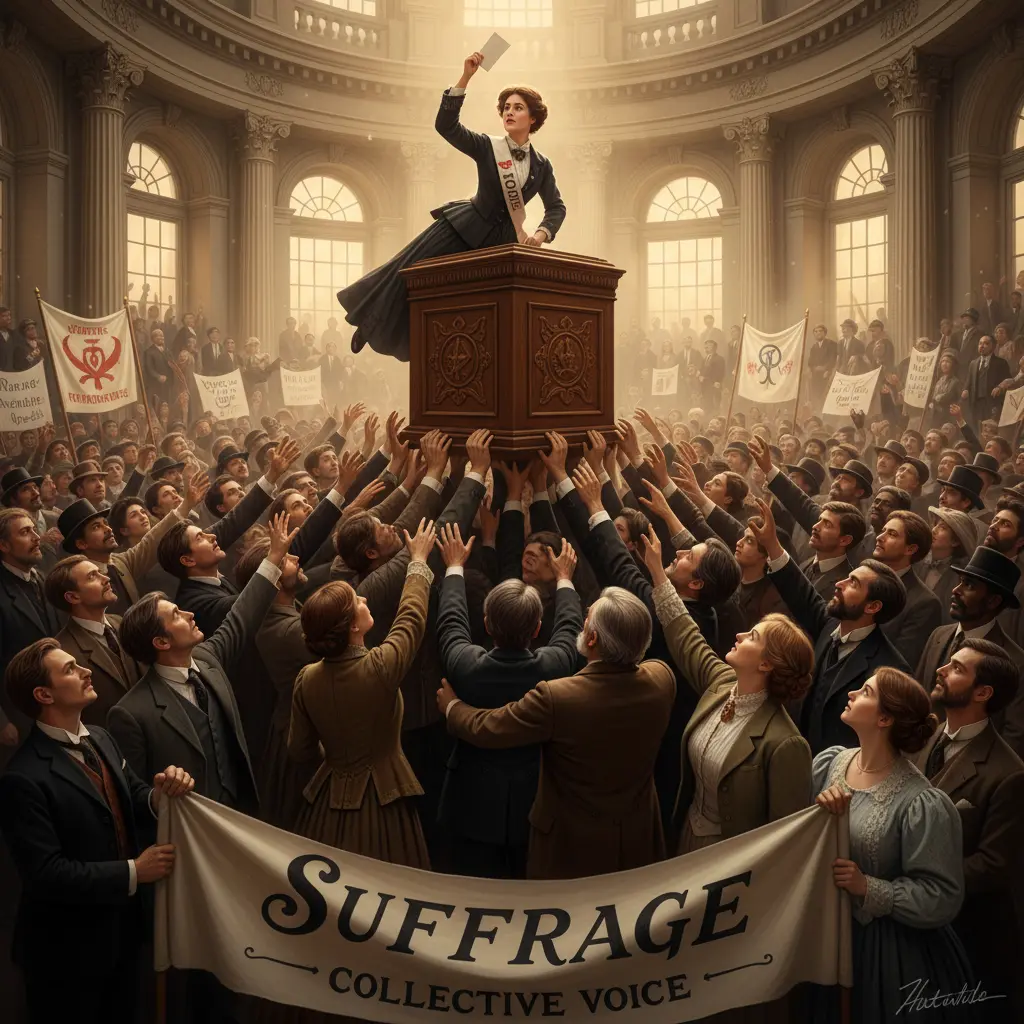
The word 'suffrage' comes from the Latin 'suffragium', composed of 'sub-' meaning 'under' and 'frangere' meaning 'to break' or 'to vote'. It evolved through Old French to English. Imagine a crowd lifting a person up to the ballot box, symbolizing their collective power to make a choice - this image evokes suffrage as a vital collective voice in democracy.
Note 1: These definitions and etymologies are not standard dictionary definitions, but extended explanations provided to help with memorization and understanding of the actual application of words. Through this background information, we strive to make words more vivid and easier to understand, and help you remember their meanings in real life.
Note 2: LexiTalk designs the learning flow around the linguistics principle of “Comprehensible Input.” When learners encounter material that is slightly above their level but still understandable from context, the brain naturally absorbs the language. That’s why we keep every word inside authentic contexts, using examples and associations to help you understand it and use it flexibly.
Read the FAQ explanation of Comprehensible InputSuffrage refers to the right to vote in elections, or to express an opinion on governance through voting. It also captures the broader notion of political voice within a democracy, including participation in public decisions and campaigns. Historically, suffrage has been expanded through reform movements that challenged restrictions based on property, gender, race, or age, making voting more inclusive. The term emphasizes collective power exercised by eligible voters to shape policy and leadership. While the precise legal criteria for suffrage vary by country, the idea remains central to discussions of democracy, equality, and citizen participation in public life.
In English, suffrage is often framed as both a legal entitlement and a historical movement, which learners may confuse with simply casting a vote or with contemporary political debates. Focus on the distinction between 'the right to vote' (suffrage) and 'the act of voting' (to vote).
What is the definition of 'suffrage'?
Choose the sentence that correctly uses the word 'suffrage'.
Which word is most similar to 'suffrage'?
What is the opposite of 'suffrage'?
Can you think of a real-life context in which suffrage applies?
Download LexiTalk app for personalized learning experience
Download AppCookies
We use cookies for essential site functions, analytics, and ads. You can accept, reject, or manage preferences. Privacy Policy