television - Master This Word
Master this word with our 5-step learning method – Learn English in English
Train English Through Brain Routes, Not Translation.
This page helps you stop memorizing isolated translations and start understanding a word through its shared mental image, native-style thinking, and practical training steps.
Master this word with our 5-step learning method – Learn English in English
Example sentences are the start of understanding. Don't rush to memorize. First feel how the word works in a sentence.
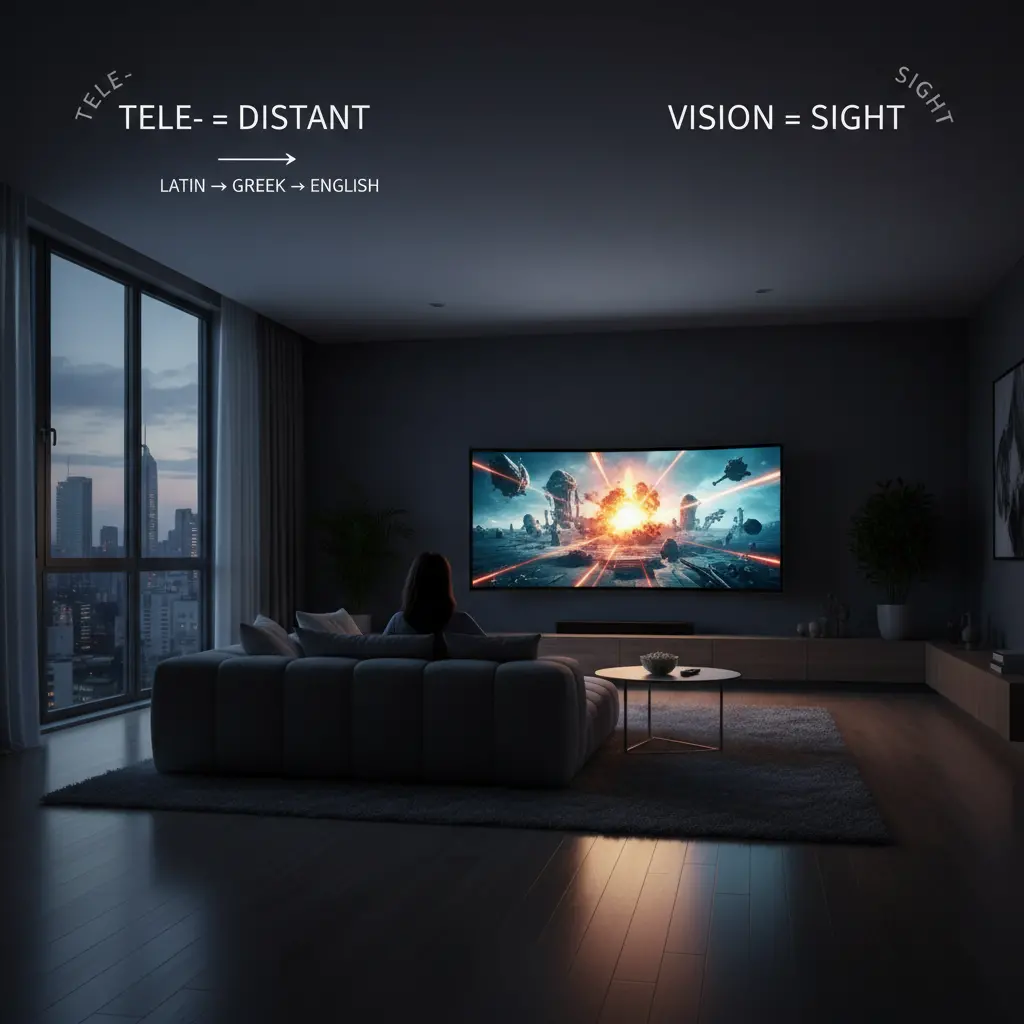
tele- = distant, vision = sight; Latin → Greek → English. Imagine sitting at a distance and watching your favorite show on a screen.
Note 1: These definitions and etymologies are not standard dictionary definitions, but extended explanations provided to help with memorization and understanding of the actual application of words. Through this background information, we strive to make words more vivid and easier to understand, and help you remember their meanings in real life.
Note 2: LexiTalk designs the learning flow around the linguistics principle of “Comprehensible Input.” When learners encounter material that is slightly above their level but still understandable from context, the brain naturally absorbs the language. That’s why we keep every word inside authentic contexts, using examples and associations to help you understand it and use it flexibly.
Read the FAQ explanation of Comprehensible InputI reach for the remote, press a button, and the screen glows to life. The image shifts as I adjust the channel, and the room fills with light and sound. I feel the effort of choosing, a small tug of attention, as I set the scene I want to watch. Television stops being a lump of plastic and becomes a window I keep turning toward, letting stories, news, or jokes shape my evening.
Television is a noun that can refer to a physical television set that receives broadcast signals and displays them as moving pictures with sound, often simply called a TV. It also means the medium or industry of broadcasting entertainment and news, and more generally the system of transmitting visual images and sound to screens around the world. In everyday English, people say 'watch television' or 'watch a TV show' rather than 'watch the television'. With digital and streaming platforms, the line between traditional television and online video has blurred, but many sentences still contrast 'television' with 'streaming'. Learners should note that 'television' is more formal; the plural is rarely used to refer to programs.
English speakers often treat television as both a device and the broad medium, but many other languages encode this with distinct terms for the hardware versus the medium, which can lead to mixups in learners when switching contexts.
What is the best definition of 'television'?
Which sentence uses 'television' correctly?
Which word is most similar in meaning to 'television'?
Which word is the best contrasting medium to 'television'?
Which of these real-life scenarios correctly describes when you would use a television?
Download LexiTalk app for personalized learning experience
Download AppCookies
We use cookies for essential site functions, analytics, and ads. You can accept, reject, or manage preferences. Privacy Policy