
tempt - Master This Word
Master this word with our 5-step learning method – Learn English in English
Train English Through Brain Routes, Not Translation.
This page helps you stop memorizing isolated translations and start understanding a word through its shared mental image, native-style thinking, and practical training steps.
Master this word with our 5-step learning method – Learn English in English
Example sentences are the start of understanding. Don't rush to memorize. First feel how the word works in a sentence.
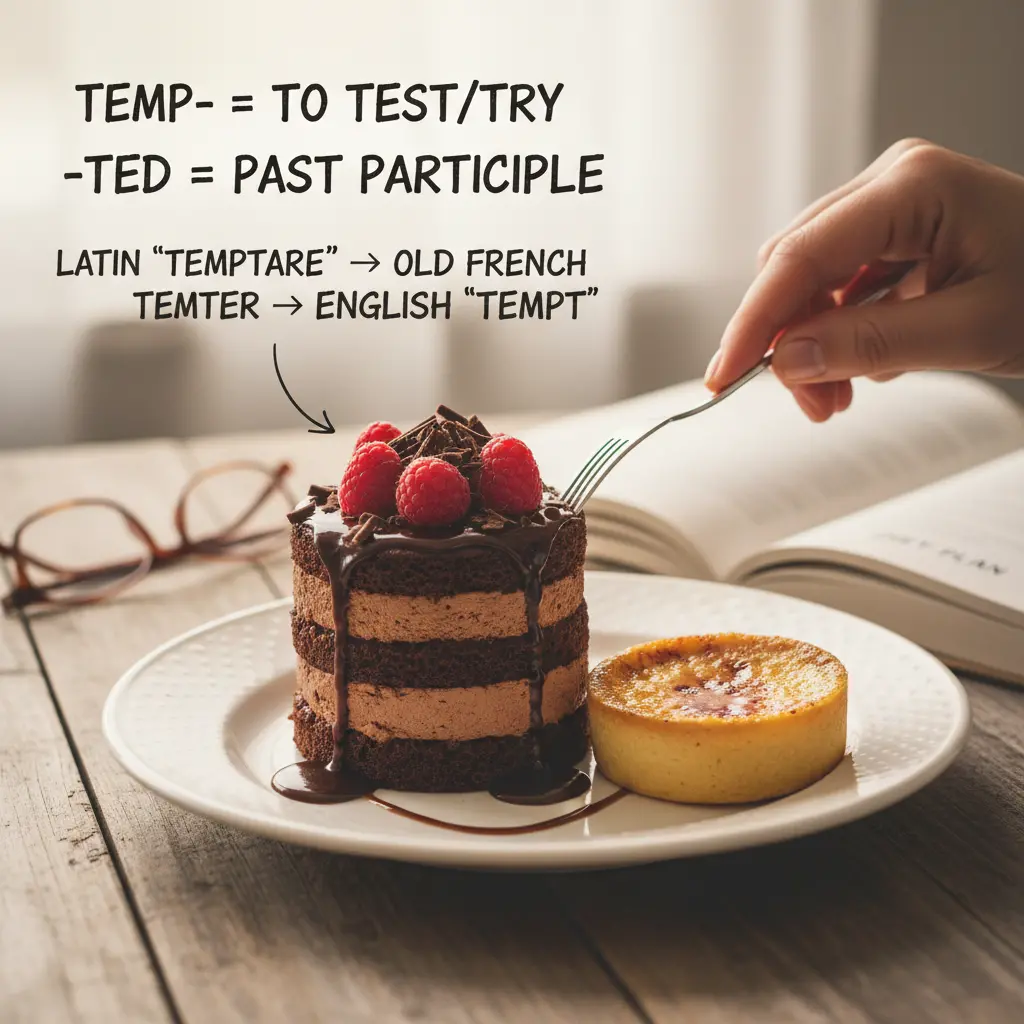
Root decomposition: temp- = to test/try, -ted = past participle. Historical origin: Latin 'temptare' → Old French 'temter' → English 'tempt'. Memory image: Picture a delicious dessert on a table, tempting you to taste it, even if you’re on a diet.
Note 1: These definitions and etymologies are not standard dictionary definitions, but extended explanations provided to help with memorization and understanding of the actual application of words. Through this background information, we strive to make words more vivid and easier to understand, and help you remember their meanings in real life.
Note 2: LexiTalk designs the learning flow around the linguistics principle of “Comprehensible Input.” When learners encounter material that is slightly above their level but still understandable from context, the brain naturally absorbs the language. That’s why we keep every word inside authentic contexts, using examples and associations to help you understand it and use it flexibly.
Read the FAQ explanation of Comprehensible InputI lean toward the counter, eyes catching a glittering offer and my hand hovering above it. The pull grows as I shift my weight and feel a warm thrill that tempts me to reach out. I set my feet, hold my breath, and decide whether to go for it or step back. That small moment shows up in daily life as I choose what to do next, the point where temptation nudges action.
Tempt means to entice someone to do something, often something wrong or risky. It highlights a strong attraction or pull, sometimes involving curiosity, pleasure, or social pressure. You say someone is tempted to do something, meaning they feel drawn even if they know it might be unwise. Tempt can be used with temptation or tempting as a noun or adjective, but the verb emphasizes the act of trying to influence behavior rather than simply offering an option. Common collocations include tempt fate, tempt someone into agreeing, and be tempted by. The imagery is positive or negative, depending on the context, and learners should watch for phrasal verbs and indirect temptations.
English speakers often see temptation as an internal pull toward an action, with clarity from rational thought but a tug from desire. Learners may overgeneralize to all attractive offers or confuse tempting with persuading someone.
What is the meaning of the word 'tempt'?
Which sentence uses the word 'tempt' correctly?
Which word is most similar to 'tempt'?
What is the opposite of 'tempt'?
Can you think of a real-life context where someone might be tempted to do something?
Download LexiTalk app for personalized learning experience
Download AppCookies
We use cookies for essential site functions, analytics, and ads. You can accept, reject, or manage preferences. Privacy Policy