thousands - Master This Word
Master this word with our 5-step learning method – Learn English in English
Train English Through Brain Routes, Not Translation.
This page helps you stop memorizing isolated translations and start understanding a word through its shared mental image, native-style thinking, and practical training steps.
Master this word with our 5-step learning method – Learn English in English
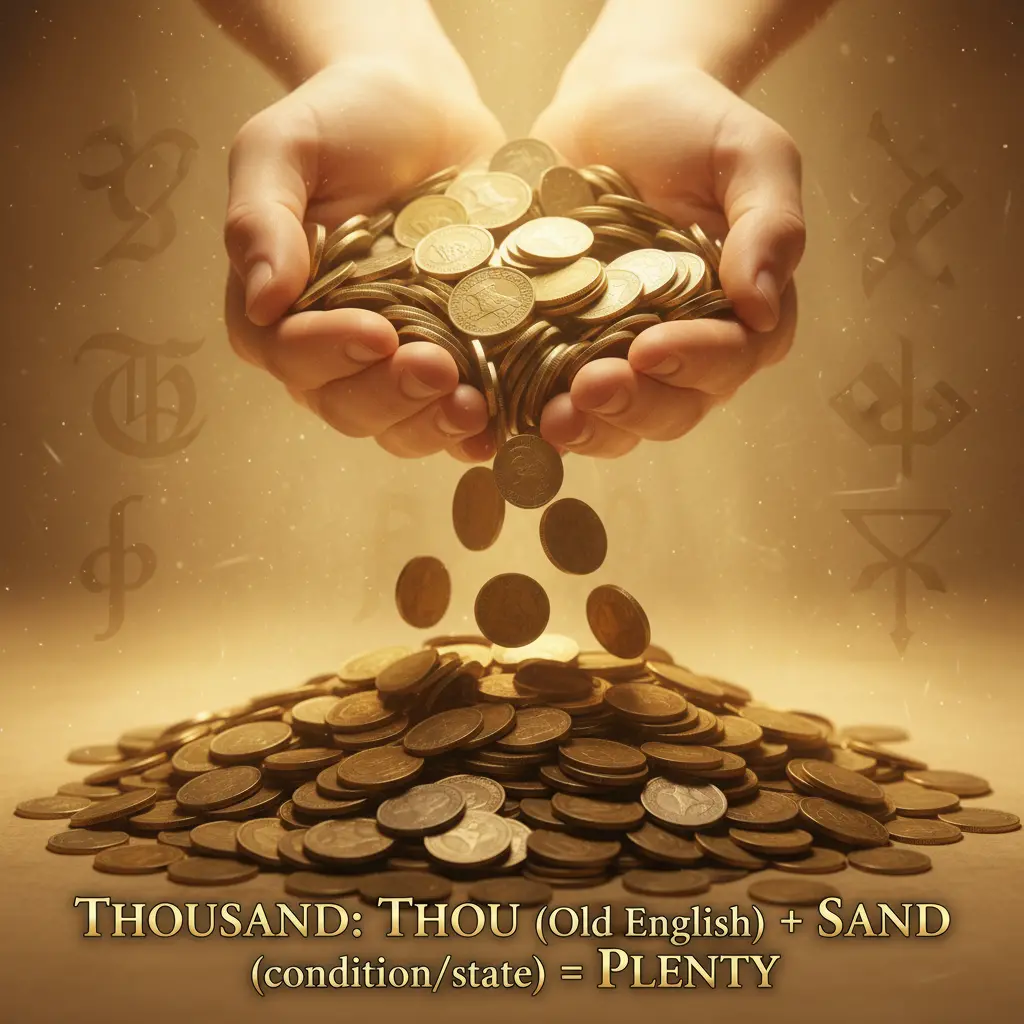
Example sentences are the start of understanding. Don't rush to memorize. First feel how the word works in a sentence.
thousand = thou (from Old English 'þūsend') + sand (a suffix meaning 'condition or state'). Historical origin: Old English > Middle English > Modern English. Memory image: Imagine having a thousand small coins spilling into your hands, representing plenty and abundance.
Note 1: These definitions and etymologies are not standard dictionary definitions, but extended explanations provided to help with memorization and understanding of the actual application of words. Through this background information, we strive to make words more vivid and easier to understand, and help you remember their meanings in real life.
Note 2: LexiTalk designs the learning flow around the linguistics principle of “Comprehensible Input.” When learners encounter material that is slightly above their level but still understandable from context, the brain naturally absorbs the language. That’s why we keep every word inside authentic contexts, using examples and associations to help you understand it and use it flexibly.
Read the FAQ explanation of Comprehensible InputI set down a handful of coins and move them one by one across the tray, counting as I go. I push and slide, then shift my gaze to the growing stack that stretches toward a thousand. The pace tightens, and I feel the effort in my hand and in my breath as I keep going. When the last coin clicks into place, the number feels bigger than any single coin, a quiet sense that many small moves build toward a thousand.
Thousand is a basic number word used for counting, grouping, and describing large quantities. In everyday English you say one thousand, two thousand, etc., and you can also use thousand to mean approximately 1000 in informal speech (a thousand people arrived). The word operates as a count noun in noun phrases (a thousand dollars) and can appear before nouns with determiners. In writing, 'thousand' is typically used in formal numbers, while 'k' is common in abbreviations (5k). Learners often confuse thousand with million, and they may drop the 'th' sound in fast speech; practicing with simple pairs helps cement pronunciation and usage.
Think of thousand as a straightforward count noun that English uses with a and numbers. Learners often fear it always needs a determiner or confuse it with million. Practice with money, time, and distance to feel the scale.
Download LexiTalk app for personalized learning experience
Download AppCookies
We use cookies for essential site functions, analytics, and ads. You can accept, reject, or manage preferences. Privacy Policy