trading - Master This Word
Master this word with our 5-step learning method – Learn English in English
Train English Through Brain Routes, Not Translation.
This page helps you stop memorizing isolated translations and start understanding a word through its shared mental image, native-style thinking, and practical training steps.
Master this word with our 5-step learning method – Learn English in English
Example sentences are the start of understanding. Don't rush to memorize. First feel how the word works in a sentence.
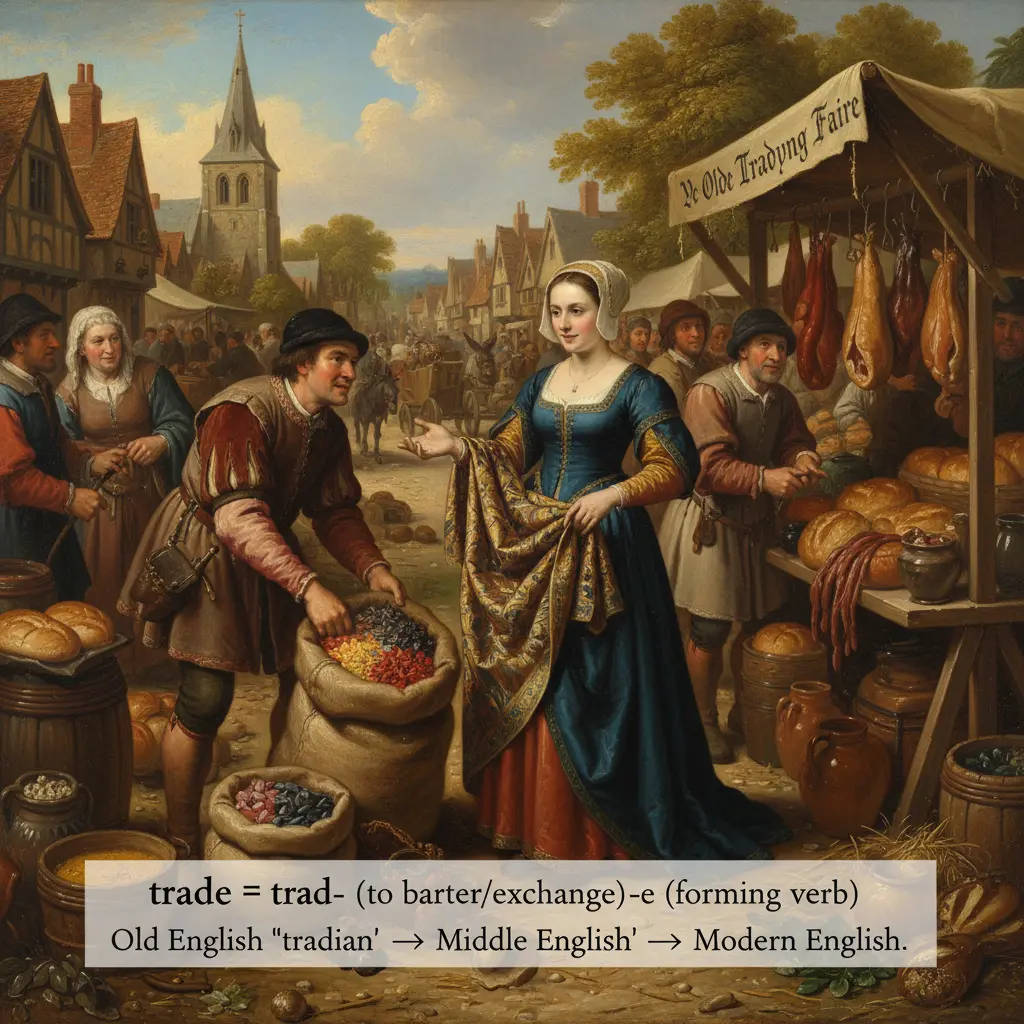
trade = trad- (to barter/exchange) + -e (forming verb), Historical origin: Old English 'tradian' → Middle English 'trade' → Modern English, Memory image: Imagine a bustling market where people are swapping goods: the trade of spices for textiles.
Note 1: These definitions and etymologies are not standard dictionary definitions, but extended explanations provided to help with memorization and understanding of the actual application of words. Through this background information, we strive to make words more vivid and easier to understand, and help you remember their meanings in real life.
Note 2: LexiTalk designs the learning flow around the linguistics principle of “Comprehensible Input.” When learners encounter material that is slightly above their level but still understandable from context, the brain naturally absorbs the language. That’s why we keep every word inside authentic contexts, using examples and associations to help you understand it and use it flexibly.
Read the FAQ explanation of Comprehensible InputI reach out, move a bottle across the counter, then shift it closer to the other person as if testing a response. I adjust my stance, hold back a moment, and pull back when needed, keeping my eyes on what the other side wants. We place our items side by side and set a small agreement in motion, letting the options change with every nod. In the end, the act gives me a sense of exchange—not just goods, but a quick read of trust and how I will use what I get.
Trade means the action of buying and selling goods and services, and it also refers to exchanges of items between people or companies. As a noun, trade can describe a whole system of commerce, a specific field, or a group of skilled workers who perform a craft, while as a verb it means to exchange something you have for something else, often with another party. Trade ranges from simple bartering to modern cross-border transactions involving contracts, payments, and logistics. Understanding trade also means recognizing differences between domestic commerce and international trade, including tariffs, regulations, and supply chains.
In English, trade is a broad concept used for both an everyday exchange and formal commerce; learners often mix up the noun and verb forms and miss collocations like trade agreement or trade deficit.
What is the meaning of the word 'trading'?
Which of the following sentences uses 'trading' correctly?
Which word is a synonym of 'trading'?
What is the opposite meaning of 'trading'?
In what real-life context would you see 'trading' happening?
Download LexiTalk app for personalized learning experience
Download AppCookies
We use cookies for essential site functions, analytics, and ads. You can accept, reject, or manage preferences. Privacy Policy