
trapezoids - Master This Word
Master this word with our 5-step learning method – Learn English in English
Train English Through Brain Routes, Not Translation.
This page helps you stop memorizing isolated translations and start understanding a word through its shared mental image, native-style thinking, and practical training steps.
Master this word with our 5-step learning method – Learn English in English
Example sentences are the start of understanding. Don't rush to memorize. First feel how the word works in a sentence.
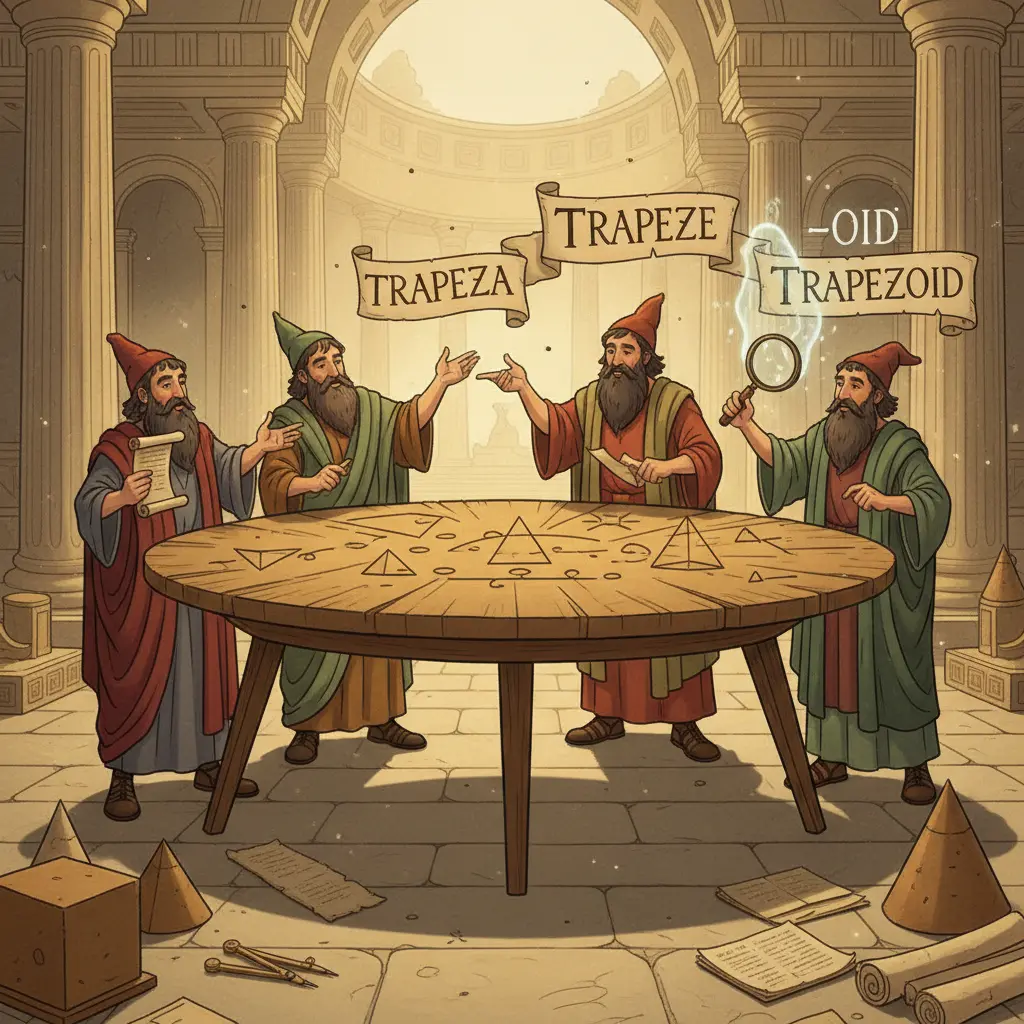
Root decomposition: 'trapez-' from Greek 'trapeza' (table), '-oid' meaning 'like'. Historical origin: from Greek to Latin, then into Old French as 'trapeze', and finally into English. Memory image: picture a table with a flat top and slanted sides, resembling a trapezoid, where mathematicians gather to discuss shapes.
Note 1: These definitions and etymologies are not standard dictionary definitions, but extended explanations provided to help with memorization and understanding of the actual application of words. Through this background information, we strive to make words more vivid and easier to understand, and help you remember their meanings in real life.
Note 2: LexiTalk designs the learning flow around the linguistics principle of “Comprehensible Input.” When learners encounter material that is slightly above their level but still understandable from context, the brain naturally absorbs the language. That’s why we keep every word inside authentic contexts, using examples and associations to help you understand it and use it flexibly.
Read the FAQ explanation of Comprehensible InputTrapezoids are four-sided figures with at least one pair of parallel sides, a defining feature that sets them apart from most other quadrilaterals. In everyday geometry you can form a trapezoid by cutting a rectangle diagonally or by tilting one side of a parallelogram, producing a shape with bases that run parallel. The word comes from Greek trapeza, meaning table, with the suffix -oid meaning like, so a trapezoid is literally “like a table.” In classrooms and exams, trapezoids are used to introduce key ideas such as bases, legs, altitude, and the area formula. Learners often mistake all shapes with a single parallel pair for trapezoids, but regional definitions can vary, so context matters.
In English, the trapezoid is commonly defined as a quadrilateral with at least one pair of parallel sides, which makes it easy to generalize from rectangles and parallelograms. Learners often anchor the idea to everyday ‘table-like’ shapes, leading to quick intuition about bases and height. A common mistake is assuming a trapezoid must resemble a drawn rectangle, or that all trapezoids have exactly one pair of parallel sides.
Download LexiTalk app for personalized learning experience
Download AppCookies
We use cookies for essential site functions, analytics, and ads. You can accept, reject, or manage preferences. Privacy Policy