
unconstitutional - Master This Word
Master this word with our 5-step learning method – Learn English in English
Train English Through Brain Routes, Not Translation.
This page helps you stop memorizing isolated translations and start understanding a word through its shared mental image, native-style thinking, and practical training steps.
Master this word with our 5-step learning method – Learn English in English
Example sentences are the start of understanding. Don't rush to memorize. First feel how the word works in a sentence.
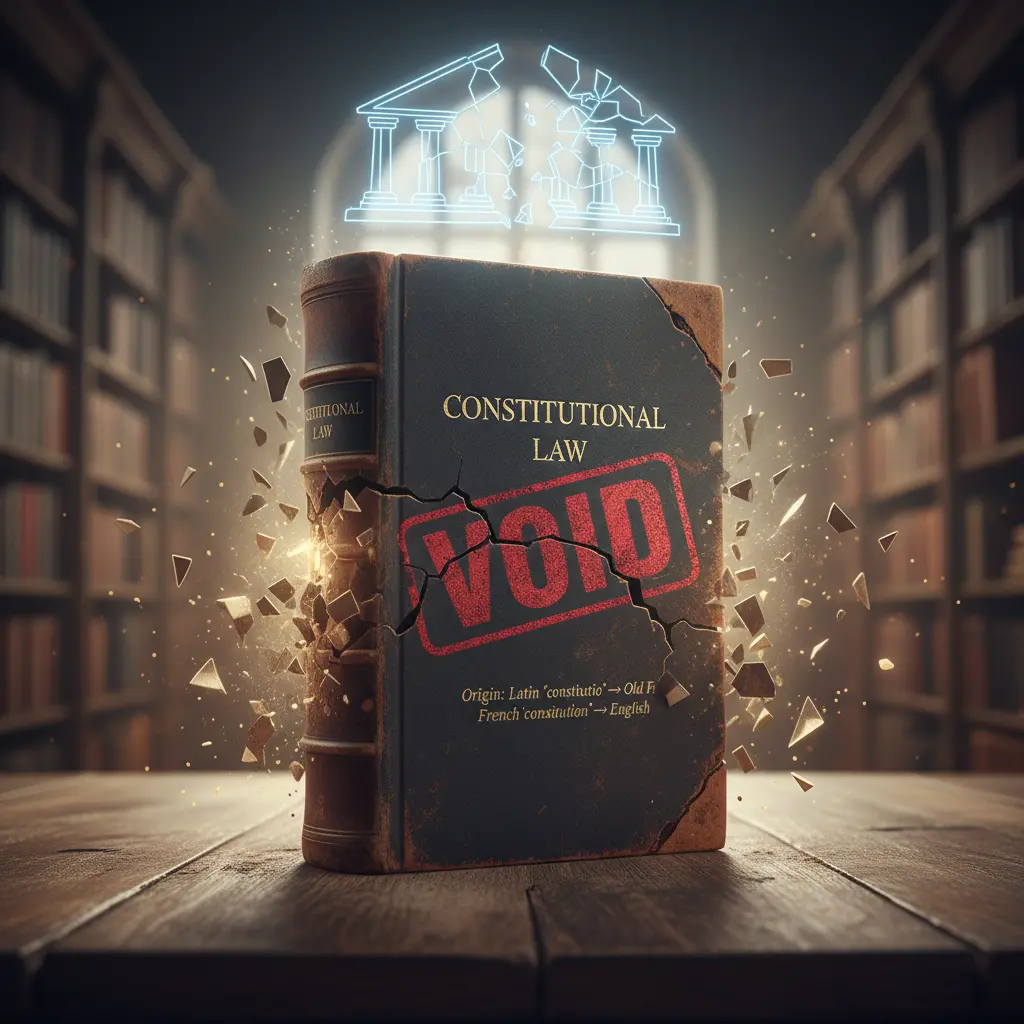
un- = not, constitutional = related to the constitution. Origin: Latin 'constitutio' → Old French 'constitution' → English. Imagine a law book with the word 'void' stamped across it, symbolizing laws that cannot hold up due to being unconstitutional, as if they failed to exist in a structured reality.
Note 1: These definitions and etymologies are not standard dictionary definitions, but extended explanations provided to help with memorization and understanding of the actual application of words. Through this background information, we strive to make words more vivid and easier to understand, and help you remember their meanings in real life.
Note 2: LexiTalk designs the learning flow around the linguistics principle of “Comprehensible Input.” When learners encounter material that is slightly above their level but still understandable from context, the brain naturally absorbs the language. That’s why we keep every word inside authentic contexts, using examples and associations to help you understand it and use it flexibly.
Read the FAQ explanation of Comprehensible InputI grip the edge of a document, move it along the desk, and set it beside the constitution. The two texts shift against each other, a quiet friction that makes me lean in and decide what to keep. I adjust my stance, push and pull, watching my own sense of control shift in my hands. When a rule clearly blocks what the constitution allows, I label it unconstitutional, letting the boundary show itself in the air.
Unconstitutional means a law, action, or policy that violates a country’s constitution. When a court rules something unconstitutional, it holds that the measure contradicts the supreme law and cannot stand as written. This concept is formal and legal, often arising in constitutional challenges, civil liberties cases, and arguments about the powers of government. Learners should recognize that unconstitutional is not simply “bad” or “morally wrong”; it is a specific judgment about alignment with the constitution. In everyday news, you’ll see it in discussions of rights, checks and balances, and reform efforts. Remember that constitutional validity is context-specific and can vary by country.
In English, constitutional validity is a formal, legal standard tied to a country’s supreme law; learners from non-legal backgrounds may think 'unconstitutional' means merely unfair or immoral, or assume it applies the same way in every country.
What is the meaning of 'unconstitutional'?
Which of the following sentences uses 'unconstitutional' correctly?
Which word is an antonym of 'unconstitutional'?
In what real-life context might the term 'unconstitutional' be used?
Reflect on why understanding the concept of 'unconstitutionality' is important.
Download LexiTalk app for personalized learning experience
Download AppCookies
We use cookies for essential site functions, analytics, and ads. You can accept, reject, or manage preferences. Privacy Policy