united - Master This Word
Master this word with our 5-step learning method – Learn English in English
Train English Through Brain Routes, Not Translation.
This page helps you stop memorizing isolated translations and start understanding a word through its shared mental image, native-style thinking, and practical training steps.
Master this word with our 5-step learning method – Learn English in English
Example sentences are the start of understanding. Don't rush to memorize. First feel how the word works in a sentence.
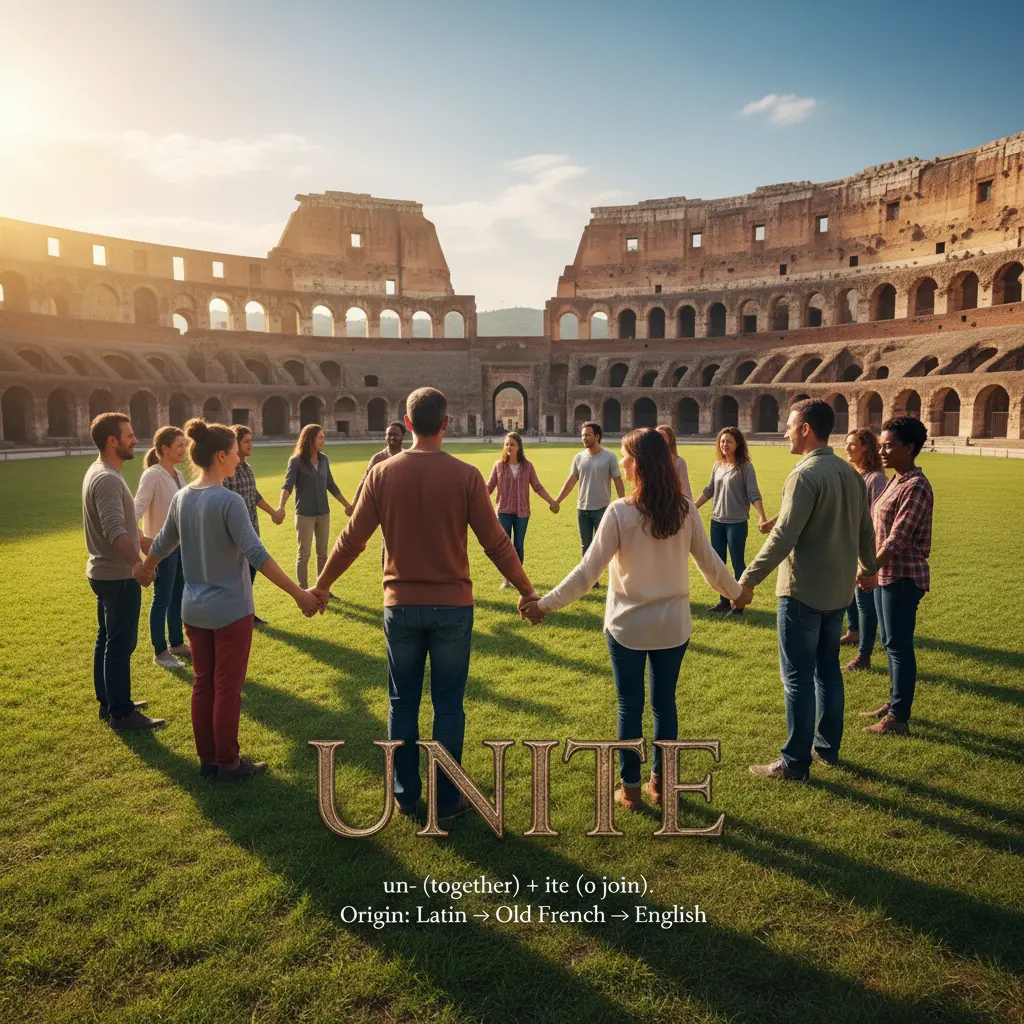
unite = un- (together) + ite (to join). Origin: Latin → Old French → English. Picture people holding hands in a circle to symbolize unity.
Note 1: These definitions and etymologies are not standard dictionary definitions, but extended explanations provided to help with memorization and understanding of the actual application of words. Through this background information, we strive to make words more vivid and easier to understand, and help you remember their meanings in real life.
Note 2: LexiTalk designs the learning flow around the linguistics principle of “Comprehensible Input.” When learners encounter material that is slightly above their level but still understandable from context, the brain naturally absorbs the language. That’s why we keep every word inside authentic contexts, using examples and associations to help you understand it and use it flexibly.
Read the FAQ explanation of Comprehensible InputI reach out, move two cups on the table closer, and clasp their rims. I push one toward the other until they touch, then pull back just enough to keep the balance. I feel the shift as the two pieces align, a shared steadiness settling in my hands. Soon I think of friends teaming up for a project, and the feeling in my chest says we can unite.
To unite means to bring people or groups into a single, cooperative whole for a shared aim. You can unite families, communities, teams, or nations by pooling resources, agreeing on goals, and showing mutual support. The verb carries a sense of harmony and purpose, often with a collective outcome, such as uniting behind a campaign or uniting forces to overcome a challenge. It is common in political, organizational, and social contexts, and can be followed by phrases like “unite with,” “unite behind,” or “unite for.” Learners sometimes confuse it with simply joining or merging, or confuse “unite” with “unified” as a past participle rather than a verb.
English tends to pair unite with civic, communal, or collaborative contexts, emphasizing shared purpose and morale. Learners often mix it with general 'join' or 'connect' and miss the nuance of concerted action.
What is the meaning of the word 'united'?
Which of the following sentences uses 'united' correctly?
What is a synonym for 'united'?
What is the opposite of 'united'?
How does the concept of being 'united' apply in a family setting?
Download LexiTalk app for personalized learning experience
Download AppCookies
We use cookies for essential site functions, analytics, and ads. You can accept, reject, or manage preferences. Privacy Policy