useful - Master This Word
Master this word with our 5-step learning method – Learn English in English
Train English Through Brain Routes, Not Translation.
This page helps you stop memorizing isolated translations and start understanding a word through its shared mental image, native-style thinking, and practical training steps.
Master this word with our 5-step learning method – Learn English in English
Example sentences are the start of understanding. Don't rush to memorize. First feel how the word works in a sentence.
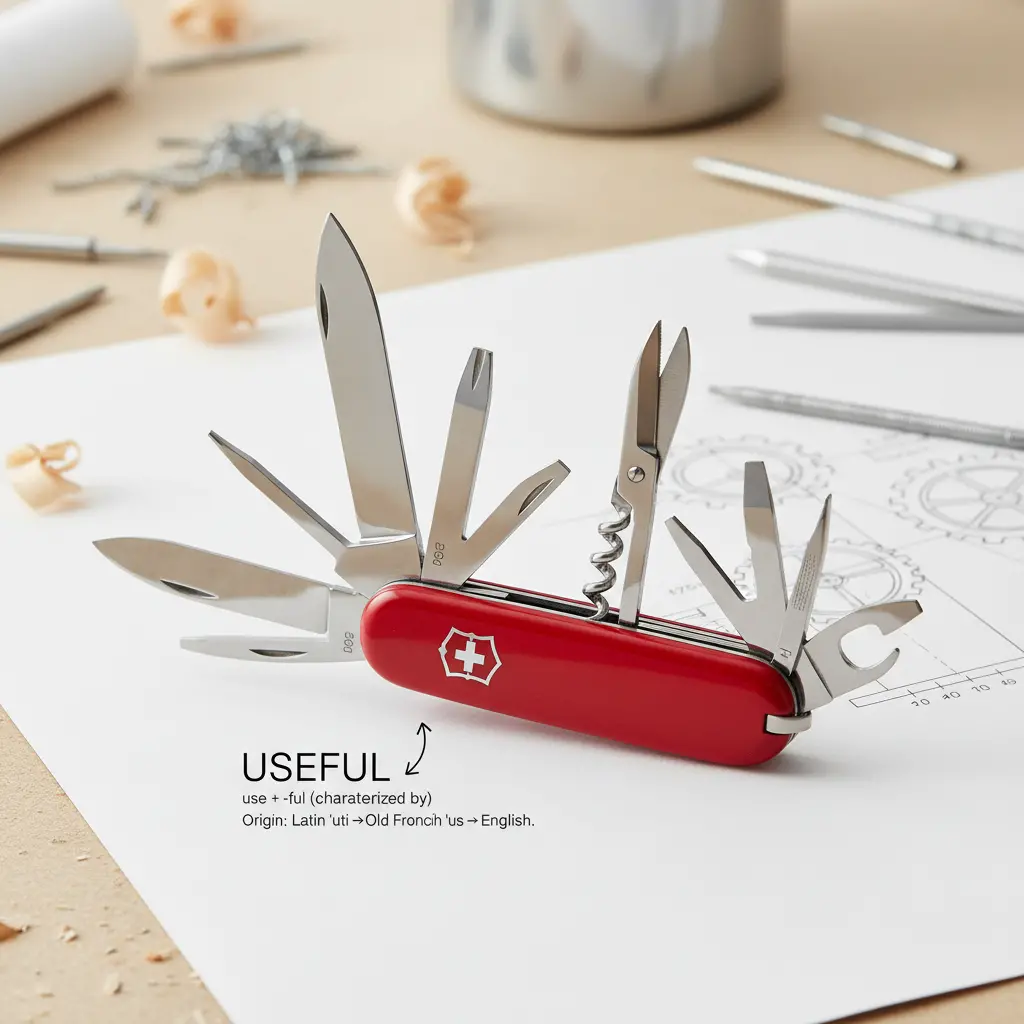
useful = use + -ful (characterized by). Origin: Latin 'uti' → Old French 'us' → English. Memory image: Imagine a Swiss Army knife, packed with various tools, showing how something can be useful in many ways.
Note 1: These definitions and etymologies are not standard dictionary definitions, but extended explanations provided to help with memorization and understanding of the actual application of words. Through this background information, we strive to make words more vivid and easier to understand, and help you remember their meanings in real life.
Note 2: LexiTalk designs the learning flow around the linguistics principle of “Comprehensible Input.” When learners encounter material that is slightly above their level but still understandable from context, the brain naturally absorbs the language. That’s why we keep every word inside authentic contexts, using examples and associations to help you understand it and use it flexibly.
Read the FAQ explanation of Comprehensible InputFirst I reach out and grip the everyday tool, then I move the lever a touch and feel it shift under my hand. I push and pull a little, adjust my grip, and watch the thing react, ticking toward progress. It’s a small strain and a tiny turn of choice, keeping control as I steer it toward what needs doing. By the end, the result sits steady and feels useful, because it helps me get the job done without fuss.
Useful describes something with practical utility or value that helps you achieve a goal. It applies to objects, information, advice, or people who can help you complete a task more efficiently. When something is useful, it can be applied in a real situation, save time, solve a problem, or improve outcomes. The nuance is more about function and practicality than sentiment or rarity. 'Useful' is often paired with prepositions like for and to: a tool that is useful for repairing bikes, information useful to plan a trip, advice useful to avoid mistakes. It is positive but not grand; something can be useful without being outstanding, and something can be very useful in one context but not another.
English speakers often separate usefulness from emotional value, focusing on function and context; learners may misread 'useful' as 'needed' or confuse with 'helpful' when the helper context is explicit.
What is the meaning of the word 'useful'?
Which sentence uses the word 'useful' correctly?
Which word is most similar to 'useful'?
What is the opposite of 'useful'?
Can you give an example of a real-life scenario where being 'helpful' is important?
Download LexiTalk app for personalized learning experience
Download AppCookies
We use cookies for essential site functions, analytics, and ads. You can accept, reject, or manage preferences. Privacy Policy