variation - Master This Word
Master this word with our 5-step learning method – Learn English in English
Train English Through Brain Routes, Not Translation.
This page helps you stop memorizing isolated translations and start understanding a word through its shared mental image, native-style thinking, and practical training steps.
Master this word with our 5-step learning method – Learn English in English
Example sentences are the start of understanding. Don't rush to memorize. First feel how the word works in a sentence.
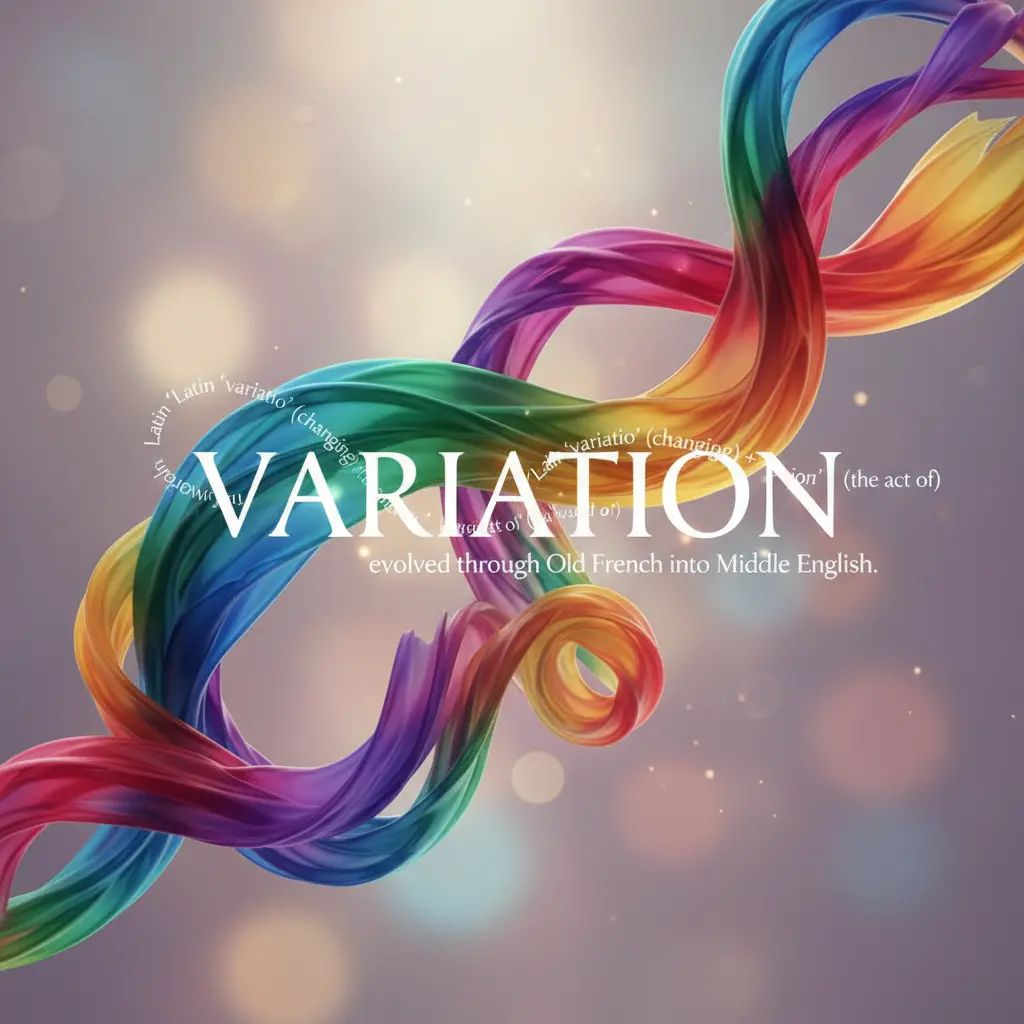
variation comes from Latin 'variatio' (changing) + suffix '-ion' (the act of). It evolved through Old French into Middle English. Imagine a colorful ribbon that sways and shifts forms, representing the many ways things can vary.
Note 1: These definitions and etymologies are not standard dictionary definitions, but extended explanations provided to help with memorization and understanding of the actual application of words. Through this background information, we strive to make words more vivid and easier to understand, and help you remember their meanings in real life.
Note 2: LexiTalk designs the learning flow around the linguistics principle of “Comprehensible Input.” When learners encounter material that is slightly above their level but still understandable from context, the brain naturally absorbs the language. That’s why we keep every word inside authentic contexts, using examples and associations to help you understand it and use it flexibly.
Read the FAQ explanation of Comprehensible InputHands on the switch, I move my thumb a little and watch the lights respond. I push, I pull, I adjust, and the glow shifts as the room’s feel changes. The effort to calibrate gives me a sense of control, a small turn toward comfort. Variation reveals itself as a difference in tone or mood, not a definition, when I hold steady and keep listening.
Variation is a noun that captures how things are not fixed but can change in amount, quality, or condition. It covers both small and large differences: a variation in temperature from day to day, a variation of plan or schedule, or a variation in a musical theme that keeps returning with slight changes. It also refers to a different form or version of something, such as a variation of a recipe or a product variant. Finally, variation can describe the act of changing or altering itself, or the range of possible outcomes in a study. The word often appears in scientific, statistical, artistic, and everyday contexts.
Variation is often used broadly in English to mean any difference or change, but in science and statistics it has a more precise sense of spread or range; learners may confuse it with 'difference' or 'variety'.
What is the meaning of the word 'variation'?
In which of the following sentences is 'variation' used correctly?
Which word is most similar to 'variation'?
What is the opposite of 'variation'?
Can you think of a real-life example where 'variation' plays a significant role?
Download LexiTalk app for personalized learning experience
Download AppCookies
We use cookies for essential site functions, analytics, and ads. You can accept, reject, or manage preferences. Privacy Policy