virus - Master This Word
Master this word with our 5-step learning method – Learn English in English
Train English Through Brain Routes, Not Translation.
This page helps you stop memorizing isolated translations and start understanding a word through its shared mental image, native-style thinking, and practical training steps.
Master this word with our 5-step learning method – Learn English in English
Example sentences are the start of understanding. Don't rush to memorize. First feel how the word works in a sentence.
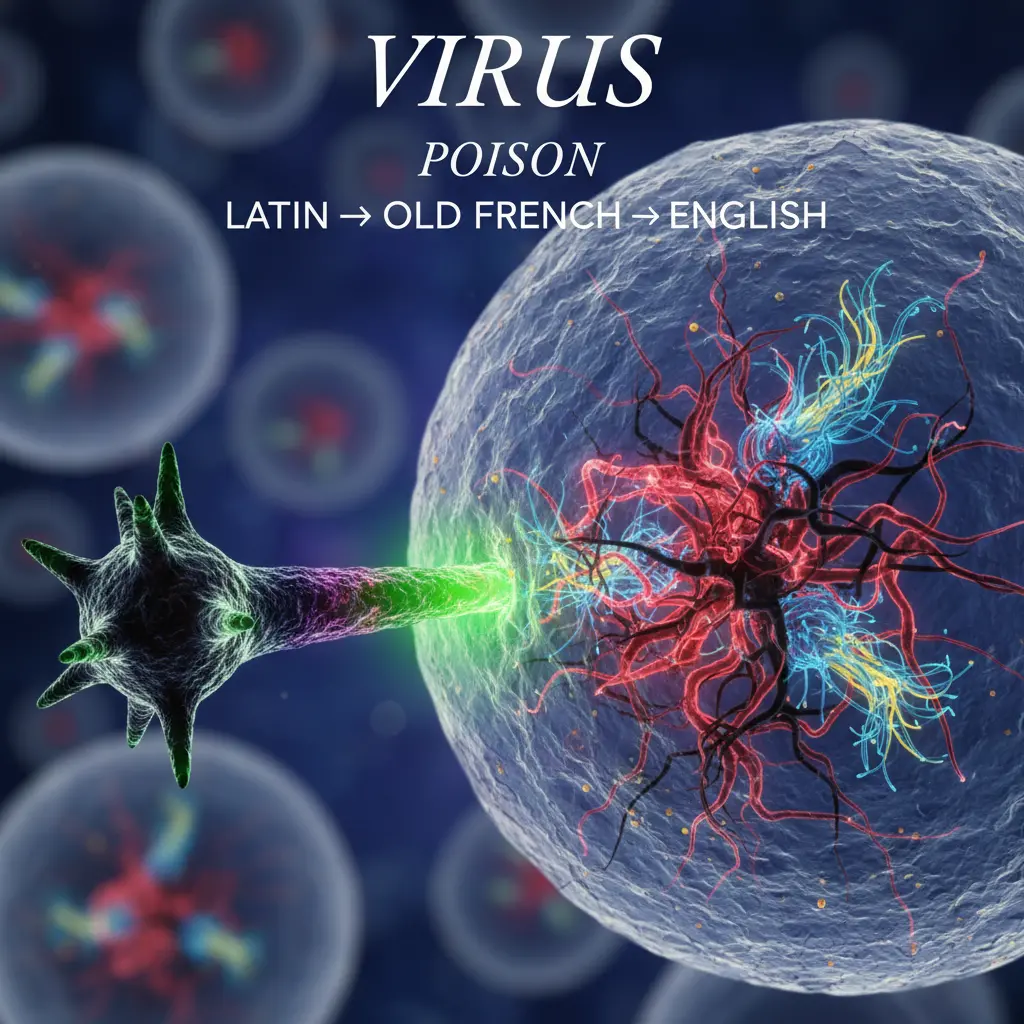
Root: virus = poison; Historical origin: Latin → Old French → English; Memory image: Imagine a tiny poison dart that sneaks into a cell and takes over its functions, spreading further.
Note 1: These definitions and etymologies are not standard dictionary definitions, but extended explanations provided to help with memorization and understanding of the actual application of words. Through this background information, we strive to make words more vivid and easier to understand, and help you remember their meanings in real life.
Note 2: LexiTalk designs the learning flow around the linguistics principle of “Comprehensible Input.” When learners encounter material that is slightly above their level but still understandable from context, the brain naturally absorbs the language. That’s why we keep every word inside authentic contexts, using examples and associations to help you understand it and use it flexibly.
Read the FAQ explanation of Comprehensible InputI pick up a tiny model and turn it in my hand, feeling the weight shift as I rotate it. A second copy slides out and starts to fill the desk, as if it learned to copy itself. I push a button, watching the glow change and the little shapes spread a little farther; I adjust my grip to keep it under control. In that tempo of turn and spread, I sense a virus—something that can move through bodies or through machines, changing what it touches.
Virus is a small infectious agent that replicates only inside living cells of an organism. It can refer to a biological virus that harms humans, animals, or plants, or to a computer virus that copies itself and spreads across networks. In everyday use, virus also stands for anything that corrupts or damages a system, program, or data. Learners should distinguish biological and computer senses, watch for collocations such as viral infection, antiviral drug, or antivirus software, and recognize that viruses are not alive in the same way as cellular organisms according to many scientists.
English speakers rely on distinct biological vs computing domains; learners should seek explicit phrases like 'virus infection' and 'computer virus' to avoid generic use.
What is the meaning of the word 'virus'?
In which of the following scenarios would you most likely encounter a virus?
Which of the following is a similar word to 'virus'?
What is the opposite of 'virus'?
Where would you most likely encounter information about computer viruses?
Download LexiTalk app for personalized learning experience
Download AppCookies
We use cookies for essential site functions, analytics, and ads. You can accept, reject, or manage preferences. Privacy Policy