war - Master This Word
Master this word with our 5-step learning method – Learn English in English
Train English Through Brain Routes, Not Translation.
This page helps you stop memorizing isolated translations and start understanding a word through its shared mental image, native-style thinking, and practical training steps.
Master this word with our 5-step learning method – Learn English in English
Example sentences are the start of understanding. Don't rush to memorize. First feel how the word works in a sentence.
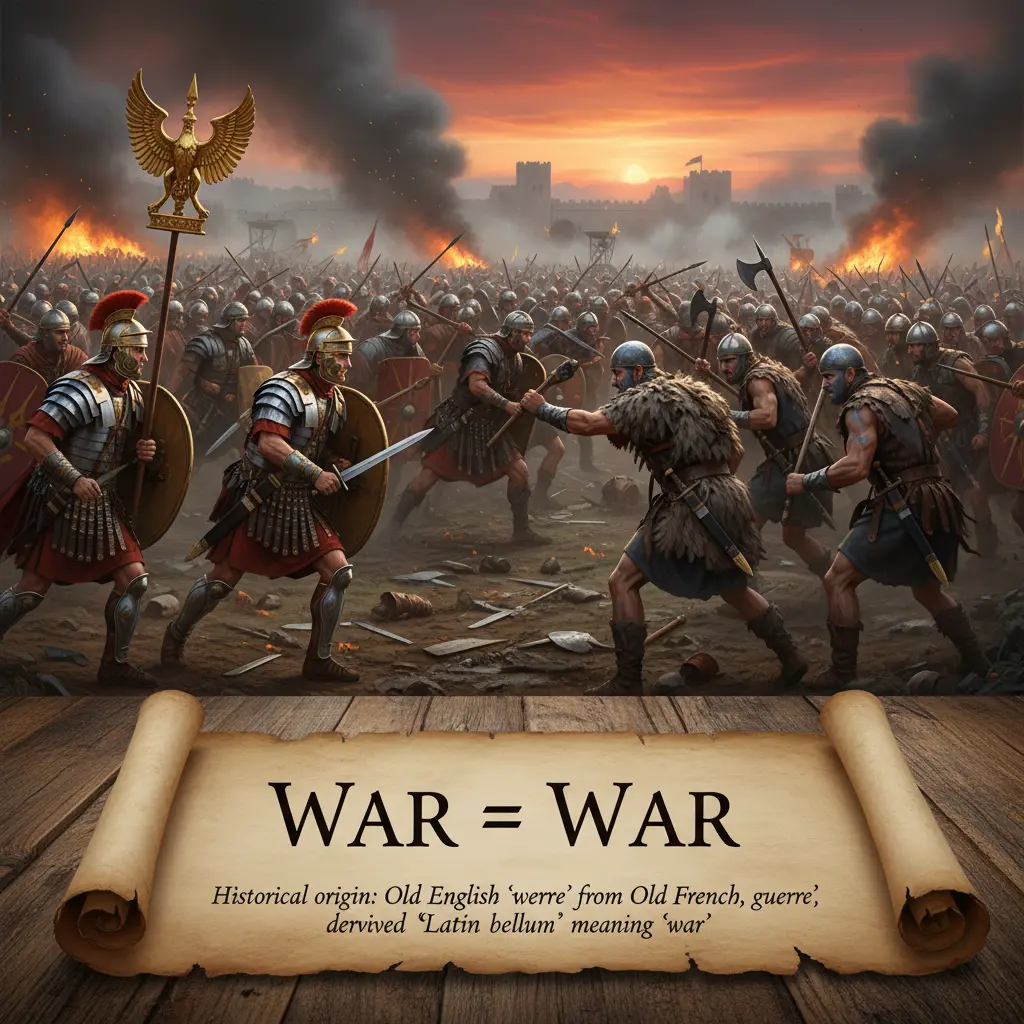
war = war; Historical origin: Old English 'werre' from Old French 'guerre', derived from Latin 'bellum' meaning 'war'; Memory image: envision armies clashing, with the sound of swords rattling and echoes of battle cries.
Note 1: These definitions and etymologies are not standard dictionary definitions, but extended explanations provided to help with memorization and understanding of the actual application of words. Through this background information, we strive to make words more vivid and easier to understand, and help you remember their meanings in real life.
Note 2: LexiTalk designs the learning flow around the linguistics principle of “Comprehensible Input.” When learners encounter material that is slightly above their level but still understandable from context, the brain naturally absorbs the language. That’s why we keep every word inside authentic contexts, using examples and associations to help you understand it and use it flexibly.
Read the FAQ explanation of Comprehensible InputPlace your hand on the map and move the marker as it shifts under your fingers. The room tightens and I adjust my posture, keeping a careful eye on the lines that could pull friends apart. I let a quiet decision rise, to hold ground or step back, and the weight of that choice settles like a held breath. War feels like a test of control, where small moves echo into big consequences.
War is a powerful, multi-faceted word in English. It refers to organized armed conflict between nations, coalitions, or large groups, and it also appears in metaphorical phrases that describe intense, sustained struggles. Historically, wars have reshaped borders, economies, and societies, often defining eras and changing lives across generations. In everyday speech, you will hear expressions like wage war, declare war, or wage a war on poverty. These phrases reveal how leaders frame conflict as a policy choice, and how civilians are urged to support national effort. The word itself carries moral weight, evokes fear and loss, and reminds us of the human costs behind political decisions. Learners should distinguish war from general violence and from individual quarrels.
Explain to an English speaker: war is formal, historical, and policy-driven; avoid using it for trivial fights; focus on collocations like wage war and declare war.
What is the meaning of the word 'war'?
How is the word 'war' used in a sentence?
Which word is similar to 'war'?
Which word is the opposite of 'war'?
In what real-life context would you hear the word 'war'?
Download LexiTalk app for personalized learning experience
Download AppCookies
We use cookies for essential site functions, analytics, and ads. You can accept, reject, or manage preferences. Privacy Policy