adjacent - Master This Word
Master this word with our 5-step learning method – Learn English in English
Train English Through Brain Routes, Not Translation.
This page helps you stop memorizing isolated translations and start understanding a word through its shared mental image, native-style thinking, and practical training steps.
Master this word with our 5-step learning method – Learn English in English
Example sentences are the start of understanding. Don't rush to memorize. First feel how the word works in a sentence.
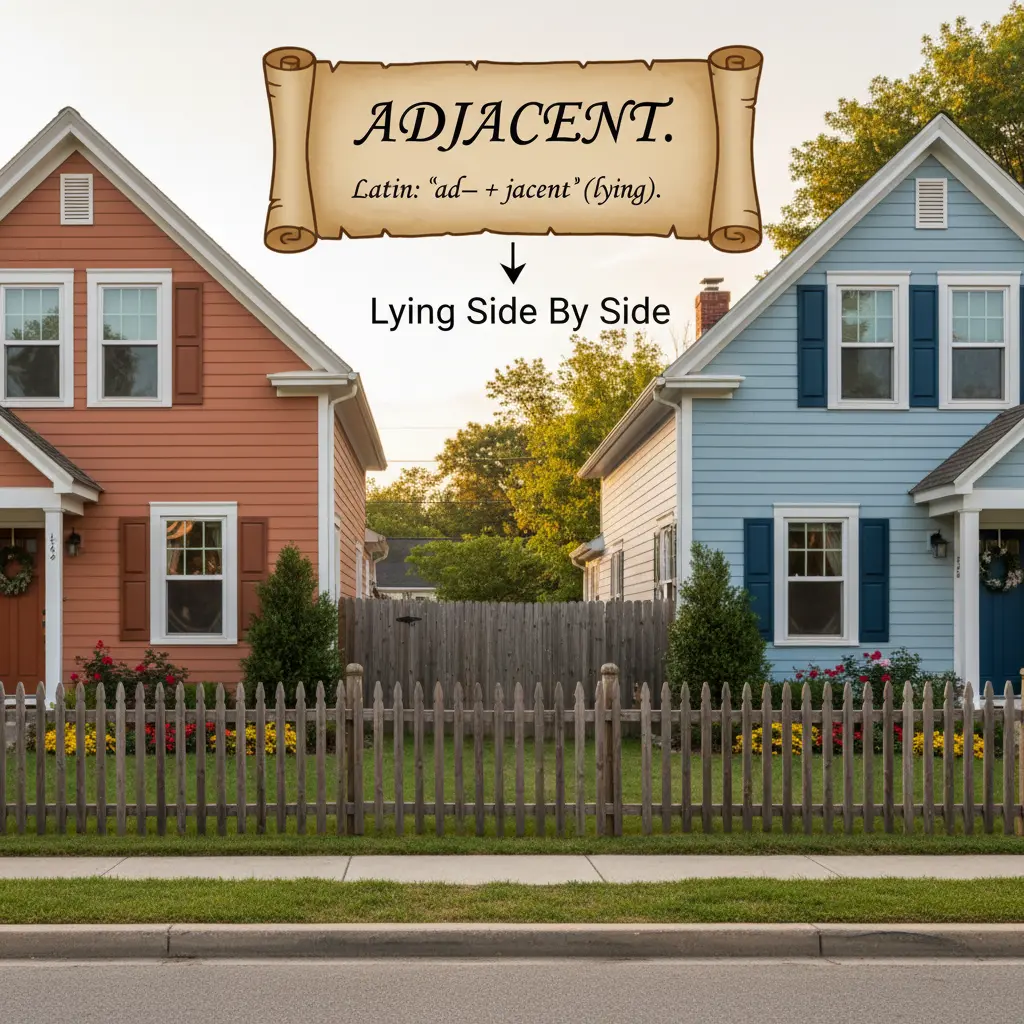
ad- = to, jacent = lying (from 'jacere'). The historical origin is Latin → French → English. Picture two houses right next to each other, sharing a fence, representing how they are 'lying side by side'.
Note 1: These definitions and etymologies are not standard dictionary definitions, but extended explanations provided to help with memorization and understanding of the actual application of words. Through this background information, we strive to make words more vivid and easier to understand, and help you remember their meanings in real life.
Note 2: LexiTalk designs the learning flow around the linguistics principle of “Comprehensible Input.” When learners encounter material that is slightly above their level but still understandable from context, the brain naturally absorbs the language. That’s why we keep every word inside authentic contexts, using examples and associations to help you understand it and use it flexibly.
Read the FAQ explanation of Comprehensible InputI move my hand to the notebook and push it toward the space beside the mug. I adjust the angle, shift it a bit, and keep nudging until the edge almost touches. The effort feels like a small decision, a turn here and a pause there as I set them near one another. When they sit side by side, the scene seems quietly connected, like two items that are adjacent in a neat arrangement.
Adjac ent describes things that lie side by side in space or in a figurative sense. In physical terms it means next to or adjoining another object, as in adjacent rooms sharing a wall or an adjacent property line. It can also imply close similarity or direct connection, such as adjacent ideas or adjacent problems that closely relate in a discussion. While near or nearby can convey proximity, adjacent emphasizes a definite boundary or touch point, often with a sense of spatial or logical adjacency. The word comes from Latin ad- meaning to and jacere meaning lying, via French and into English, evoking two things lying beside one another.
English speakers often distinguish adjacent from near by stressing boundary or contact; learners must notice tactile implications in physical layouts and metaphorical closeness in ideas.
Select the sentence where 'adjacent' is used correctly.
What is a synonym for 'adjacent'?
What is an antonym for 'adjacent'?
How is the concept of 'adjacent' important in mathematics?
Download LexiTalk app for personalized learning experience
Download AppCookies
We use cookies for essential site functions, analytics, and ads. You can accept, reject, or manage preferences. Privacy Policy