
what - Master This Word
Master this word with our 5-step learning method – Learn English in English
Train English Through Brain Routes, Not Translation.
This page helps you stop memorizing isolated translations and start understanding a word through its shared mental image, native-style thinking, and practical training steps.
Master this word with our 5-step learning method – Learn English in English
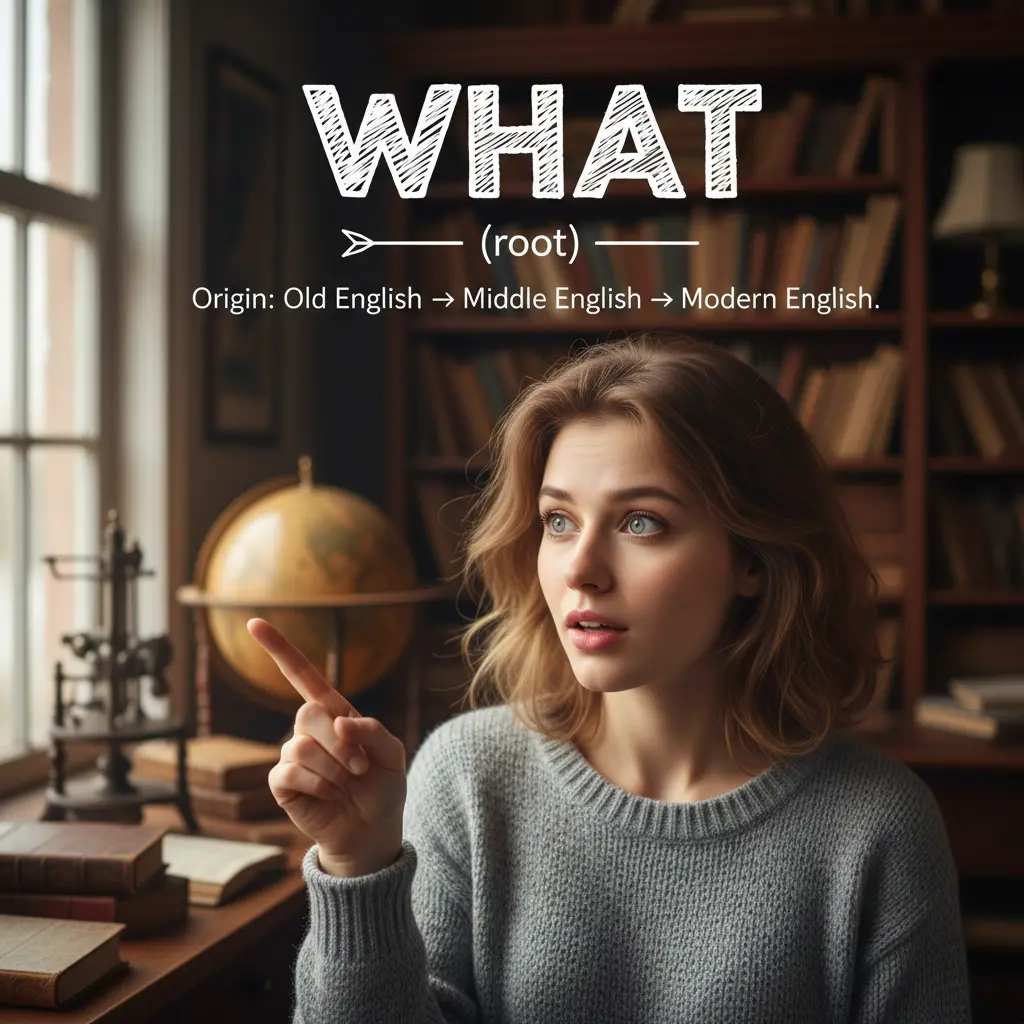
Example sentences are the start of understanding. Don't rush to memorize. First feel how the word works in a sentence.
what = what (root). Origin: Old English → Middle English → Modern English. Memory image: Imagine pointing at something and asking 'What is that?' while keeping your eyes wide with curiosity.
Note 1: These definitions and etymologies are not standard dictionary definitions, but extended explanations provided to help with memorization and understanding of the actual application of words. Through this background information, we strive to make words more vivid and easier to understand, and help you remember their meanings in real life.
Note 2: LexiTalk designs the learning flow around the linguistics principle of “Comprehensible Input.” When learners encounter material that is slightly above their level but still understandable from context, the brain naturally absorbs the language. That’s why we keep every word inside authentic contexts, using examples and associations to help you understand it and use it flexibly.
Read the FAQ explanation of Comprehensible InputI lean forward and move my eyes along the page, my hand gripping the desk edge as I whisper, 'What is this?' I adjust my posture, set my shoulders, and keep listening as the word sits between ideas, inviting a search. I push the question forward and the scene shifts; the word what drifts from a label into a cue for action. By the time I decide my next move, I know what I need to know, and the moment feels settled, not fixed.
What is a versatile word in English, used to ask for information, to identify something, and to express surprise or emphasis. As a pronoun, it asks about things, actions, or reasons: What happened? As a determiner, it precedes a noun to inquire about its nature: What color is your car? The meaning of what can shift with context or the following verb, and it often starts a question. Compared with which, what asks about a broad set rather than a specific selection; in casual speech it can appear in shortened forms like what’re or what’s. Its Old English roots trace back to early forms that evolved into the modern word, retaining its curiosity-driven function.
What invites curiosity about a broad range of possibilities, reflecting English openness to unknowns; learners often default to which when they suspect a limited set, or struggle with choosing between what and which in open-ended questions.
Which one of the following words is the opposite of 'what'?
In a sentence, which of the following can 'what' be used for?
Which word is similar in meaning to 'what'?
Real-Life Context: Imagine you are in a store and you want to ask the salesperson about a product. What word will you use to begin your question?
Can you please frame a sentence using the word 'what'?
Download LexiTalk app for personalized learning experience
Download AppCookies
We use cookies for essential site functions, analytics, and ads. You can accept, reject, or manage preferences. Privacy Policy