africa - Master This Word
Master this word with our 5-step learning method – Learn English in English
Train English Through Brain Routes, Not Translation.
This page helps you stop memorizing isolated translations and start understanding a word through its shared mental image, native-style thinking, and practical training steps.
Master this word with our 5-step learning method – Learn English in English
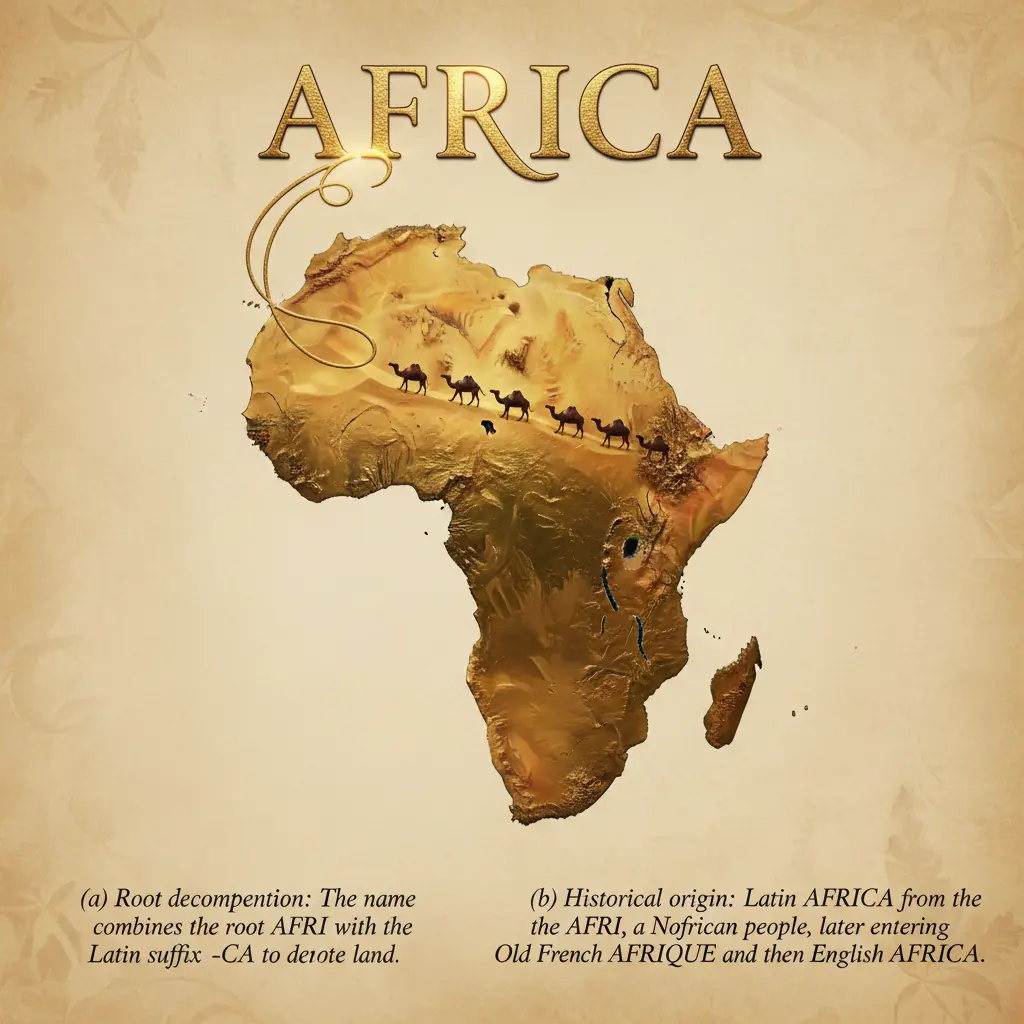
Example sentences are the start of understanding. Don't rush to memorize. First feel how the word works in a sentence.
(a) Root decomposition: the name combines the root Afri with the Latin suffix -ca to denote land. (b) Historical origin: Latin Africa from the Afri, a North African people, later entering Old French Afrique and then English Africa. (c) Memory image: picture a gold-colored map of Africa with caravans crossing the Sahara, the name linked to the land of the Afri.
Note 1: These definitions and etymologies are not standard dictionary definitions, but extended explanations provided to help with memorization and understanding of the actual application of words. Through this background information, we strive to make words more vivid and easier to understand, and help you remember their meanings in real life.
Note 2: LexiTalk designs the learning flow around the linguistics principle of “Comprehensible Input.” When learners encounter material that is slightly above their level but still understandable from context, the brain naturally absorbs the language. That’s why we keep every word inside authentic contexts, using examples and associations to help you understand it and use it flexibly.
Read the FAQ explanation of Comprehensible InputAfrica is the second-largest continent by land area and population, stretching across a wide belt from the Mediterranean to the Indian Ocean and from the Atlantic to the Indian Ocean. In English, Africa names the whole landmass and its diverse cultures, histories, and ecosystems, while phrases like the African continent emphasize the geographic and cultural scope. The word appears in academic writing, journalism, travel guides, and classroom lessons, often with qualifiers such as sub-Saharan Africa or North Africa. Learners should treat Africa as a proper noun that is capitalized. Use it with African as an adjective, or say in Africa to discuss events or conditions on the continent.
English speakers often frame Africa as a vast, diverse region and routinely distinguish the continent from its many individual nations; learners may overgeneralize or treat Africa as a single country. Emphasize both geographic scale and cultural pluralism to avoid stereotyping.
What is the definition of the word 'africa'?
Which of the following sentences correctly uses the word 'africa'?
Which word is most similar to 'africa'?
What is the opposite of 'africa'?
Can you give an example of a real-life scenario concerning 'africa'?
Download LexiTalk app for personalized learning experience
Download AppCookies
We use cookies for essential site functions, analytics, and ads. You can accept, reject, or manage preferences. Privacy Policy