alike - Master This Word
Master this word with our 5-step learning method – Learn English in English
Train English Through Brain Routes, Not Translation.
This page helps you stop memorizing isolated translations and start understanding a word through its shared mental image, native-style thinking, and practical training steps.
Master this word with our 5-step learning method – Learn English in English
Example sentences are the start of understanding. Don't rush to memorize. First feel how the word works in a sentence.
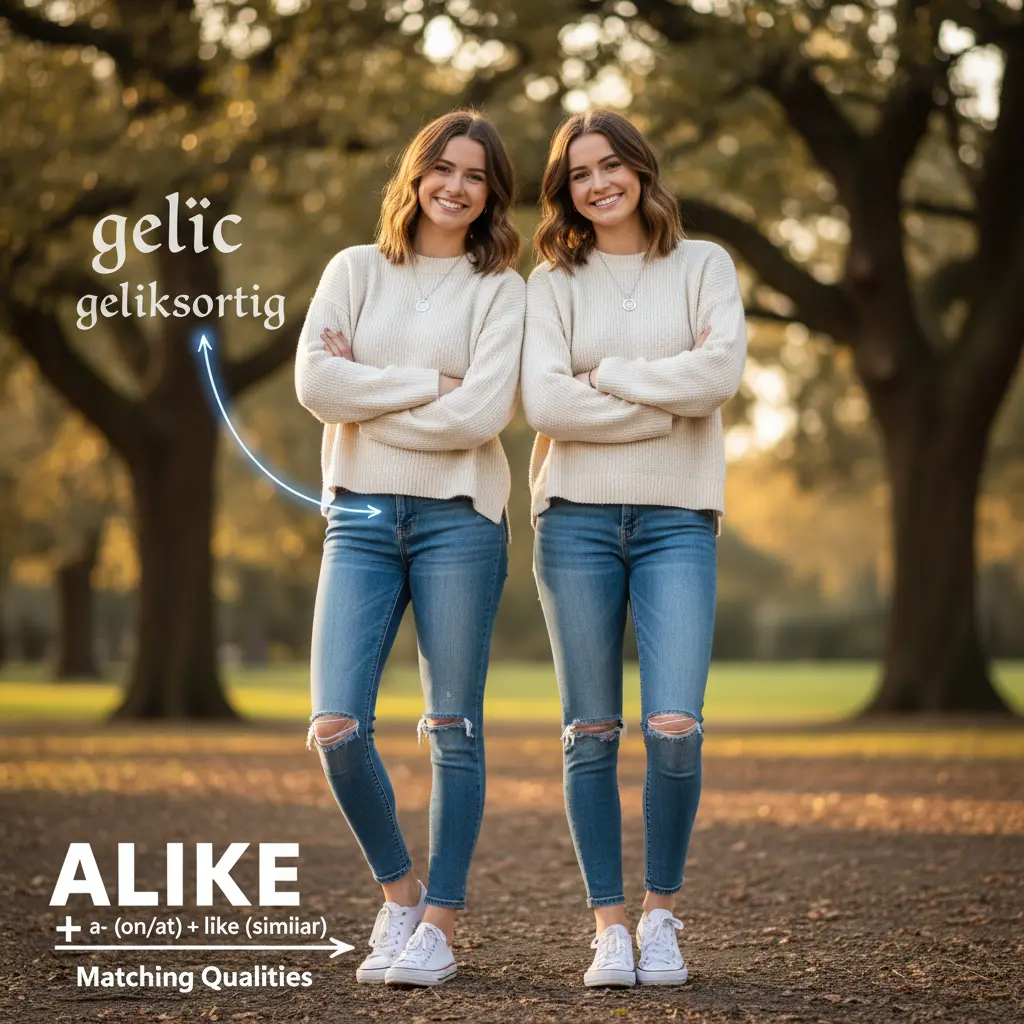
Root: alike = a- (on/at) + like (similar). Historical origin: Old English 'gelīc' influenced by Middle Dutch. Memory image: Imagine two identical twins dressed similarly, representing how alike they are in appearance and behavior. This extension into comparison evokes the idea of matching qualities.
Note 1: These definitions and etymologies are not standard dictionary definitions, but extended explanations provided to help with memorization and understanding of the actual application of words. Through this background information, we strive to make words more vivid and easier to understand, and help you remember their meanings in real life.
Note 2: LexiTalk designs the learning flow around the linguistics principle of “Comprehensible Input.” When learners encounter material that is slightly above their level but still understandable from context, the brain naturally absorbs the language. That’s why we keep every word inside authentic contexts, using examples and associations to help you understand it and use it flexibly.
Read the FAQ explanation of Comprehensible InputI set two cards on the desk and push one a little closer to the other. I adjust their angles, then pull back and watch how the light makes them seem the same. My hands steady, I move my eyes back and forth, trying to hold the moment where traits match. They look alike, and the scene feels balanced.
Alike describes a strong similarity between two or more things, either in appearance or in their characteristics. In English, it is used with look or be to compare people, objects, or ideas: two twins look alike, the students are alike in their dedication, or the two proposals are alike in budget and scope. Unlike similar, alike emphasizes shared traits as a direct, sometimes close, match. Learners often confuse it with 'similar' or place it after a noun ('two alike'). A few phrases also exist like 'they are alike in many ways' or 'alike as ever'. This nuance matters for natural-sounding comparisons.
In English, alike is a pointed way to say two things share strong features; it works best with verbs like be/look and with in-phrases, not directly before a noun. Learners often confuse it with similar, or try to nounify it. Use it for close, almost identical similarity rather than general resemblance.
In which of the following sentences is 'alike' used correctly?
Which word is a synonym of 'alike'?
What is the opposite of 'alike'?
How would you describe two siblings who have the same eye color, hair color, and smile but with different personalities?
English Learning Listening Content
Listen NowDownload LexiTalk app for personalized learning experience
Download AppCookies
We use cookies for essential site functions, analytics, and ads. You can accept, reject, or manage preferences. Privacy Policy