
am - Master This Word
Master this word with our 5-step learning method – Learn English in English
Train English Through Brain Routes, Not Translation.
This page helps you stop memorizing isolated translations and start understanding a word through its shared mental image, native-style thinking, and practical training steps.
Master this word with our 5-step learning method – Learn English in English
Example sentences are the start of understanding. Don't rush to memorize. First feel how the word works in a sentence.
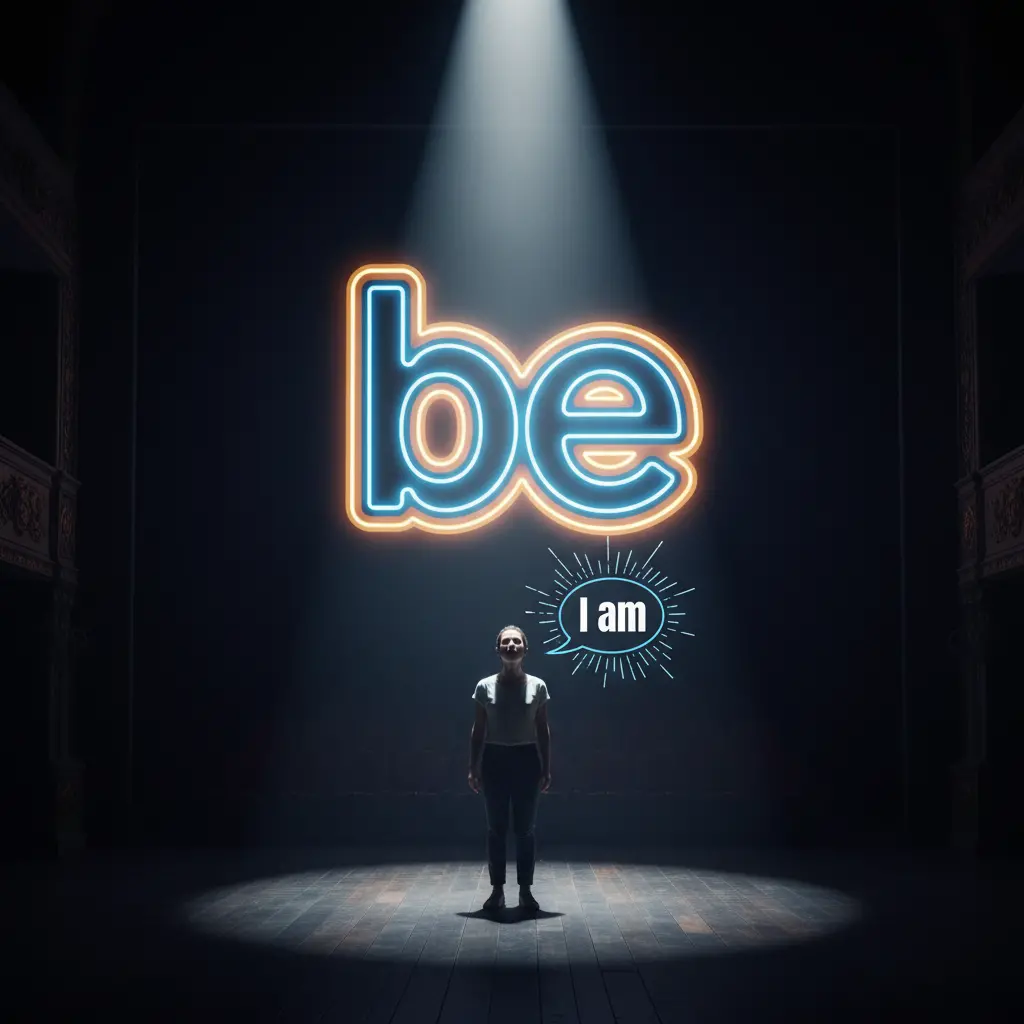
Root decomposition: root be; no prefix; am is the 1st-person singular present form of be. Historical origin: from Proto-Indo-European *bheu- meaning to be or exist, via Proto-Germanic *biju- into Old English be/eom; am derives from the OE form eom. Memory image: imagine a bright stage sign reading be, as someone steps forward and says I am to prove existence.
Note 1: These definitions and etymologies are not standard dictionary definitions, but extended explanations provided to help with memorization and understanding of the actual application of words. Through this background information, we strive to make words more vivid and easier to understand, and help you remember their meanings in real life.
Note 2: LexiTalk designs the learning flow around the linguistics principle of “Comprehensible Input.” When learners encounter material that is slightly above their level but still understandable from context, the brain naturally absorbs the language. That’s why we keep every word inside authentic contexts, using examples and associations to help you understand it and use it flexibly.
Read the FAQ explanation of Comprehensible Inputam is the present 1st-person singular form of the verb be. It is used with I to describe existence, identity, or states of being. It also serves as an auxiliary verb for forming continuous tenses, questions, and negatives in the simple present. In everyday speech, 'I am' can contract to I'm, and it often appears in phrases indicating feelings, locations, or ongoing actions: I am here, I am happy, I am studying. Learners sometimes confuse am with is and are, especially because the subject changes between languages or when translating directly. Remember that am only appears with I, not with you, he, or they, and it is followed by adjectives, nouns, or the base verb in forms like I am reading.
Many languages do not mark the present copular form with the same specificity as English I am; some languages drop the verb in simple present or use a different word order. Learners often overgeneralize am to similar verbs or try to translate it literally, leading to errors in questions or contractions.
In which of the following sentences is 'am' used correctly?
Which of the following is a synonym for 'am'?
Which of the following is an antonym for 'am'?
In a conversation between two friends, how would one use the word 'am'?
Download LexiTalk app for personalized learning experience
Download AppCookies
We use cookies for essential site functions, analytics, and ads. You can accept, reject, or manage preferences. Privacy Policy