anaerobic - Master This Word
Master this word with our 5-step learning method – Learn English in English
Train English Through Brain Routes, Not Translation.
This page helps you stop memorizing isolated translations and start understanding a word through its shared mental image, native-style thinking, and practical training steps.
Master this word with our 5-step learning method – Learn English in English
Example sentences are the start of understanding. Don't rush to memorize. First feel how the word works in a sentence.
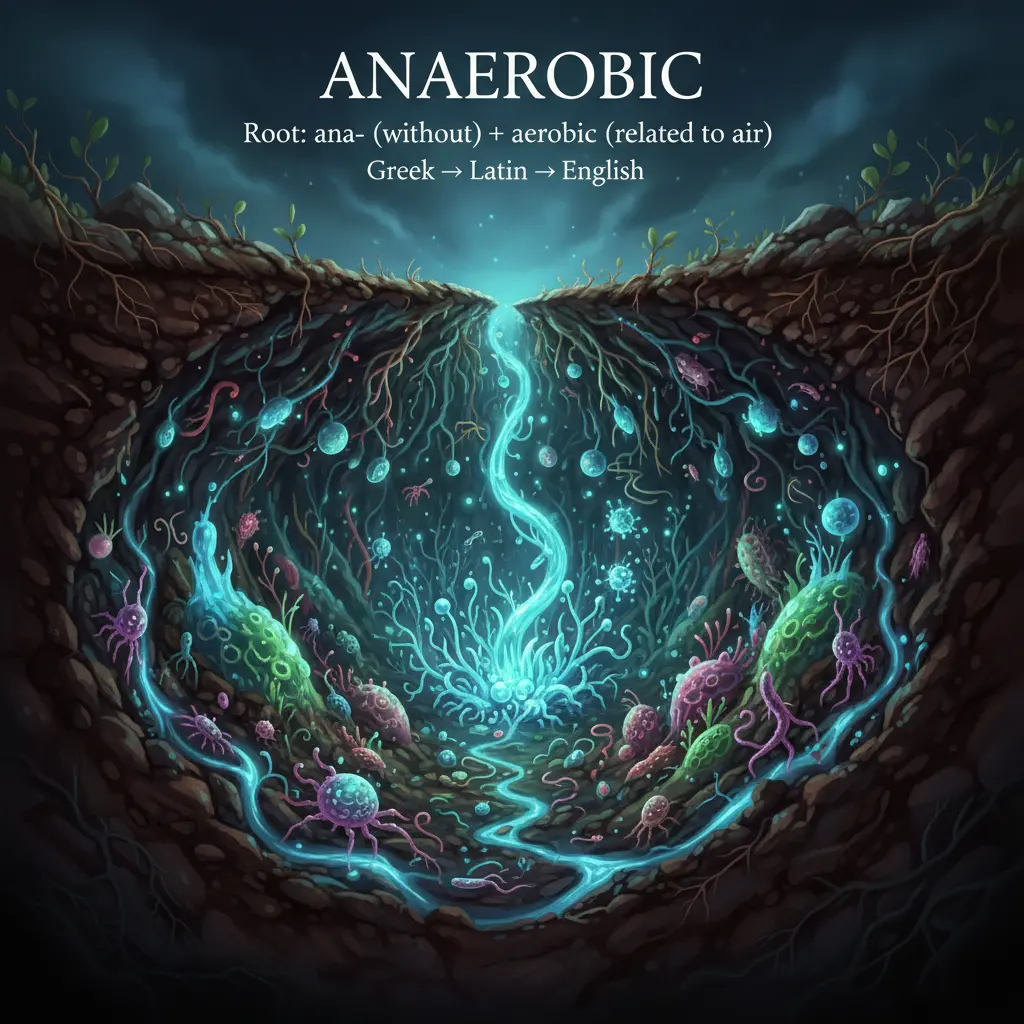
Root: ana- (without) + aerobic (related to air). Historical origin: Greek → Latin → English. Memory image: Imagine a small, thriving world beneath the soil where organisms live and grow without air, like a hidden garden of life beneath the surface.
Note 1: These definitions and etymologies are not standard dictionary definitions, but extended explanations provided to help with memorization and understanding of the actual application of words. Through this background information, we strive to make words more vivid and easier to understand, and help you remember their meanings in real life.
Note 2: LexiTalk designs the learning flow around the linguistics principle of “Comprehensible Input.” When learners encounter material that is slightly above their level but still understandable from context, the brain naturally absorbs the language. That’s why we keep every word inside authentic contexts, using examples and associations to help you understand it and use it flexibly.
Read the FAQ explanation of Comprehensible InputAnaerobic is an adjective used in biology and physiology to describe processes or environments that do not require oxygen. It covers organisms that thrive in oxygen-free realms and reactions that proceed without O2, such as fermentation. In exercise science, anaerobic metabolism refers to energy produced quickly from stored fuels without relying on oxygen, leading to short, intense efforts. The two main senses are biological/medical and athletic: anaerobic bacteria live where oxygen is scarce, and anaerobic training emphasizes bursts of power rather than endurance. The root ana- means without, and aerobic means relating to air or oxygen. The historical path Greek → Latin → English is often remembered with an image of a tiny, airless world beneath the soil.
Anaerobic is often thought of as two domains (biology and sport). Learners may overgeneralize it as 'no oxygen anywhere' or mix it with 'airless' contexts. The contrast to aerobic is crucial, but in everyday life 'airless' is not common. Focus on the setting: environment without oxygen vs metabolism without oxygen, and remember the classic prefix ana- = without.
What is the meaning of the word 'anaerobic'?
Which of the following sentences uses 'anaerobic' correctly?
What is a synonym for 'anaerobic'?
What is the opposite of 'anaerobic'?
In which of the following real-life situations would 'anaerobic' be applicable?
Download LexiTalk app for personalized learning experience
Download AppCookies
We use cookies for essential site functions, analytics, and ads. You can accept, reject, or manage preferences. Privacy Policy