annoying - Master This Word
Master this word with our 5-step learning method – Learn English in English
Train English Through Brain Routes, Not Translation.
This page helps you stop memorizing isolated translations and start understanding a word through its shared mental image, native-style thinking, and practical training steps.
Master this word with our 5-step learning method – Learn English in English
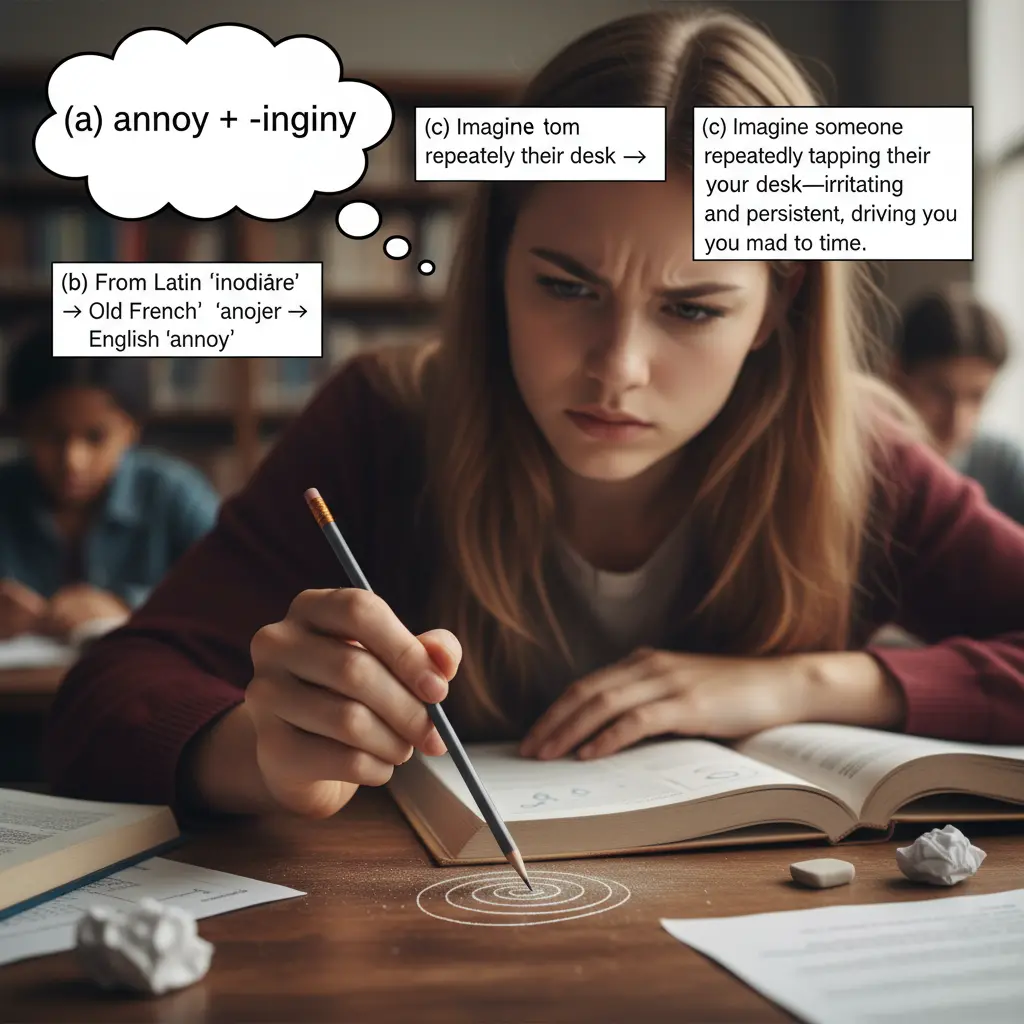
Example sentences are the start of understanding. Don't rush to memorize. First feel how the word works in a sentence.
(a) annoy + -ingly; (b) From Latin 'inodiāre' -> Old French 'anoier' -> English 'annoy'; (c) Imagine someone repeatedly tapping their pencil on your desk—irritating and persistent, driving you mad over time.
Note 1: These definitions and etymologies are not standard dictionary definitions, but extended explanations provided to help with memorization and understanding of the actual application of words. Through this background information, we strive to make words more vivid and easier to understand, and help you remember their meanings in real life.
Note 2: LexiTalk designs the learning flow around the linguistics principle of “Comprehensible Input.” When learners encounter material that is slightly above their level but still understandable from context, the brain naturally absorbs the language. That’s why we keep every word inside authentic contexts, using examples and associations to help you understand it and use it flexibly.
Read the FAQ explanation of Comprehensible InputI push the chair back a notch and adjust my posture, then glance at the noisy clock. The second hand keeps moving, and every ping from the hallway pulls my attention away. I swallow the urge to snap and decide to keep my cool, shifting my focus to something calmer. That tense, creeping feeling sits in my chest as I realize the word fits: annoying, the mood that comes when small things stack up in a bothersome way.
Annoying is used to describe something or someone that causes irritation or discomfort through persistent, often trivial behavior. When you say something is annoying, you imply a mild or moderate nuisance rather than a serious offense. In American English, annoying is commonly paired with adverbial forms like annoyingly to describe actions that irritate. The term can carry a slightly negative judgment but is widely used in casual conversation. Note that annoying can describe people (an annoying neighbor) or situations (an annoying delay).
In English, annoying often conveys a personal judgment about a behavior. Learners may assume it always targets people or exaggerate the strength, confusing it with irritating or irritating strongly. Remember to distinguish the vibe: annoying can describe a behavior or a situation, not the entire person.
What is the meaning of the word 'annoying'?
Which sentence uses 'annoying' correctly?
What is a synonym for 'annoying'?
What is an antonym for 'annoying'?
In what real-life situation would you describe something or someone as 'annoying'?
Download LexiTalk app for personalized learning experience
Download AppCookies
We use cookies for essential site functions, analytics, and ads. You can accept, reject, or manage preferences. Privacy Policy