arms - Master This Word
Master this word with our 5-step learning method – Learn English in English
Train English Through Brain Routes, Not Translation.
This page helps you stop memorizing isolated translations and start understanding a word through its shared mental image, native-style thinking, and practical training steps.
Master this word with our 5-step learning method – Learn English in English
Example sentences are the start of understanding. Don't rush to memorize. First feel how the word works in a sentence.
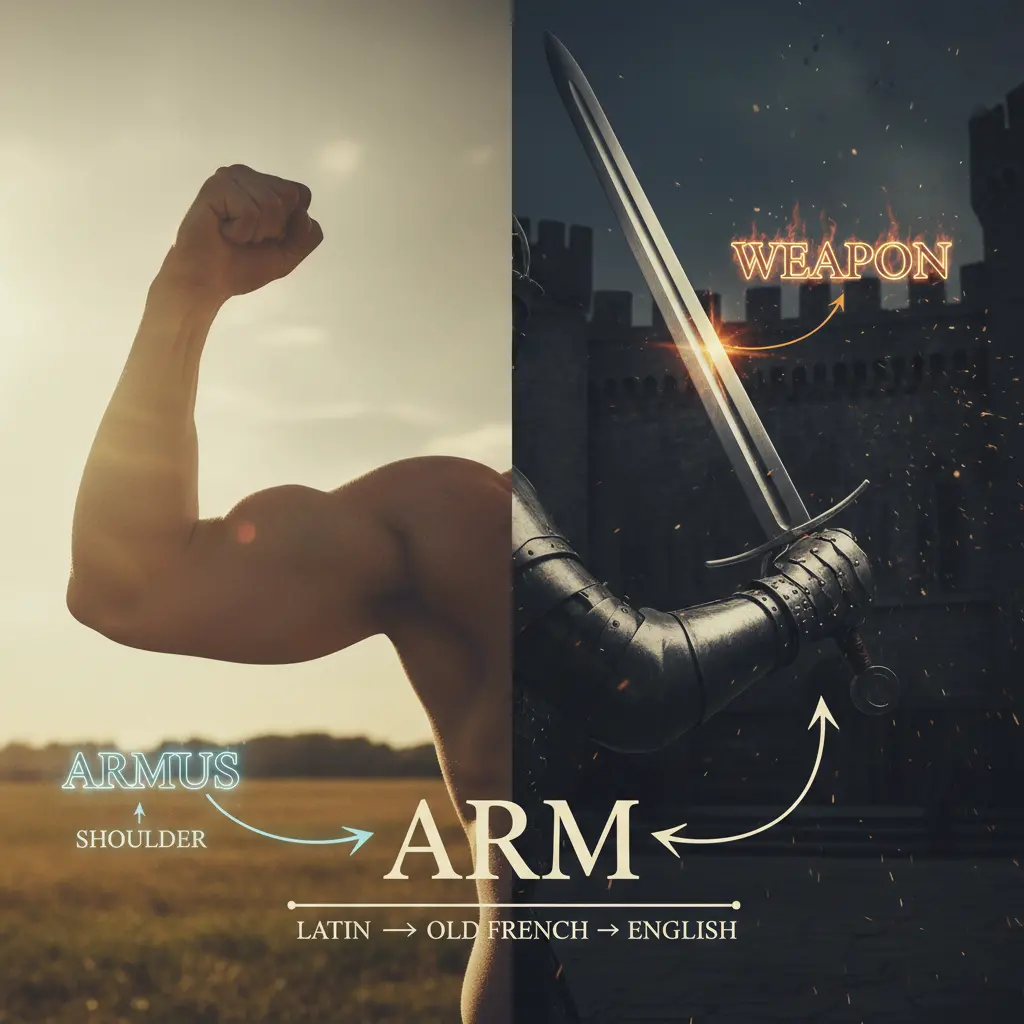
arm = (from Latin 'armus' meaning 'shoulder') + (derived to mean 'weapon'). Historical origin: Latin → Old French → English. Memory image: Imagine raising your arms in celebration or defending yourself with a sword, depicting power and protection.
Note 1: These definitions and etymologies are not standard dictionary definitions, but extended explanations provided to help with memorization and understanding of the actual application of words. Through this background information, we strive to make words more vivid and easier to understand, and help you remember their meanings in real life.
Note 2: LexiTalk designs the learning flow around the linguistics principle of “Comprehensible Input.” When learners encounter material that is slightly above their level but still understandable from context, the brain naturally absorbs the language. That’s why we keep every word inside authentic contexts, using examples and associations to help you understand it and use it flexibly.
Read the FAQ explanation of Comprehensible InputI move my arm and set the pace of the moment. I shift my grip, feeling the weight change in my shoulder as I adjust my stance. I hold steady, then let my fingers align and keep control of what comes next. The sequence feels like a quiet decision in motion, and meaning arrives through the feel of action.
Arm can refer to the upper limb from shoulder to wrist, to equip with weapons, or to prepare for action. In everyday English you might talk about moving an arm, lifting something, or extending an arm to greet someone. In security or military contexts, arm becomes a verb meaning to supply or prepare weapons, as in arming a squad, or a noun in phrases like arms and armor. Some idioms use arm in body parts expressions, or in compound nouns such as armchair or armory. Pay attention to context clues to choose the right sense and to note the pronunciation /ɑːrm/ in many dialects. Be mindful of confusing arm with hand or forearm.
For English learners, arm commonly covers both a body part and the verb to arm, which can be confusing if you don’t identify the surrounding words. In many other languages, a single word more explicitly marks whether arm is a noun or a verb and may couple differently with prepositions or objects. Learners often default to arm as a weapon sense; watch for non-weapon contexts with greetings or body movement.
What is the meaning of the word 'arms'?
Which sentence correctly uses the word 'arms'?
Which word is most similar to 'arms'?
What is the opposite of 'arms'?
Can you think of a real-life context that involves the concept of arms?
Download LexiTalk app for personalized learning experience
Download AppCookies
We use cookies for essential site functions, analytics, and ads. You can accept, reject, or manage preferences. Privacy Policy