sit - Master This Word
Master this word with our 5-step learning method – Learn English in English
Train English Through Brain Routes, Not Translation.
This page helps you stop memorizing isolated translations and start understanding a word through its shared mental image, native-style thinking, and practical training steps.
Master this word with our 5-step learning method – Learn English in English
Example sentences are the start of understanding. Don't rush to memorize. First feel how the word works in a sentence.
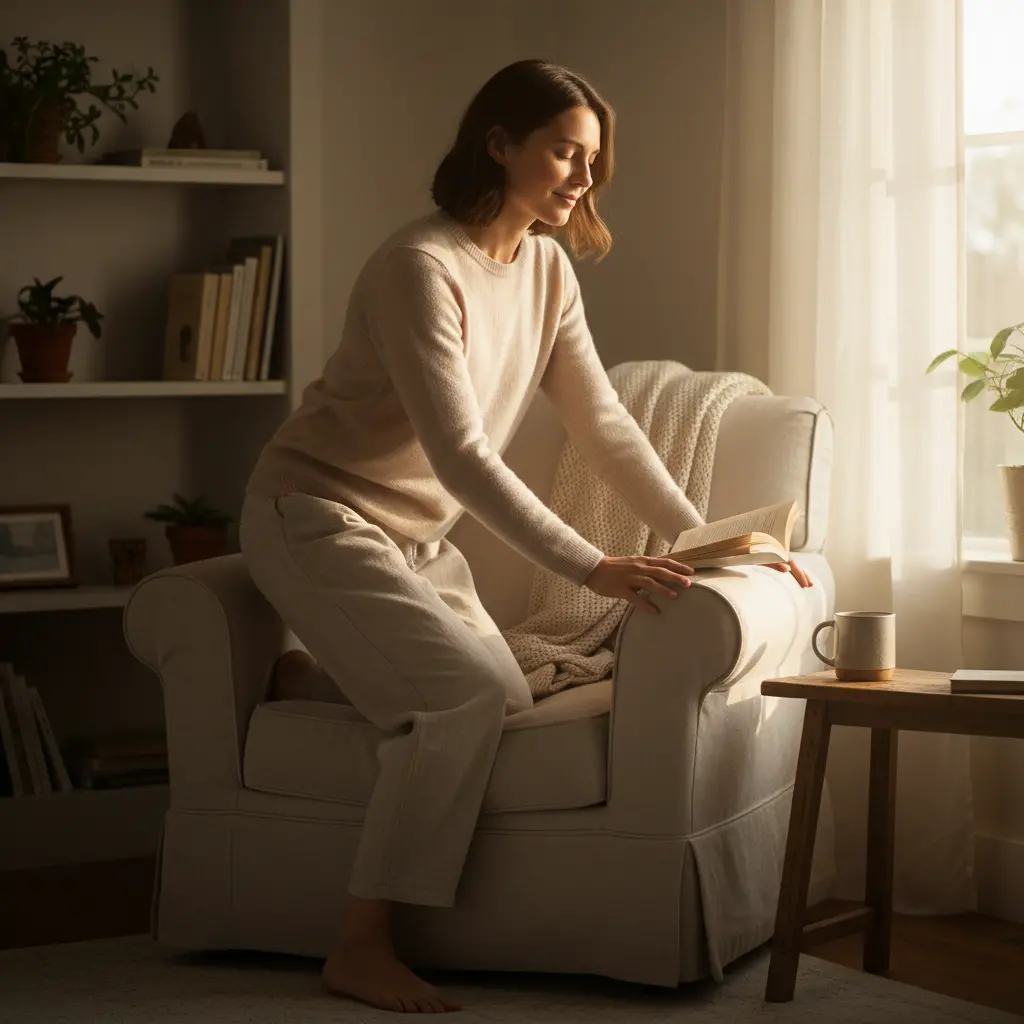
sit: from 'sittan', Meaning: 'to place oneself'. A person choosing to sit down may picture themselves gently lowering their body onto a chair, finding comfort while resting.
Note 1: These definitions and etymologies are not standard dictionary definitions, but extended explanations provided to help with memorization and understanding of the actual application of words. Through this background information, we strive to make words more vivid and easier to understand, and help you remember their meanings in real life.
Note 2: LexiTalk designs the learning flow around the linguistics principle of “Comprehensible Input.” When learners encounter material that is slightly above their level but still understandable from context, the brain naturally absorbs the language. That’s why we keep every word inside authentic contexts, using examples and associations to help you understand it and use it flexibly.
Read the FAQ explanation of Comprehensible InputI bend my knees and reach for support, then lower my weight toward the chair. I shift my hips and let the seat catch me, settling into a steady pause as gravity does the work. I feel the small push of balance, the way my back adjusts and I hold my posture, breathing easy as I set into place. This simple motion becomes a habit—sitting through a talk, waiting, or a quiet moment when I need to stay present.
Sit is a versatile verb describing the act of placing oneself in a position where weight is supported by the buttocks, or remaining in that position. It also covers taking a seated position and occupying a place or position. In everyday English, sit is usually intransitive, as in 'Please sit down,' but you can pair it with prepositions to describe location ('sit in the front row') or context ('sit on the bench'). Learners often confuse sit with set, which is transitive and has a different object focus. Common collocations include sit still, sit back, sit in, sit up, and sit out. Pay attention to phrasal verbs and to when you need 'down' to indicate the act of taking a seat.
In English, sit centers on the act of taking a seat or occupying a place, with clear phrasal patterns and prepositions. Other languages often use one verb with fewer particle changes, or reflexive forms to express seated states, which can mislead learners into overusing or misplacing prepositions.
Which sentence uses the word 'sit' correctly?
Which word is most similar to 'sit'?
What is the opposite of the word 'sit'?
Can you give an example of a real-life scenario of 'sit'?
Download LexiTalk app for personalized learning experience
Download AppCookies
We use cookies for essential site functions, analytics, and ads. You can accept, reject, or manage preferences. Privacy Policy