arthritis - Master This Word
Master this word with our 5-step learning method – Learn English in English
Train English Through Brain Routes, Not Translation.
This page helps you stop memorizing isolated translations and start understanding a word through its shared mental image, native-style thinking, and practical training steps.
Master this word with our 5-step learning method – Learn English in English
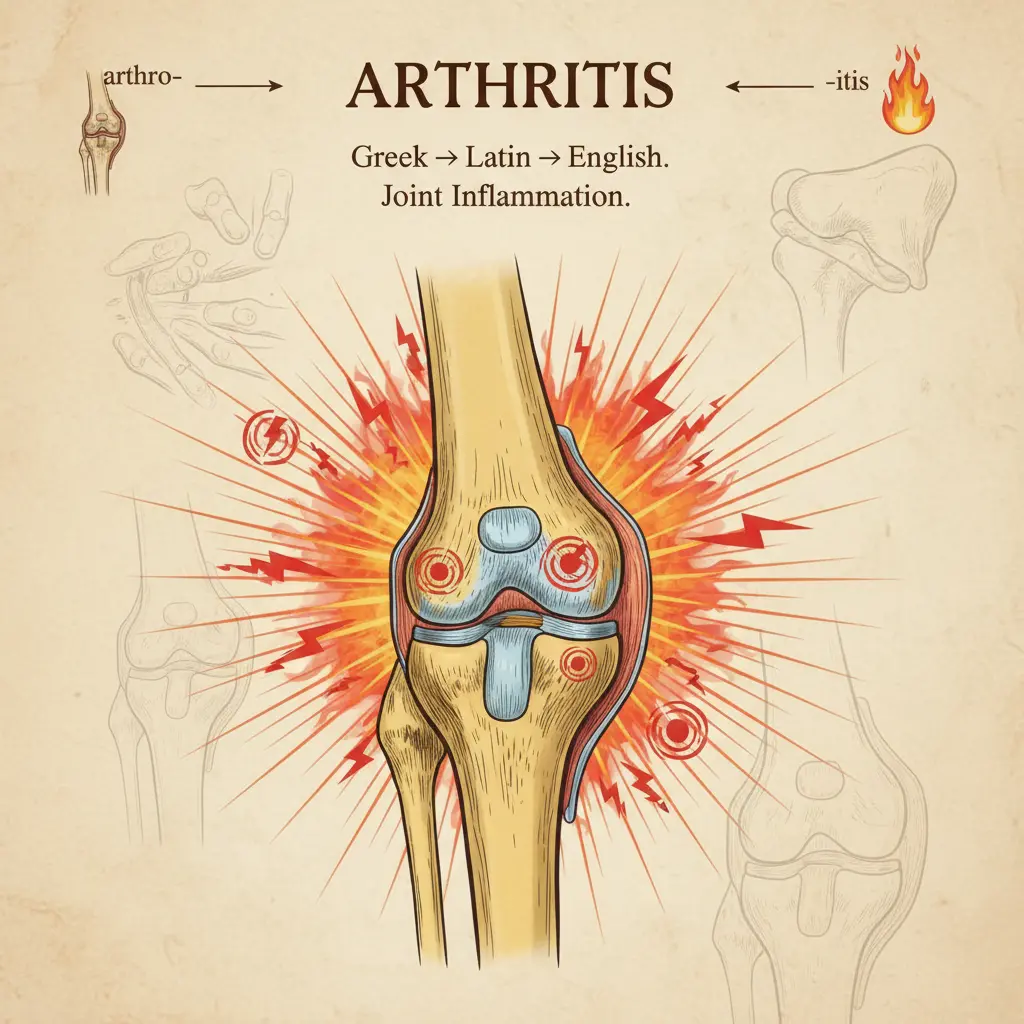
Example sentences are the start of understanding. Don't rush to memorize. First feel how the word works in a sentence.
From 'arthro-' meaning 'joint' and '-itis' meaning 'inflammation'. Historical origin: Greek → Latin → English. Visualize a joint bending and inflaming, representing the pain associated with arthritis.
Note 1: These definitions and etymologies are not standard dictionary definitions, but extended explanations provided to help with memorization and understanding of the actual application of words. Through this background information, we strive to make words more vivid and easier to understand, and help you remember their meanings in real life.
Note 2: LexiTalk designs the learning flow around the linguistics principle of “Comprehensible Input.” When learners encounter material that is slightly above their level but still understandable from context, the brain naturally absorbs the language. That’s why we keep every word inside authentic contexts, using examples and associations to help you understand it and use it flexibly.
Read the FAQ explanation of Comprehensible InputArthritis is a general term for inflammation and degeneration of joints, causing pain, stiffness, and limited movement. It can affect people of all ages, but is most common with aging or in autoimmune conditions like rheumatoid arthritis. Symptoms often include joint swelling, reduced range of motion, and morning stiffness lasting longer than a few minutes. Treatments focus on relieving pain and slowing progression, using medications such as NSAIDs, disease-modifying drugs for some types, physical therapy, and lifestyle adjustments like weight management and regular gentle exercise. The word breaks into arthro- meaning joint and -itis meaning inflammation; in practice, arthritis describes many specific conditions rather than a single disease.
Explain to an English speaker: English often uses arthritis as a broad, umbrella term that covers several distinct conditions. Learners may assume arthritis means one disease and fear mislabeling different disorders; clarify OA and RA early and keep examples near body parts for memory.
What is the meaning of the word 'arthritis'?
Which sentence correctly uses the word 'arthritis'?
Which word is most similar to 'arthritis'?
What is the opposite of 'arthritis'?
Can you give an example of a real-life scenario of 'arthritis'?
Download LexiTalk app for personalized learning experience
Download AppCookies
We use cookies for essential site functions, analytics, and ads. You can accept, reject, or manage preferences. Privacy Policy