badly - Master This Word
Master this word with our 5-step learning method – Learn English in English
Train English Through Brain Routes, Not Translation.
This page helps you stop memorizing isolated translations and start understanding a word through its shared mental image, native-style thinking, and practical training steps.
Master this word with our 5-step learning method – Learn English in English
Example sentences are the start of understanding. Don't rush to memorize. First feel how the word works in a sentence.
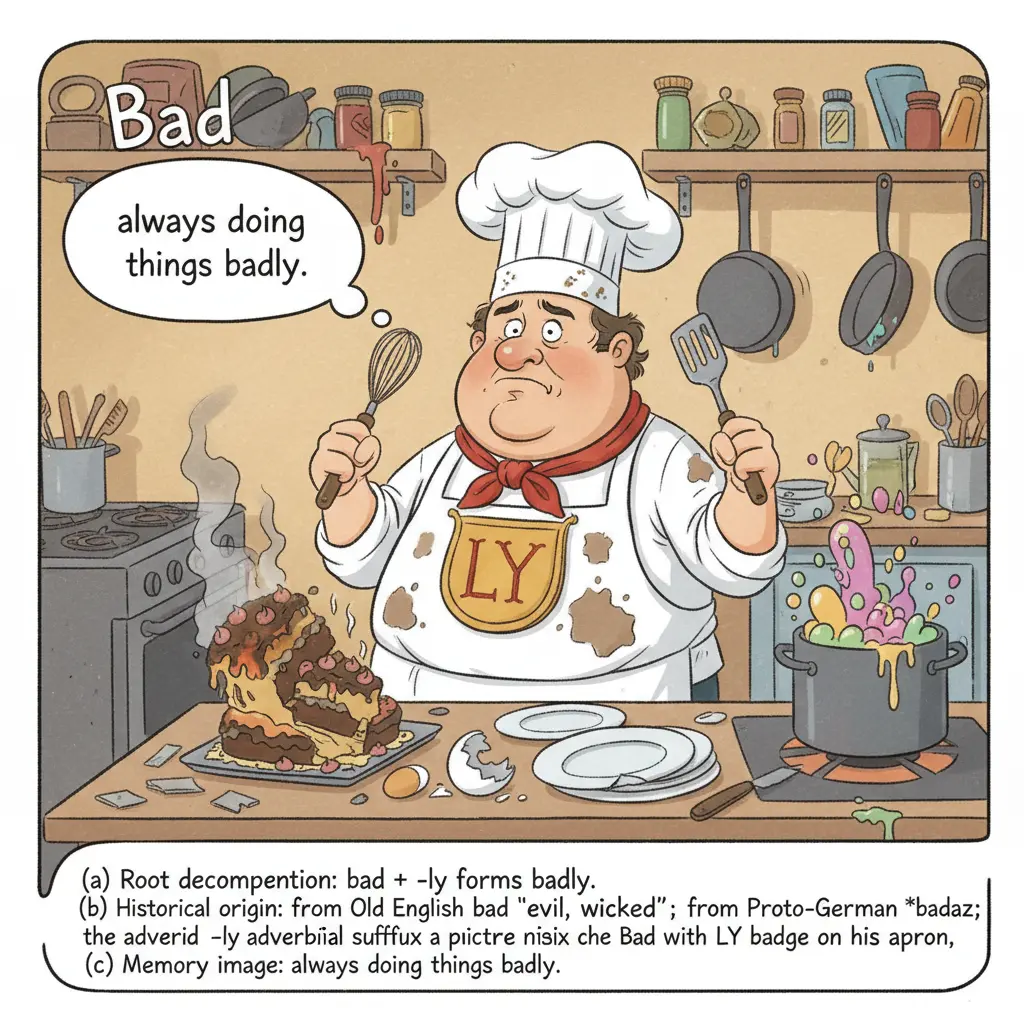
(a) Root decomposition: bad + -ly forms badly. (b) Historical origin: from Old English bad 'evil, wicked'; from Proto-Germanic *badaz; the adverbial suffix -ly developed in Old English. (c) Memory image: picture a chef named Bad with a LY badge on his apron, always doing things badly.
Note 1: These definitions and etymologies are not standard dictionary definitions, but extended explanations provided to help with memorization and understanding of the actual application of words. Through this background information, we strive to make words more vivid and easier to understand, and help you remember their meanings in real life.
Note 2: LexiTalk designs the learning flow around the linguistics principle of “Comprehensible Input.” When learners encounter material that is slightly above their level but still understandable from context, the brain naturally absorbs the language. That’s why we keep every word inside authentic contexts, using examples and associations to help you understand it and use it flexibly.
Read the FAQ explanation of Comprehensible InputI grip the keyboard, my fingers move and I try to type with a steady rhythm. At first the sentences come out badly, clumsy and rushed. I slow my breath, shift my posture, adjust my wrist, and keep going. Soon the words settle into a smoother flow, and I notice the effort paying off.
Badly is an adverb meaning in a poor or unsatisfactory manner. It modifies actions, states, or adjectives to express the quality or degree of something done or experienced. Use badly when you want to emphasize the seriousness of the action or the failing outcome, as in He did badly on the test or She needs badly to rest. In informal speech you will hear badly instead of poorly in many contexts, but poorly remains common for speaking about health or quality in some dialects. Note that badly is built from the adjective bad plus the suffix -ly, and its sense can shift with emphasis and tone.
For English learners, badly often contrasts with poorly; badly focuses on the action or outcome and usually implies urgency or strong feeling depending on context, while poorly can sound more neutral or health-focused in some dialects.
In which sentence is 'badly' used correctly?
Which word is the opposite of 'badly'?
Can you provide a real-life context for the word 'badly'?
How would you use the word 'badly' in a sentence?
Download LexiTalk app for personalized learning experience
Download AppCookies
We use cookies for essential site functions, analytics, and ads. You can accept, reject, or manage preferences. Privacy Policy