
battle - Master This Word
Master this word with our 5-step learning method – Learn English in English
Train English Through Brain Routes, Not Translation.
This page helps you stop memorizing isolated translations and start understanding a word through its shared mental image, native-style thinking, and practical training steps.
Master this word with our 5-step learning method – Learn English in English
Example sentences are the start of understanding. Don't rush to memorize. First feel how the word works in a sentence.
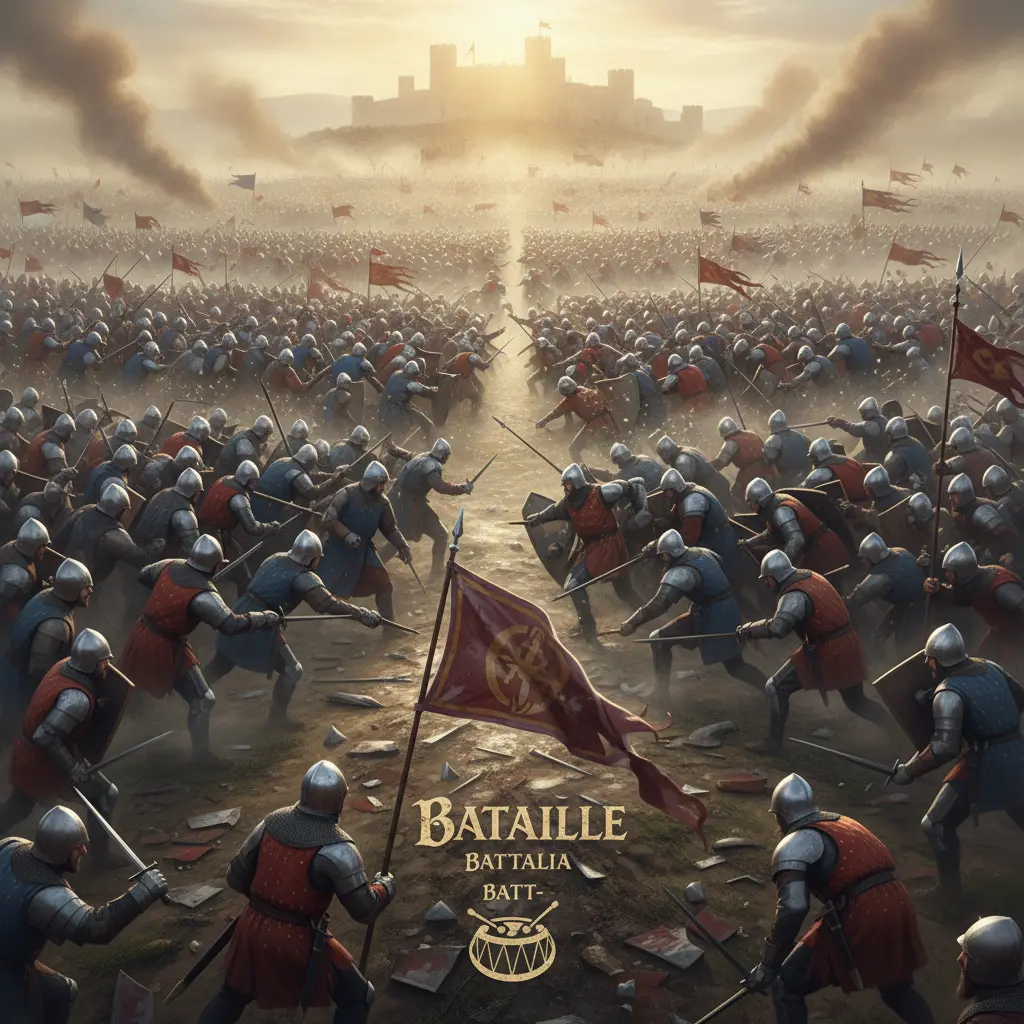
The word 'battle' comes from Old French 'bataille', derived from the Latin 'battalia', where 'batt- means to beat'. Imagine a chaotic scene where soldiers clash, symbolizing conflict and struggle, like a series of waves crashing against each other.
Note 1: These definitions and etymologies are not standard dictionary definitions, but extended explanations provided to help with memorization and understanding of the actual application of words. Through this background information, we strive to make words more vivid and easier to understand, and help you remember their meanings in real life.
Note 2: LexiTalk designs the learning flow around the linguistics principle of “Comprehensible Input.” When learners encounter material that is slightly above their level but still understandable from context, the brain naturally absorbs the language. That’s why we keep every word inside authentic contexts, using examples and associations to help you understand it and use it flexibly.
Read the FAQ explanation of Comprehensible InputI square my shoulders, set my jaw, and push through the door into a crowded room. People chatter over one another; I move, listen, and shift my stance as the talk heats up. Every choice to hold my line or adjust my angle feels like a tiny skirmish, a test of control and nerve. In the end, the battle to persuade, to win space for my view, feels like taking a breath after a push and letting the idea breathe; timing and will decide the outcome.
Battle refers to a conduct of armed conflict between forces, a struggle to reach a goal, or the act of engaging in combat. In everyday use it often describes a fierce clash, a protracted contest, or the effort to overcome a difficult obstacle. You can use it literally for wars and sieges, or metaphorically for competitions, debates, or personal challenges. Common collocations include battle against, battle with, bitter battle, and battle of wits. The term carries a sense of organized action and effort rather than a casual dispute.
Explain to an English speaker (meta, keep short)
What is the meaning of the word 'battle'?
Which sentence uses the word 'battle' correctly?
Which word is most similar to 'battle'?
What is the opposite of 'battle'?
Can you give an example of a real-life scenario of 'battle'?
Download LexiTalk app for personalized learning experience
Download AppCookies
We use cookies for essential site functions, analytics, and ads. You can accept, reject, or manage preferences. Privacy Policy